ABELE
Abele is a surname with roots in both Germanic and Hebrew traditions. The name originates from the personal name Abel, a derivative of the Hebrew Hevel, which translates as “breath” or “vapor”. The biblical figure Abel, known as the second son of Adam and Eve, serves as the cultural anchor for the name.
The transformation of the biblical personal name into a family name is best understood as a patronymic process. Families that descended from, or were associated with, an individual called Abel adopted Abele as a surname, signalling “son of Abel”. In regions where the name had been adopted, it was often recorded with minimal alteration in spelling, maintaining the Dutch or Germanic consonant cluster Ab‑ and the soft ending ‑ele.
Historical documentation indicates that the surname spread across Europe in the Middle Ages. Early evidence appears in the 12th‑century Pipe Rolls of Essex, where a resident named William Abel is noted. By the early 13th century, the name was established in both Germany and the British Isles, with a record of Master Abel of Kelso Abbey in Scotland in 1235 and Hans Abel of Niederstotzingen, Germany, in 1355. The name later appears in the 18th‑century civil registers as Catharine Abele, married to Bernardus Widman in Jagskreis, Germany, in 1780, and as Thomas Abele, christened at St Matthew’s church, Bethnal Green, London, on 30 May 1818.
The surname Abele is also known to have been carried by Crusaders and pilgrims returning from the Holy Land, who introduced the name into northern European societies. The enduring use of the name in its consistent spelling across countries is a notable feature, lending the surname a perceived “universal” quality within Europe.
Variations of the surname, many of which arise from phonetic shifts in local dialects, include Abel, Able, Abelle, as well as patronymic forms such as Abels, Abelsen, Abelson and Ableson. Less frequent derivatives also appear, such as Abeler, Abeles, Abelmann and Abelius. In some Southern German, Swiss and Austrian localities, the prefix von or Dutch van is affixed, producing von Abele or van Abele, although these are not always clear indicators of a single genealogical line.
In heraldic tradition, the Abele coat of arms is distinctive. It is described as a silver field charged with twelve gold fleur-de-lis positioned on a blue saltire. The visual simplicity of the design belies its symbolic significance, with the fleur-de-lis often representing purity and the saltire indicating service or sacrifice.
The surname remains most common in Germany, particularly within the states of Baden-Württemberg and Bavaria. Its presence in the United States is largely concentrated in states with large populations of German ancestry, including North Dakota, Wisconsin and Nebraska. Additional European concentrations can be found in Italy, Switzerland and the Netherlands, where localised phonetic adaptations have occurred.
In Jewish tradition, variants of the name such as Abelovich, Abelson and Abelsohn appear. These surnames incorporate Slavic or German patronymic suffixes, indicating descent from an ancestor named Abel. The coexistence of these variants underscores the multicultural reach of the name’s origins while also signalling distinct genealogical pathways that require individual research for accurate lineage reconstruction.
Similar and related surnames
Related and similar names are generated algorithmically based on the spelling, and may not necessarily share an etymology.
How to communicate the surname Abele in...
Braille
⠁⠃⠑⠇⠑
Morse
.--.....-...
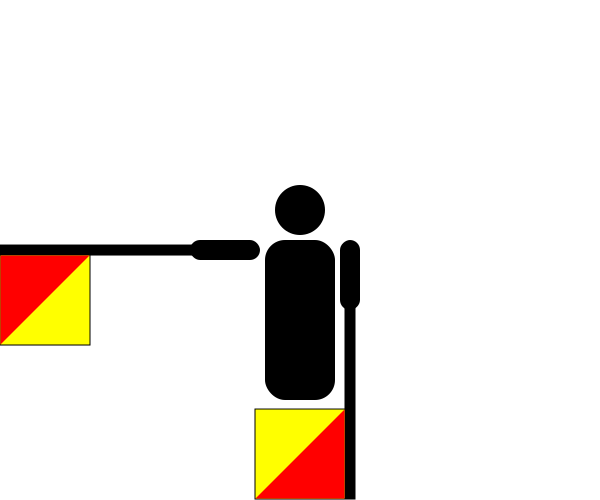
Semaphore



There are approximately 81 people named Abele in the UK. That makes it one of Britain's least common surnames. Only around one in a million people in Britain are named Abele.