ZINK
The surname Zink is a Germanic name that originally derives from the Middle High German word zinke, meaning tine, point or prong. This linguistic root suggests that the earliest bearers of the name were associated with objects that had a pointed or pronged end, most commonly metal implements such as spear points or the starting bar of a carriage.
Historically, the name is believed to have first appeared as an occupational designation for metalworkers. Such artisans were responsible for forging items that required a sharp or pronounced tip, a task for which the word zinke provided a convenient descriptor. Another plausible origin notes a topographical connection; the name may have been given to those dwelling on a sharp piece of land, or as a nickname for a man with a notably pointed nose.
Evidence of the surname in archival records dates back to the mid‑sixteenth century. The earliest documented spelling is that of a Gartrude Synke, whose christening was recorded on 26 December 1566 at St. Martin-in-the-Fields, Westminster, London, during the reign of Queen Elizabeth I. Subsequent marriages and christenings in the seventeenth and early eighteenth centuries—such as the union of Christian Frederick Zincke and Elizabeth Bothman in St. George Mayfair, Westminster, London on 4 November 1718—demonstrate the name’s establishment in England.
The surname’s spelling variants reflect regional linguistic influences across the German‑speaking world. Common forms include Synke, Syncke, Zincke, Zinck, Zincken, Zynke and Zinckmann. In some locales the suffix -ink conveys a locational origin, while in others it may indicate an occupational lineage related to tinsmithing when combined with the Middle Low German word zinkere (tin manufacture).
Statistical data show that Zink is a relatively common surname in Germany, ranking as the forty‑second most frequent name. In Austria it occupies the thirty‑third position, and in the Czech Republic and other parts of Eastern Europe it remains a recognizable, if less prevalent, surname. The distribution in Germany is heavily concentrated in the western regions, a pattern that mirrors the historical presence of metalworking industries and the migration of skilled artisans.
In the United Kingdom, Zink accounts for approximately 0.02 % of the population, with London being the focal point for those bearing the name. The name entered Britain through a wave of German migration and was established in the early modern period, as evidenced by parish registers and civil documents.
Across the Atlantic, the surname first appeared in the United States during the eighteenth and nineteenth centuries, coinciding with the arrival of German immigrants, particularly in Pennsylvania. By the mid‑nineteenth century, pattern books and census data indicate that individuals named Zink settled in the Midwest, including Maryland, Pennsylvania and Missouri. As of recent counts, the name is listed as the five‑thousand‑seventh most common surname in the country.
Internationally, the surname has spread beyond Europe. Concentrations are now found in Australia, Canada and other English‑speaking nations, a testament to the broader diaspora of German emigrants during the nineteenth and twentieth centuries.
A heraldic depiction associated with the name features a youth dressed in gold garments, holding a trio of blue flowers, situated upon a silver shield edged by a green mount. While the precise blazon is not universally accepted, such imagery is recorded in family arms grants from the early modern period.
The varied derivations of Zink illustrate how a single surname can encapsulate multiple facets of linguistic evolution, geography, craft and migration. Its occupational roots in metalwork and possible topographical origins have both contributed to its endurance across centuries.
In contemporary society, the surname remains a marker of German heritage, retained in its original spelling but transcribed in local languages through variants like Zincke and Zynke. Its procedural classification as patronymic in some cases—where forms such as Zincker meaning “son of Zink” appear—demonstrates the name’s adaptability within differing naming systems.
The persistence of the surname Zink across a broad geographic and cultural spectrum confirms its strong genealogical continuity and its role as a lingering reminder of ancestral trades and landscapes.
Similar and related surnames
Related and similar names are generated algorithmically based on the spelling, and may not necessarily share an etymology.
How to communicate the surname Zink in...
Braille
⠵⠊⠝⠅
Morse
--....-.-.-
Semaphore

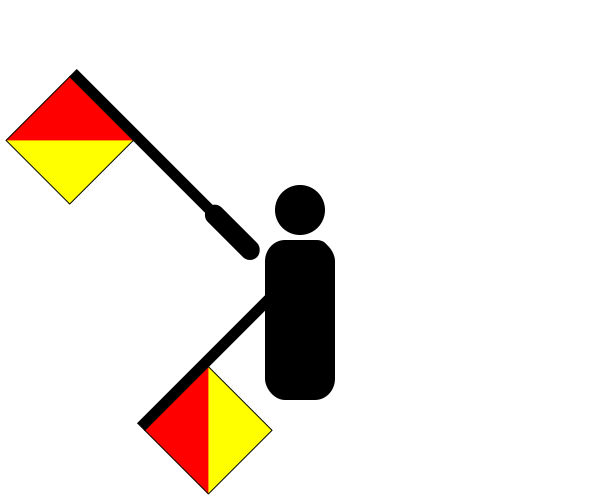
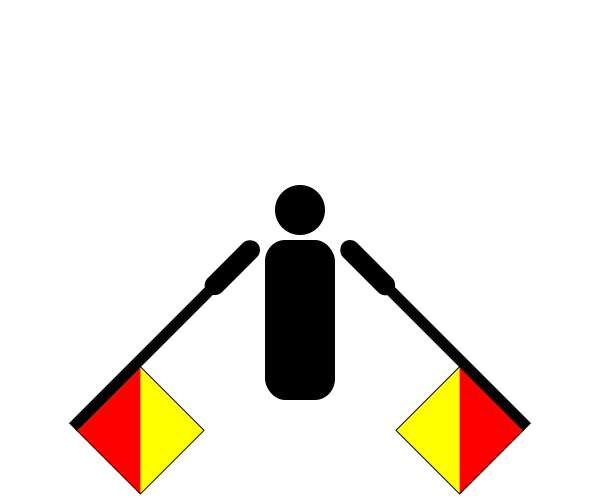
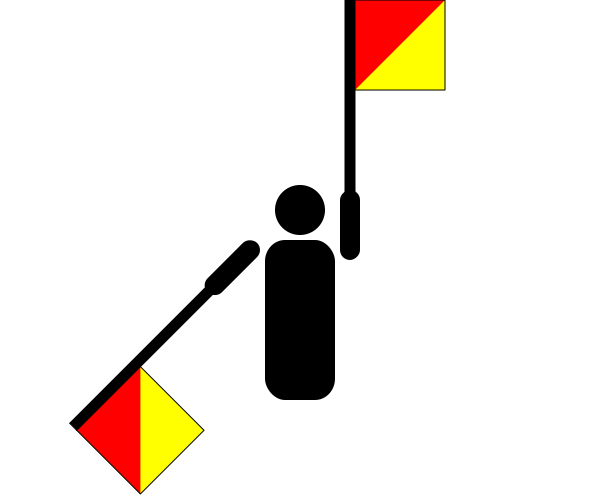
There are approximately 42 people named Zink in the UK. That makes it one of Britain's least common surnames. Only around one in a million people in Britain are named Zink.
Region of origin: Europe
Country of origin: Germany
Language of origin: German
