ZHANG
Zhang is one of the most frequent surnames in China, with a presence that extends across the mainland, Taiwan and the myriad overseas Chinese communities. The name is derived from the Chinese character 张 (pinyin zhāng) which traditionally signifies the act of opening or spreading. Those who bear the surname are said to embody qualities that are wide‑minded, generous and expansive, and the character itself has historically been used to denote open‑handedness in both literal and metaphorical contexts.
The earliest documented use of 张 as a surname can be traced back to the Zhou Dynasty, where it appears as a reign title held by King Mu of Zhou. In that period the character was also used to mark a specific duration or era, and the adoption of this title as a family name reflects the ancient linkage between rule, time and lineage. In addition to this royal association, the word 张 carries an occupational meaning derived from the term “bow‑maker” or “archer”, and it was traditionally assigned to officials who supervised the manufacture of arrows and bows during the reign of the legendary Emperor Huang Di.
Throughout history, the surname has evolved in pronunciation and spelling according to regional dialects and romanisation systems. In the Roman alphabet it is most commonly rendered as Chang, Cheung, Tjiang, Tiong, Tsan, Tsang, Zang or Teong, among other variants. The Cantonese form is frequently transliterated as Cheung or Jeung, whereas Hokkien, Teochew and Taiwanese speakers usually spell it as Tiong, Teong, Zang, Thiong, Thong, Jong or Zhong. Korean usage often appears as Jang or Jhang, and Vietnamese usage is recorded as Trương. These divergent orthographies illustrate the broad phonetic and cultural spectrum represented by the single Mandarin syllable.
The character 张 should not be confused with the homophonous but distinct surnames 章 or 獐, which are written differently although both are pronounced zhāng in Mandarin. This distinction is particularly important in genealogical research, where accurate identification of the original character determines the correct lineage.
Today, the surname Zhang is found not only throughout the vast expanse of mainland China but also in Taiwan, Hong Kong, Singapore, Malaysia, and within the Chinese diaspora in North America, Australia, and Europe. In the United States and Canada, for example, the name ranks among the top fifty most common surnames, reflecting the large scale of migration and settlement from Chinese-speaking regions over the past century.
Beyond its numerical prominence, Zhang carries significant cultural weight. It is often invoked in literature, history texts, and contemporary media as a representative of Chinese heritage, illustrating how a single surname can encapsulate national identity, social continuity, and the values associated with openness and generosity. The surname's long history and rootedness in both aristocratic titles and skilled craftsmanship further underscore its multifaceted legacy.
In sum, the surname Zhang encapsulates a rich tapestry of linguistic, historical and cultural threads. From its early origins as a reign title and occupational marker to its modern global distribution, the name continues to reflect the enduring influence of Chinese civilisation on the world stage.
Typical given names associated with the Zhang surname
Male
- Hong
- Jian
- Jie
- Jun
- Lei
- Peng
- Wei
- Xiao
- Yan
- Yi
- Yong
- Yu
Female
- Agnes
- Hui
- Jing
- Jun
- Li
- Lin
- Linda
- Ling
- Qian
- Rui
- Xin
- Yan
- Yang
- Yi
- Ying
Similar and related surnames
Related and similar names are generated algorithmically based on the spelling, and may not necessarily share an etymology.
How to communicate the surname Zhang in...
Braille
⠵⠓⠁⠝⠛
Morse
--.......--.--.
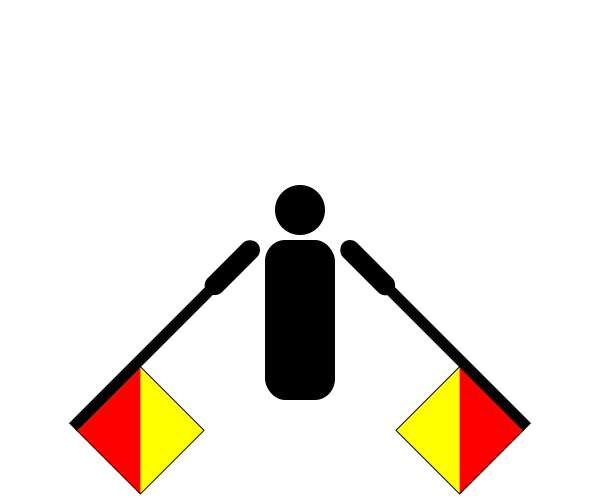
Semaphore



There are approximately 6,123 people named Zhang in the UK. That makes it roughly the 1,548th most common surname in Britain. Around 94 in a million people in Britain are named Zhang.
Region of origin: Asia
Country of origin: China
Language of origin: Chinese
