WYLES
The surname Wyles has its roots firmly in England, and its earliest attestations appear in several medieval records. The name is recorded in a variety of spellings – including Willas, Wiles, Willes, Wills, Willys, Williss, Wileson, Wyles – and is therefore a prime example of how orthographic variation developed in the English language before the advent of standardised spelling.
One of the earliest documented instances of the surname is the entry for Walter Wyls in the Poll Tax Rolls of Staffordshire, dated 1327, during the reign of King Edward I. Other archival evidence includes the mention of John Willys in a 1549 entry for St Stephans, Coleman Street; a 1565 christening witness, William Willes, at Christchurch Greyfriars; and an 1838 marriage record for John Willas and Ann Blows at St Giles Cripplegate. These records demonstrate that the name was already well established by the sixteenth and nineteenth centuries.
Several etymological explanations are assigned to Wyles by different scholars. One view holds that the name is a locational surname derived from the Old English word wiel, meaning “well” or “spring.” In this interpretation, the surname would have been applied to those who lived near a well, a spring or a place whose name contained that element. Historical writers confirm that the term was commonly used in the English landscape to refer to water sources.
Another widely cited origin is patronymic, relating the name to the Anglo‑Germanic personal name William. The elements of that personal name are wil, meaning “will” or “desire,” and helm, meaning “helmet” or “protector.” This element of the name gained great popularity in England and Scotland after the Norman conquest of 1066. The Domesday Book records a Robert filius Willelmi in 1086, and the Hundred Rolls of Oxfordshire record a Richard Willam in 1275. Subsequent references from the Poll Tax records of Yorkshire in 1379 – documents that mention Johannes Willeson and Adam Wylis – provide further evidence of the patronymic usage.
Some evidence also supports an occupational dimension. In the early medieval period, the Old English word wielle was used to describe someone who made or repaired wooden wheels—a wheelwright. The name Wyles has been linked by certain researchers to this occupation, especially given that the craft was predominantly practised by Saxon communities before the medieval era.
There are also suggestions that the surname might have arisen from other Germanic or Anglo‑Saxon personal names. For example, the given name Wigl, meaning “one who fights,” or the derivative Wigle, stemming from the Old Germanic Wighelin (a compound of wig, “battle,” and helm, “helmet”), are cited as possible origins. While these forms are documented as personal names, the medieval records that connect them specifically to the surname Wyles are limited.
Over the centuries, the surname acquired a number of variations, many of which appear in subsequent legal, parish and civil documents. Notable among these are the spellings Wiles, Wyllys, Wylie, Wills, Willsher, Wylye, Wylys, Wylyce, Wyless, Wylly, Wyllie, Wellys and others. The frequency of these variants underscores the absence of a fixed orthography before the twentieth century.
In the modern era, Wyles continues to appear in English‑speaking countries, with the United Kingdom, Australia and the United States documenting its presence. Within the UK, the surname is most frequently recorded in East Anglia and Yorkshire. In the United States, clusters occur in New York, Pennsylvania and Virginia, whereas in Australia the name is predominantly found in Victoria and New South Wales. These distribution patterns are consistent with documented migration flows from rural England during the periods of colonisation and industrial expansion.
The surname has been borne by a number of individuals who have made noteworthy contributions to public life. Francis Willis (1718‑1807), a physician, is recorded in the Dictionary of National Biography for attending King George I during a first episode of madness in 1788. More recently, Sergeant Charles Wyles of the British Army, noted for his gallantry in 1918, received the Military Medal.
In sum, the surname Wyles exemplifies the complex pathways by which English surnames evolved, incorporating locational, patronymic and occupational influences. The available documentary evidence favours a multifaceted origin in which the name may originally have described proximity to a well, derived from a personal name such as William, or reflected an early Saxon craft. The wealth of historical records that capture the various spellings of the name offers a rich resource for researchers and genealogists interested in tracing the lineage of families carrying the surname today.
Typical given names associated with the Wyles surname
Male
- Adrian
- Andrew
- Christopher
- Daniel
- Darren
- David
- James
- John
- Mark
- Matthew
- Peter
- Robert
- Stephen
Female
- Elizabeth
- Helen
- Joanne
- Karen
- Margaret
- Michelle
- Pamela
- Pm
- Rachel
- Rebecca
- Regina
- Sarah
- Susan
Similar and related surnames
Related and similar names are generated algorithmically based on the spelling, and may not necessarily share an etymology.
How to communicate the surname Wyles in...
Braille
⠺⠽⠇⠑⠎
Morse
.---.--.-......
Semaphore
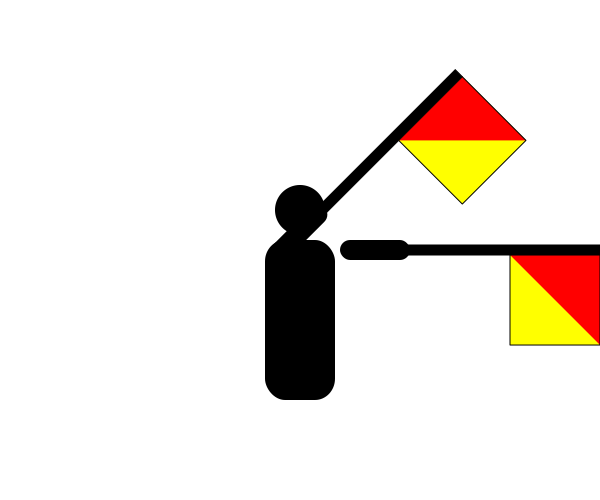
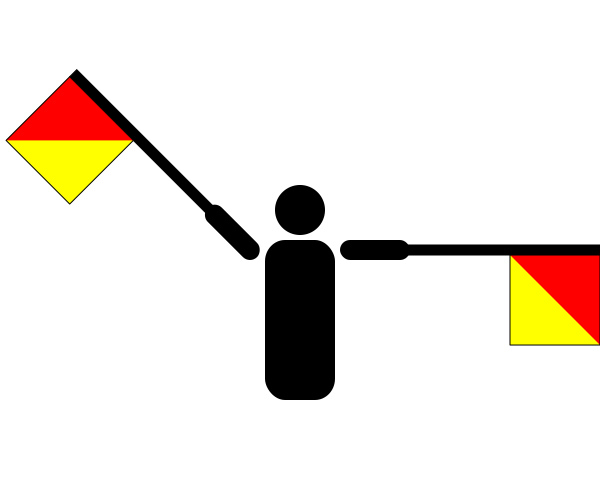


There are approximately 1,434 people named Wyles in the UK. That makes it roughly the 5,559th most common surname in Britain. Around 22 in a million people in Britain are named Wyles.

Famous people named Wyles
- Lilian Wyles - Police officer (1885 to 1975)
- Harry Wyles - Former professional football player (1922 to 1)
Names and descriptions courtesy of Wikipedia, and may contain errors. This is not intended to be an exhaustive list of every famous person with this name.