WRENN
The surname Wrenn is of distinctly English provenance, with its origins traced back to the Old English word wrenna, meaning the small field‑songbird known for its lively and agile nature. The use of a bird name as a descriptor for a person was common in early England, providing a simple nickname for someone who moved or worked with quickness and energy, attributes commonly associated with the wren itself.
In Middle English the word evolved to wrenne, and the surname remained in its original form until the close of the seventeenth century. The earliest surviving record of the name is that of William Wrenne, appearing in the Hundred Rolls of Norfolk in 1275 during the reign of King Edward I, who was known as the Hammer of the Scots.
Although the nickname origin is the predominant explanation, other derivations have been documented. The surname may also be patronymic, meaning “the son of Reynold,” a name derived from the Old Germanic elements that signify advice or rule. In addition, it may be a topographic name for a person dwelling in a nook or corner of land, or an occupational name associated with the capturing of the small songbird, as suggested by the Middle English word wrenne.
In Irish tradition, the name has been anglicised from the Gaelic families O'Rinn or O'Wrenn, which are believed to denote descendants of a red‑haired or ruddy‑complexioned ancestor. Consequently, the meaning of the surname Wrenn varies according to cultural and regional context, encompassing characteristics, occupation, or place of dwelling.
Over the centuries the spelling of the name has fluctuated, giving rise to variants such as Wren, Wrinne, Wrynne, Wrend, and Wrengham. The most common modern spelling remains Wrenn, even though earlier records display a wide array of orthographic forms.
One individual who has brought considerable historical prominence to the name is Sir Christopher Wren (1632–1723). An eminent English architect, he designed St. Paul’s Cathedral and over fifty other London churches following the Great Fire of 1666, as well as numerous secular buildings. A coat of arms granted to a Wren family of County Durham features a white shield with a black chevron between three lion’s heads erased purple, set against a purple field, and a red chief bearing three gold crosses crosslet.
In contemporary times, the surname Wrenn is not exceedingly common. In the United Kingdom it appears most frequently in Yorkshire, Lincolnshire, and Norfolk, with lesser concentrations in Scotland, Wales, and Ireland. In the United States the name is predominantly found in the Southern states of Tennessee, Alabama, Arkansas, and Mississippi, with smaller but notable populations in Pennsylvania, New Jersey, and California. The name is also recorded in Canada, Australia, and New Zealand, often identifying descendants of early British or Irish emigrants.
Throughout history, the spelling and distribution of the surname Wrenn have reflected migration patterns, literacy, and the gradual standardisation of family names. Its varied etymology—ranging from a bird-based nickname to patronymic and topographic origins—illustrates the complex ways in which personal identity and language evolve within the English‑speaking world.
Typical given names associated with the Wrenn surname
Male
- Andrew
- Christopher
- David
- James
- John
- Laurence
- Michael
- Paul
- Simon
- Stephen
- Thomas
Female
- Alison
- Catherine
- Elizabeth
- Janet
- Kelly
- Margaret
- Mary
- Natalie
- Patricia
- Rebecca
- Rosemary
- Sarah
- Susan
Similar and related surnames
Related and similar names are generated algorithmically based on the spelling, and may not necessarily share an etymology.
How to communicate the surname Wrenn in...
Braille
⠺⠗⠑⠝⠝
Morse
.--.-..-.-.
Semaphore
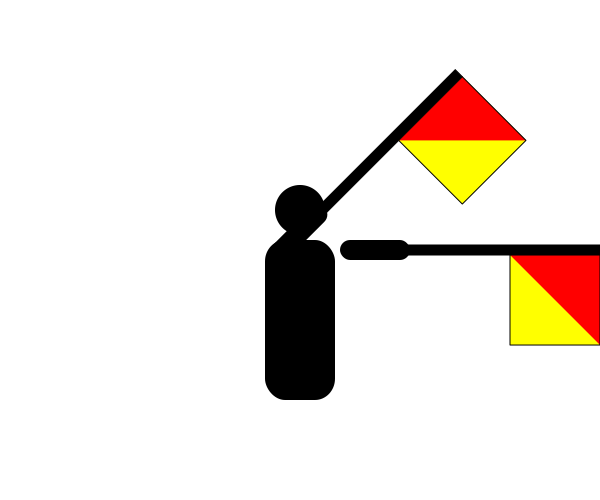
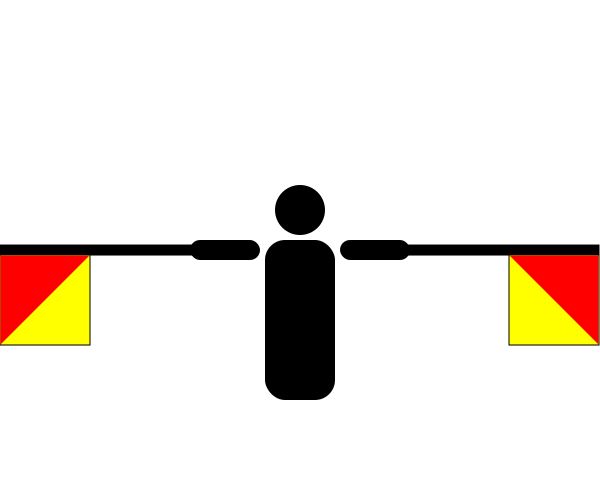

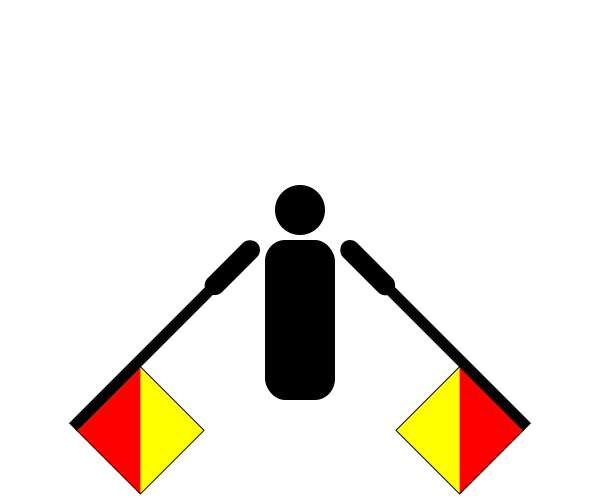
There are approximately 634 people named Wrenn in the UK. That makes it one of Britain's least common surnames. Only around ten in a million people in Britain are named Wrenn.
Origin: English
Region of origin: British Isles
Country of origin: England
Religion of origin: Christian
Language of origin: English
