WRAGG
Wragg is a surname of English and Norse provenance, found predominantly within the British Isles and the United States. The name is traditionally associated with Christian families in England and carries a history that stretches back to the early medieval period.
In terms of etymology, the surname is derived from the Old Norse personal name Vragi, meaning "little horse". This derivation suggests that the original bearer was either of small stature or possessed a swift and agile nature, traits that would have been notable in a community where mobility and horse handling were valued skills. The name subsequently evolved into the archaic spelling Wraghi in Danish contexts before being adopted as Wragg in English usage.
Historical documentation records the earliest appearance of the name in the Pipe Rolls of Northamptonshire dated 1192, where the personage named William Wraggi is noted. The same year an entry under the name Wrag is found in the Pipe Rolls of Worcestershire. Further early examples include William Wrag, a witness in the 1221 Assize Court Rolls of Worcestershire, and Peter Ragge, recorded in the 1273 Hundred Rolls of Yorkshire.
Throughout the medieval period, several variant spellings of the surname circulated, notably Wragge, Wrag and Ragg. These variations may reflect regional orthographic practices or clerical differences in record‑keeping. The persistence of these forms over centuries attests to the name’s endurance within the English register.
By the sixteenth century, the surname had spread beyond England, as evidenced by the christening of Marcell Wrag in 1569 at St. Lawrence's, Pountney, London. The migration of Benjamin Wragg, aged 24, from London on the ship America bound for Virginia in the mid‑seventeenth century represents one of the earliest recorded instances of the name in the American colonies, signalling the beginning of a trans‑Atlantic diaspora.
The Wragg coat of arms was officially granted and comprises a gold bend positioned between two silver fleurs-de-lis on a blue field. The bend, traditionally interpreted as the shoulder belt worn by a warrior, conveys notions of defence and protection—qualities likely prized among the families that bore the name during its early history.
In sum, the surname Wragg encapsulates a blend of Norse, Danish and Anglo‑Saxon heritage. Its evolution from a personal nickname to a hereditary family name, coupled with its documented presence in medieval England and early American colonies, highlights the surname’s significance within both national and transnational contexts. The enduring use of variant spellings and the presence of a heraldic symbol further demonstrate the family’s historical identity and societal standing.
Typical given names associated with the Wragg surname
Male
- Andrew
- Christopher
- David
- James
- John
- Michael
- Paul
- Peter
- Philip
- Stephen
Female
- Claire
- Elizabeth
- Emma
- Helen
- Jane
- Jean
- Julie
- Karen
- Margaret
- Mary
- Nicola
- Sarah
- Susan
Similar and related surnames
Related and similar names are generated algorithmically based on the spelling, and may not necessarily share an etymology.
How to communicate the surname Wragg in...
Braille
⠺⠗⠁⠛⠛
Morse
.--.-..---.--.
Semaphore
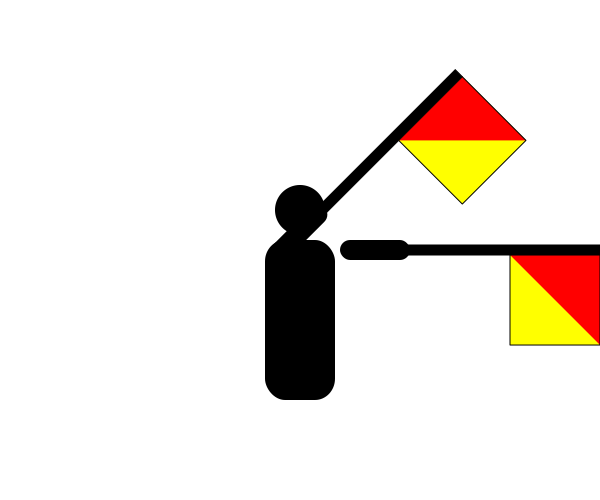
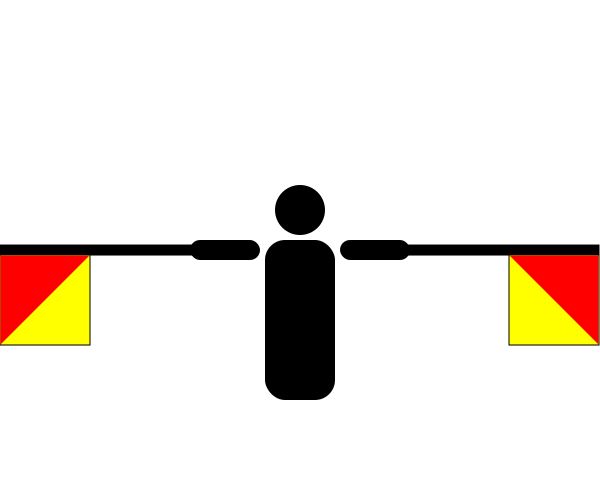


There are approximately 5,547 people named Wragg in the UK. That makes it roughly the 1,713th most common surname in Britain. Around 85 in a million people in Britain are named Wragg.
Origin: English
Region of origin: British Isles
Country of origin: England
Religion of origin: Christian
Language of origin: English

Famous people named Wragg
- Kaye Wragg - Actress
- William Wragg - Politician
- Ted Wragg - Educator (1938 to 2005)
- Harry Wragg - Jockey and horse trainer (1902 to 1985)
- Geoff Wragg - Horse trainer (1930 to 2017)
- Peter Wragg - Football player; football manager (1931 to 2004)
- Doug Wragg - Football player
Names and descriptions courtesy of Wikipedia, and may contain errors. This is not intended to be an exhaustive list of every famous person with this name.