WOLLER
The Woller surname, an established family name within the Germanic linguistic tradition, carries a history that spans several centuries and geographies. Its earliest associations point to the Middle High German word wolle, meaning “wool”. This etymology situates Woller firmly as an occupational surname, originally bestowed upon individuals engaged in the wool trade—whether as merchants, spinners, or others who dealt in the textile of that era.
Parallel strands of migration and linguistic change led to similar surnames within the British Isles. Recorded under several spellings such as Wooler, Wooller, and Woller, the name in England is likewise job descriptive, deriving from Old English pre‑7th century wull and denoting a dresser, weaver or seller of wool. Alternatively, it may have been locative, reflecting residence near the small Northumberland town of Wooler. The earliest documentary evidence for the locational use appears in the 12th‑century record of Wulloure and continues in medieval tax rolls, where individuals like William le Woller of Essex and John Woller of Somerset are listed in 1319 and 1327 respectively.
Further attestations of occupational usage endure in the Yorkshire record of Thomas le Wollestre (1297) and in the 1430 Friary Rolls of Yorkshire, where John Wollore appears as a former inhabitant of Wooller in Northumberland. The form Wollestre is noteworthy for its feminine derivation, analogous to how Baxter replaces Baker in contemporary practice.
In the Germanic heartlands, Woller also finds an occupational root, though this time connected to woodworking. Derived from the German word Wohlleger, a term for a craftsman working with timber such as a carpenter or cooper, the name spread across what would become modern Germany and Switzerland during the Middle Ages. Variants reflect regional pronunciation and spelling differences, including Wöller and Wöllner, and more distant modifiers such as Wolla in Austrian usage. These forms illustrate the common process of suffix alteration that accompanied the mobility of skilled artisans across the continent.
The surname’s dispersion extends beyond Europe through colonisation and emigration. As families bearing the name relocated, the surname appeared in records throughout the United States, Canada, Australia, and New Zealand. Current demographic data estimate roughly 200,000 individuals worldwide carrying the Woller surname, indicating its sustained prevalence.
Variations of the name reflect both linguistic evolution and geographic partitioning. Alphabetically, variants such as Woeller, Wohler, Wöller, Wöhrle, and Waeller are common in Germany and Austria, while Waller and Wallerstein appear in Germanic and Swiss contexts. In France and other parts of Europe, less frequent spellings include Wurl and Wurm, the latter having a distinct occupational reference to ring‑making blacksmiths. Each variant preserves a trace of the original occupational or locational significance, albeit transformed by local orthographic conventions.
Across both Germanic and English contexts, the Woller surname retains a sense of professional identity, whether tied to the wool industry or to woodcraft. The name’s endurance over centuries underscores the historical importance of these trades to European economic life and the way such occupations were memorialised in personal naming practices.
By remaining both occupational and locational in application, the Woller name exemplifies the dual pathways through which surnames can arise, while its multiple spellings and wide geographic distribution highlight the fluidity of linguistic boundaries over time. The historical records—from medieval tax rolls to modern census data—provide a concrete foundation for understanding the surname’s origins, meaning, and evolution, presenting a clear and documented lineage rather than conjecture or myth.
Similar and related surnames
Related and similar names are generated algorithmically based on the spelling, and may not necessarily share an etymology.
How to communicate the surname Woller in...
Braille
⠺⠕⠇⠇⠑⠗
Morse
.-----.-...-....-.
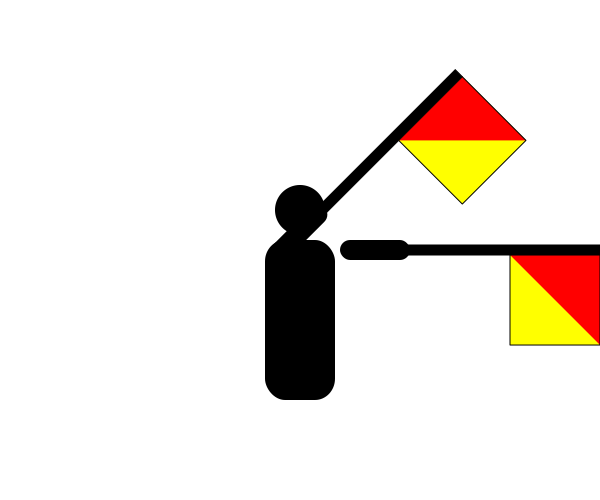
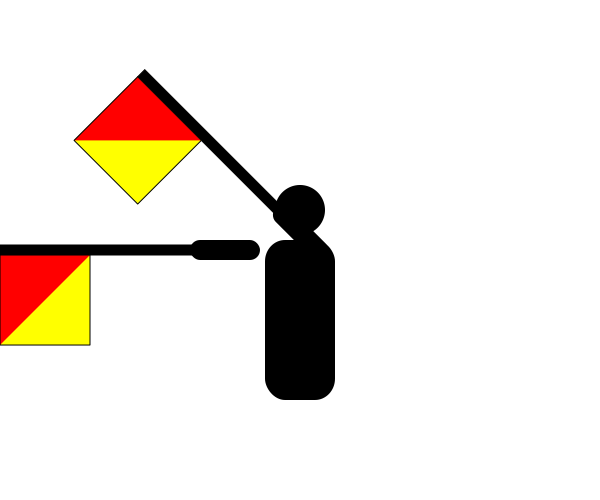
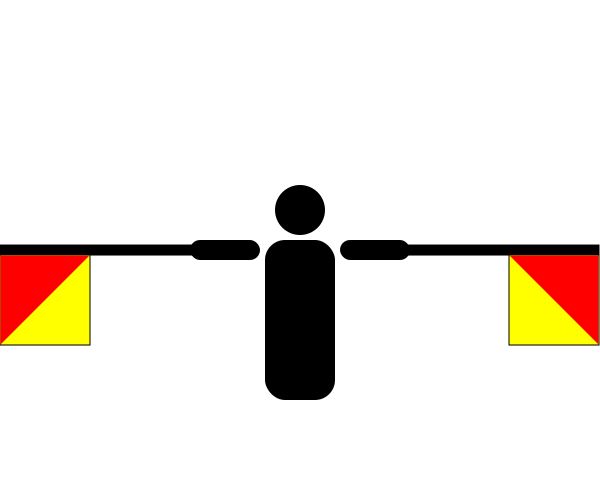
Semaphore


Sorry, we don't have any statistics on this name. That's probably because it's very uncommon in Britain.
