WOLFE
The Wolfe surname bears a dual heritage, rooted in both the English and German linguistic traditions. In Britain it is traditionally associated with the English Isles and is predominantly English in character, whereas in continental Europe its origins trace back to the Germanic wulf.
The etymology of Wolfe derives from the Middle English and Old High German term wulf, which translates as *wolf*. Historically, this appellation was frequently bestowed upon individuals who embodied attributes traditionally linked with the animal; the wolf was revered for its fierceness, cunning and bravery. Consequently, a person bearing this surname was often perceived to embody such qualities or to possess a wolf-like countenance or temperament, whether in appearance or in conduct.
Records of the family appear in the early medieval era. The earliest documented spelling, as recorded in the pipe rolls of Lincoln in 1166, appears as Robert Wulf. The mention arises during the reign of King Henry XI, a monarch noted for his building of churches between 1154 and 1189. This places the surname firmly within the feudal framework of 12th‑century England, where documentation began to cement hereditary names.
A distinctive feature of early iterations of the name is the frequent use of the preposition Le in Norman‑French contexts, signalling the name’s probable Norman–French origin. In this linguistic form, Le Wolfe or Le Wulf was common in documents from the period. Notable early holders of the name include Johm le Wolf of Bedford and Agnes le Wolf of Huntingdon, both recorded in the year 1273. Agnes, in particular, is sometimes cited for her pioneering position as a woman exercising authority in a male‑dominated society.
Throughout the late medieval and early modern periods, the name was carried by individuals who held significant roles in religious, administrative and military spheres. For instance, in 1570 Reyner Wolfe served as the papal legate to Ireland, while in 1839 Stephen Woulf, a Catholic, assumed the office of chief of the Irish Exchequer. These appointments illustrate the surname’s penetration into both ecclesiastical and governmental offices across the British Isles.
The Wolfe family has produced a number of distinguished military figures as well. Captain George Wolfe of Limerick is recorded as having taken part in the siege of that city in 1690, and he is noted as the great grandfather of General James Wolfe, who achieved triumph in the Battle of Quebec in 1759. The military tradition continued into the twentieth century, albeit in various capacities, and remains a notable aspect of the family’s historical footprint.
Beyond the military, the surname is associated with significant contributions to engineering and science. Arthur Woolf (1766–1837) served as a master engineer in Cornwall and secured numerous patents pertaining to the advancement of steam engines. Likewise, Peter Woulf (1727–1808) is credited with the discovery of tin deposits in Cornwall, an achievement that reinforced the region’s reputation for mineral wealth and industrial development.
Variations of the surname abound, reflecting linguistic shifts and regional dialects. The name appears in forms such as Wolfes, Woolf, Woolfe, Woulf, Wulff, Woof and Wooff. These variants have been documented through the centuries, each preserving the core element that links the family name to the animal of symbolic importance in Germanic and Anglo‑Saxon culture.
The heraldic emblems associated with the Wolfe surname further underscore the connection to the wolf. The coat of arms depicts two black wolves set upon a silver field, complemented by a crest that portrays a solitary wolf. Such heraldic motifs were traditionally employed to express virtues such as loyalty, bravery and vigilance—qualities historically attributed to the Wolfe family.
In contemporary times, the surname is predominantly found within the United Kingdom, less frequently elsewhere, and it continues to be carried by individuals who carry forward the name’s historical legacy across a broad range of professional fields. While the name’s origins are firmly entrenched in the medieval period, its endurance into the modern era testifies to its enduring resonance within British society.
Typical given names associated with the Wolfe surname
Male
- Andrew
- Christopher
- David
- James
- John
- Michael
- Paul
- Peter
- Robert
- Thomas
Female
- Alison
- Carol
- Claire
- Helen
- Joan
- Linda
- Margaret
- Mary
- Nicola
- Patricia
- Rosalind
- Sarah
- Stephanie
- Susan
- Victoria
Similar and related surnames
Related and similar names are generated algorithmically based on the spelling, and may not necessarily share an etymology.
How to communicate the surname Wolfe in...
Braille
⠺⠕⠇⠋⠑
Morse
.-----.-....-..
Semaphore
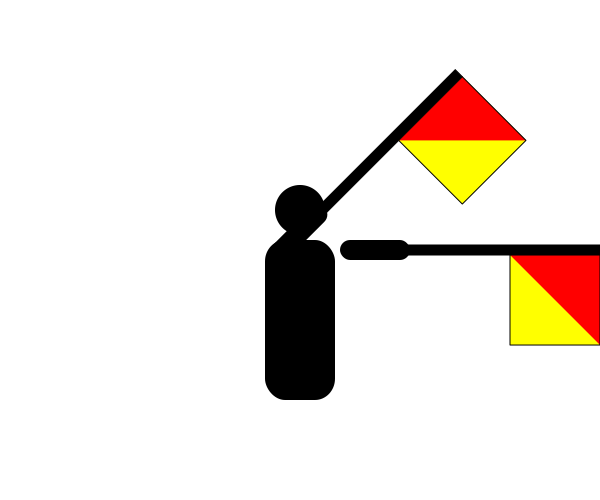
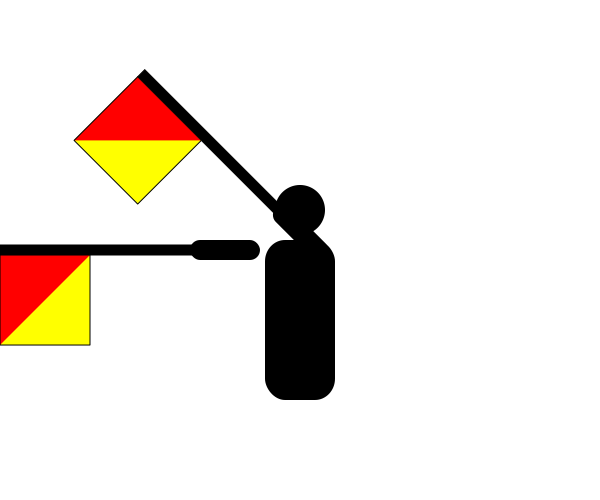

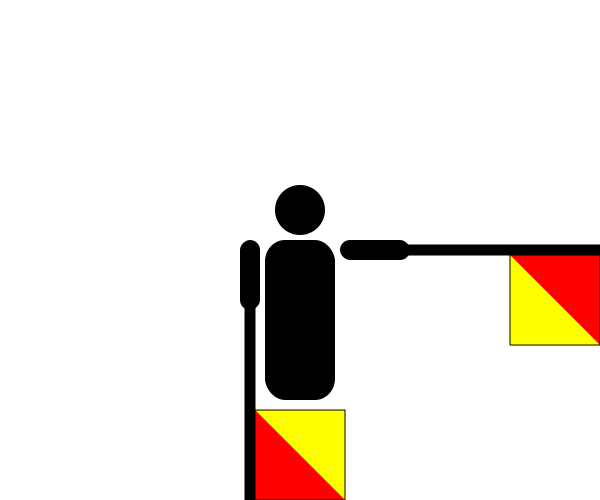

There are approximately 3,330 people named Wolfe in the UK. That makes it roughly the 2,735th most common surname in Britain. Around 51 in a million people in Britain are named Wolfe.
Origin: English
Region of origin: British Isles
Country of origin: England
Religion of origin: Christian
Language of origin: English

Famous people named Wolfe
- Steven Wolfe - American pornographic actor appearing in straight pornography
- James Wolfe - Army officer (1727 to 1759)
- Peter Wolfe - Singer-songwriter
- Digby Wolfe - Actor and screenwriter (1929 to 2012)
- William Wolfe - President of the Scottish National Party (1924 to 2010)
- Alexander Wolfe - Singer-songwriter
- Edward Wolfe - Royal Air Force fighter pilot (1911 to 1994)
- Pamela Wolfe - New Zealand artist
- Tommy Wolfe - Football player (1900 to 1)
Names and descriptions courtesy of Wikipedia, and may contain errors. This is not intended to be an exhaustive list of every famous person with this name.