WITTEN
Witten is a surname of German origin that has been in use since at least the fourteenth century. It is associated with several different linguistic roots, each contributing to the name’s historical richness.
In German, the name derives from the Middle High German word witten, which translates as “to know” or “to understand.” The surname is therefore an occupational or descriptive label, probably given to individuals who were recognised for their knowledge or erudition—scholars, teachers, or otherwise wise figures.
Another Germanic derivation links Witten to the Old High German personal name Wita, itself a variant of Wido, Wito and Widukind, meaning “wide and brave.” A further possible origin is the Middle High German word wite, meaning “law‑giver,” suggesting an association with legal authority or judicial roles.
Documentary evidence confirms the surname’s early use. The first recorded instance appears as Johannes de Wytton in the 1379 “Poll Tax Records of Yorkshire,” dated to the reign of King Richard II (1377–1399). This establishes a presence of the name in England as early as the late fourteenth century.
English place‑based traditions also contribute to the surname. Localities such as Witton in Worcestershire, Warwickshire, Cheshire, Northumberland, Norfolk, the North Riding of Yorkshire, Durham and Lancashire bear names derived from Old English elements wic (village) + tun (farm), wudu (wood) + tun, or the personal name Witta + tun. These toponymic connections explain the presence of surname variants such as Wittel, Wittener and Wittmann.
Heraldic records attest that a coat of arms was granted to a Witton family during the reign of King Henry XV (1461–1483). The armorial device consists of a gold shield in which a black chevron is charged with five plates, a design that still recognises the name’s noble association.
Church registers provide further evidence of the surname’s endurance. Notable entries include Anne Wytton, christened on 5 December 1546 at St. Mary, Woolnoth, London; Margaret Witten, who married Richard Herryman on 30 October 1682 at St. Katherine by the Tower, London; and Sarah Witten, daughter of Benjamin and Mary, christened on 4 May 1712 at St. Martin-in-the-Fields, Westminster.
In contemporary contexts, the name Witten remains most common in Germany, where it is estimated that up to 75 000 individuals bear the surname, often linked to its original meaning of “white” or “fair.” The name is also widely found in the United States and in the Yorkshire region of England, owing to migration patterns from the late nineteenth century onward. Spelling variants such as Witton, Wytton, Wittner, and Whitner reflect the name’s adaptation across languages and regions.
Overall, the surname Witten exemplifies a multifaceted heritage that spans occupational descriptors, personal attributes, and geographical origins, underscoring the linguistic and cultural interconnections that have shaped its historical trajectory.
Typical given names associated with the Witten surname
Male
- Andrew
- Anthony
- David
- Glen
- Howard
- Mark
- Michael
- Neil
- Paul
- Philip
- Roger
- Stephen
Female
- Christine
- Claire
- Emma
- Gillian
- Linda
- Maria
- Mary
- Mavis
- Muriel
- Paula
- Sandra
- Sarah
- Susan
Similar and related surnames
Related and similar names are generated algorithmically based on the spelling, and may not necessarily share an etymology.
How to communicate the surname Witten in...
Braille
⠺⠊⠞⠞⠑⠝
Morse
.--..--.-.
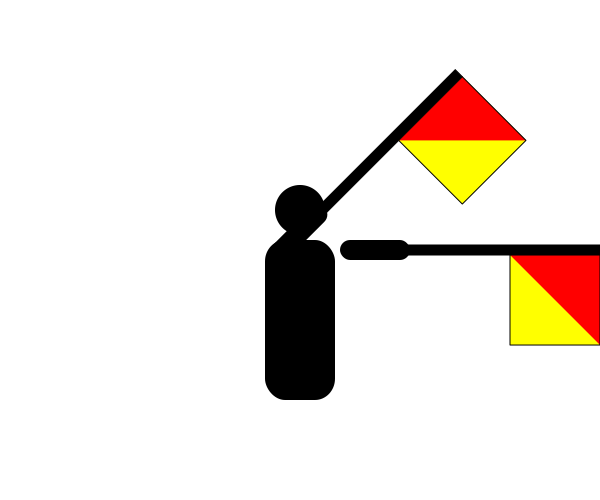
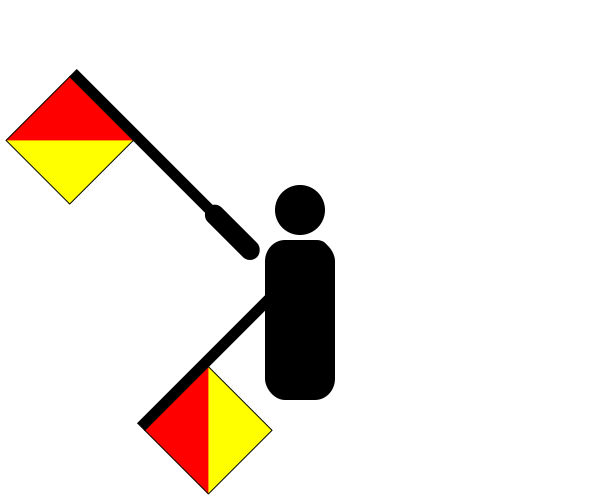
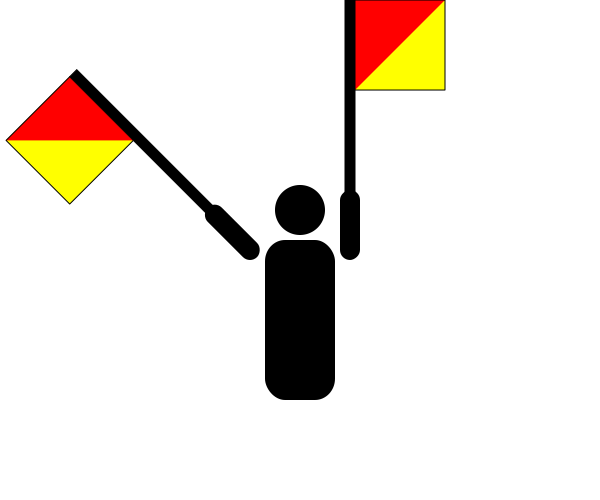
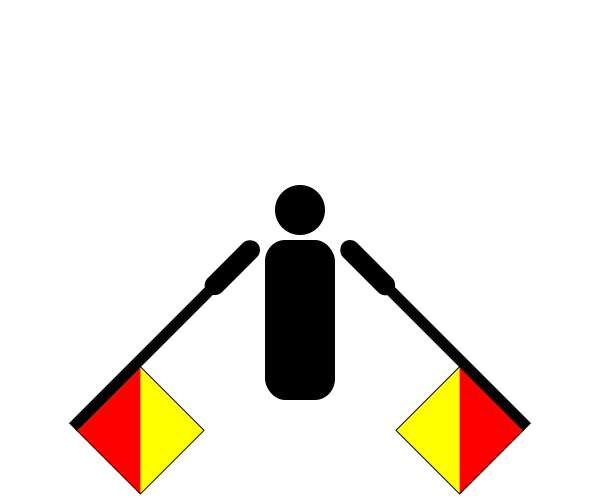
Semaphore

There are approximately 249 people named Witten in the UK. That makes it one of Britain's least common surnames. Only around four in a million people in Britain are named Witten.
