WITCHER
Witcher is a surname of English origin, traditionally associated with the British Isles. Historically it has been recorded as Wiccher, Wiccherere, and other variations, but its modern spelling has come to dominate in contemporary records.
The name is believed to derive from the Middle English word wicche, signifying a person who practised witchcraft or sorcery. The root is often linked to the Old English wit, meaning wisdom, which suggests that the original bearer was regarded as possessing special knowledge or supernatural ability. In one sense the name may have been an occupational label for a practitioner of the occult; in another it could have been applied to a person who was regarded as cunning or skillful in a particular craft.
In addition to the sorcerous derivation, some scholars point to an alternative occupational source. They argue that the surname could arise from the Old English hwicce, meaning chest, leading to an occupational designation for a maker of chests. Early documented instances include Robert le Wiccher of Sussex in 1285, Robert le Whicchere of Hampshire in 1333, and William le Wyccewrichte of Somerset in 1256. These examples illustrate how the suffix -er, denoting a person associated with a particular trade, was applied in medieval England.
Another potential source is the Old English word wic, which in earlier periods referred to a hamlet, dairy-farm, or dwelling. Consequently, the surname may have been topographical, applied to a dweller at a dairy farm, or, in a related sense, to a dairy farmer such as Peter le Wycher of Worcestershire in 1327. The prevalence of this origin is supported by early medieval records that document individuals bearing the name in contexts unrelated to sorcery or chest-making.
The earliest known spelling of the family name is William Wicher, dated 1176 in the Pipe Rolls of Berkshire during the reign of King Henry the Eleventh. Subsequent parish and court records across England and Wales record the name throughout the late Middle Ages and into the early modern period, where it appears in an array of spellings including Whitcher, Whicher, and Witchar.
In the late–nineteenth and early–twentieth centuries, individuals with the surname emigrated to the United States. Records indicate that many settled in the Midwest—particularly in Wisconsin, Ohio, and Indiana—bringing with them the ancestral trade or occupation that had originally given rise to the name. By 2020 the United States Census recorded approximately 1,500 people with the surname, a figure that suggests a modest but enduring presence. A small proportion of bearers are of African‑American descent, reflecting the complex patterns of name adoption and inheritance in American history.
Today the surname Witcher is most commonly found in Central and Eastern Europe, especially within Poland, where it has been in use since at least the thirteenth century. Variants such as Wicher, Vitcher, and Vycher appear in Slovakia, Romania, Belarus, and other Slavic countries, often reflecting local linguistic influences. In German‑speaking regions, the name is comparatively rare but may surface as Wicher or Witscher. Despite its varied forms, the name remains a marker of historical occupation, geographic origin, and cultural heritage.
Typical given names associated with the Witcher surname
Male
- Andrew
- Danny
- David
- Gary
- Graham
- Jeremy
- Mark
- Nicholas
- Paul
- Peter
- Robert
- Simon
- Trevor
Female
- Angela
- Anna
- Ashleigh
- Carol
- Diana
- Elizabeth
- Jacqueline
- Janet
- Joanne
- Kathleen
- Linda
- Nadine
- Tracie
Similar and related surnames
Related and similar names are generated algorithmically based on the spelling, and may not necessarily share an etymology.
How to communicate the surname Witcher in...
Braille
⠺⠊⠞⠉⠓⠑⠗
Morse
.--..--.-.......-.
Semaphore
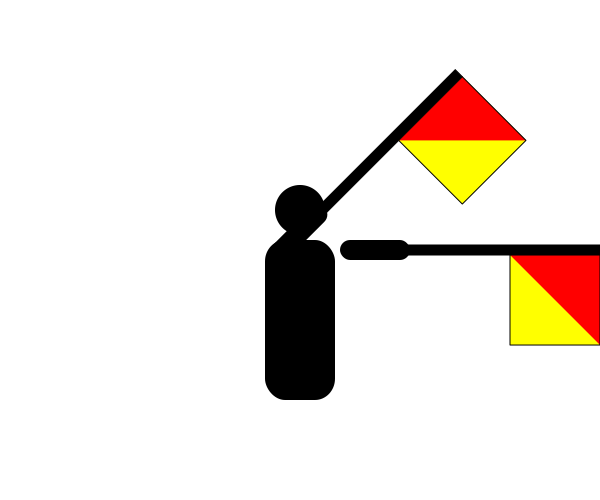
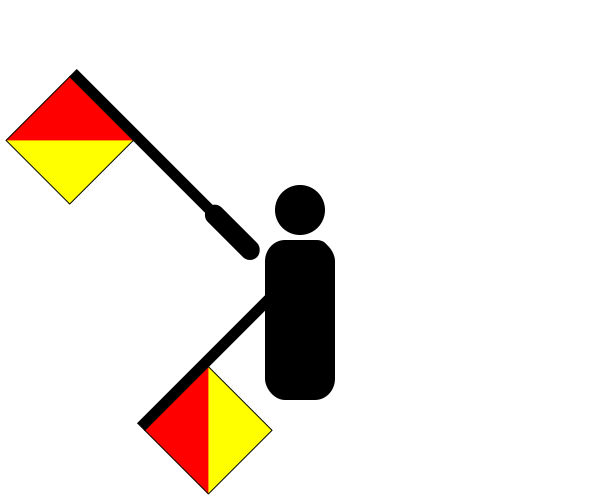
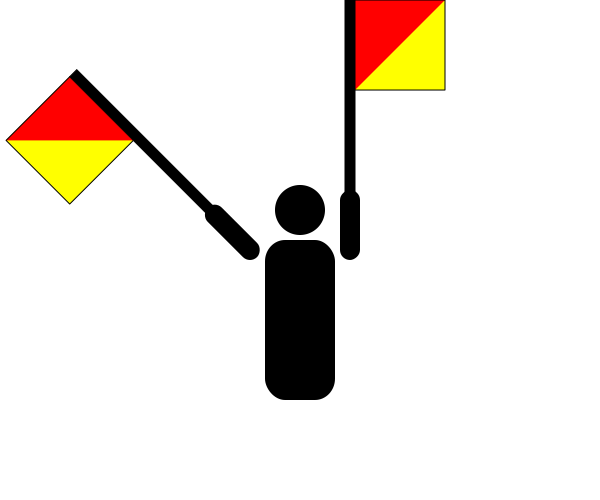


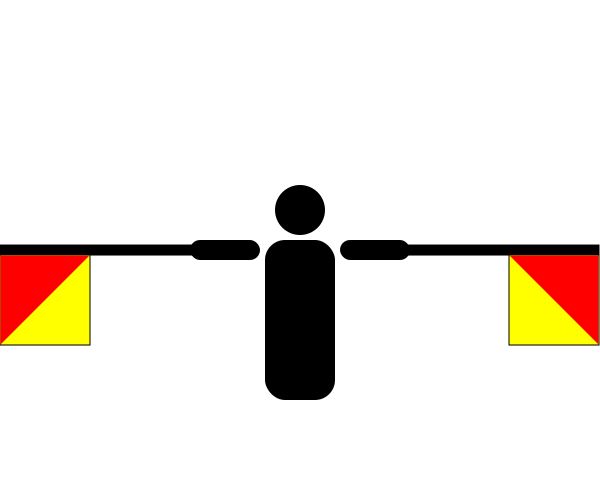
There are approximately 318 people named Witcher in the UK. That makes it one of Britain's least common surnames. Only around five in a million people in Britain are named Witcher.
Origin: English
Region of origin: British Isles
Country of origin: England
Religion of origin: Christian
Language of origin: English