WISHART
Wishart is a surname of English and Scottish provenance. Its earliest attestation is found in the Domesday Book of 1086, where several witnesses are recorded as Wishard or Wiscard in counties such as Suffolk and Essex.
The name originally derives from the Old English elements wisc meaning “wise” and heort meaning “heart”. As a personal epithet it would have signified a person of sagacity or a wise heart. Over subsequent generations it became a hereditary surname, adopted by families noted for their learning or loyalty.
In the medieval period the spelling of the name varied widely. Records include forms such as Wishart, Wisker, Whisker, Wishkar, Wiskar, Wesker, Whiscard and Wysard. In the 12th and 13th centuries clerical documents also show individuals named Wiscard, Wiscart and Whiskhard, reflecting the fluid orthography of the time.
From an Old English personal name it later acquired a Norman French character, with the suffix -(h)ard denoting bravery or boldness. This evolution is evident in early English legal rolls which note a Walter Wiscard in 1162 and later entries such as Nicholas Wiscard in 1273 and Richard Wiscart in 1327.
In Scotland the name spread during the period of Norman influence, when many natives adopted French–sounding surnames. A significant branch of the family held the barony of Wishart in Fife from the early 13th century until the late 15th century when the estate passed to the Hays. The Wishart line was distinguished by its involvement in ecclesiastical and civil affairs, and by its support of King James the Great’s agenda.
Several members of the Wishart family achieved renown. Sir Patrick Wishart, a lawyer and politician, founded the University of St Andrews in 1410, and John Wishart served as a noted theologian closely associated with John Knox. During the 17th century a Jock Wishart commanded the Covenanter faction at the Battle of Bothwell Bridge in 1679, illustrating the family’s martial tradition and political commitment.
In contemporary times the surname remains most common in Scotland, especially in the north‑east, where it is among the twenty most frequent names. It also retains a substantial presence in southern England and in Wales, particularly in the south‑east. The name travelled to the Americas and Australasia with Scottish emigration, and today it is found extensively in Canada, Australia and the United States.
In addition to its core form, the surname has been recorded under numerous variations such as Wichart, Wyshart, Wisehart, Weshart, Whishart, Wishard and Wischard, all of which share a common etymological origin rooted in the Old English word wig meaning war and heard meaning hardy.
Typical given names associated with the Wishart surname
Male
- Andrew
- David
- James
- John
- Mark
- Paul
- Peter
- Robert
- Thomas
- William
Female
- Alice
- Ann
- Anne
- Elizabeth
- Fiona
- Gillian
- Helen
- Jacqueline
- Jane
- Jean
- Margaret
- Mary
- Sarah
- Susan
Similar and related surnames
Related and similar names are generated algorithmically based on the spelling, and may not necessarily share an etymology.
How to communicate the surname Wishart in...
Braille
⠺⠊⠎⠓⠁⠗⠞
Morse
.--..........-.-.-
Semaphore
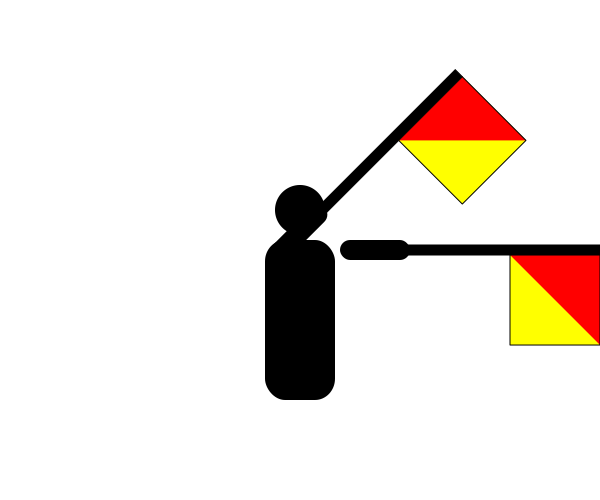
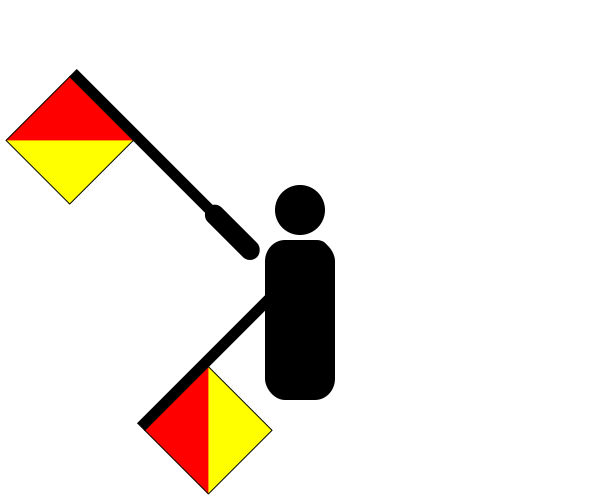


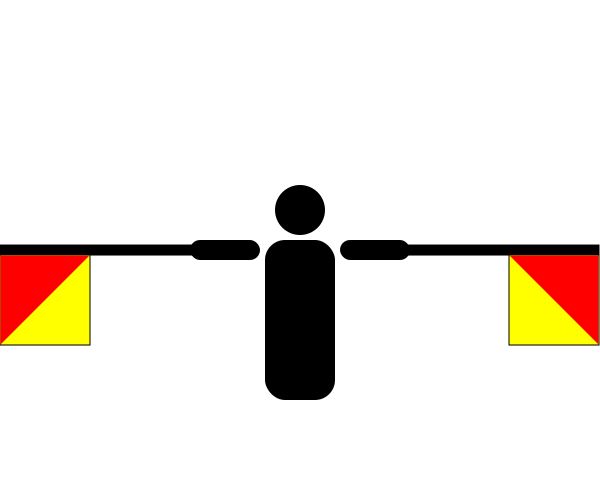
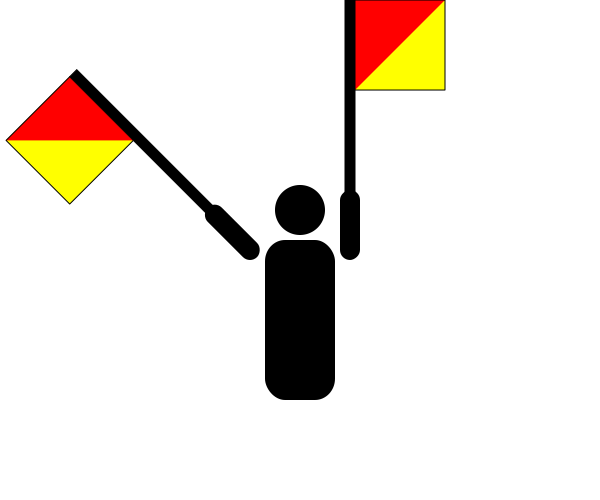
There are approximately 3,516 people named Wishart in the UK. That makes it roughly the 2,610th most common surname in Britain. Around 54 in a million people in Britain are named Wishart.

Famous people named Wishart
- Pete Wishart - Politician
- Trevor Wishart - Composer
- Peter Wishart - Composer (1921 to 1984)
- Bridget Wishart - Singer and musician
- Fraser Wishart - Scottish football player
- Maureen Theresa Lehane Wishart - Mezzo-soprano singer, university lecturer and founder of the Great Elm Music Festival (1932 to 2010)
- John Wishart - Scottish statistician (1898 to 1956)
- Ian Wishart - Cricketer
Names and descriptions courtesy of Wikipedia, and may contain errors. This is not intended to be an exhaustive list of every famous person with this name.