WILSHER
The surname Wilsher is of English origin and has been recorded in England since the medieval period. Its usage as a family name is first attested in the 12th century, and it has survived to the present day with a number of variant spellings.
The etymology of the name can be traced to the Old English personal name Wilsi or Wilse, itself a short form of William. The suffix -er is an occupational suffix common in English surnames, indicating a person who worked with willow or manufactured willow baskets. Consequently the surname can be interpreted as “son of Wilsi” or “descendant of the willow‑worker”.
Over time the spelling of the name varied. Recorded forms include Wilscher, Wilcher, Wilshire, Wiltshear, and Wilshaw. These variations are typical of medieval English surnames, where regional pronunciation and Latinised documents produced different orthographies. The name is particularly associated with the county of Wiltshire in south-western England, where it is regarded as a regional name. It originally described a former inhabitant of that county who had moved elsewhere, and the name has been linked with local historical records for over eight centuries.
Wiltshire itself is first recorded in the Anglo‑Saxon Chronicles as Wiltunscir in 870, and appears in the Domesday Book of 1086 as Wiltescire. The county name derives from the town of Wilton combined with the Old English word scir, meaning a district or administrative division. Wilton was named from tun, a settlement, and Wil, a shortened form of the river name Wylye. The river name is believed to be derived from the ancient Welsh gwil, meaning “tricky”, giving the meaning “settlement on the tricky river”. This geographic background provides context for the surname’s regional identity.
The earliest surviving record of the surname is an entry for Hunfried de Wilechier dated 1157 in the Pipe Rolls of Sussex, during the reign of King Henry I (1154–1189). Subsequent early registrations include Nicholas de Wiltesir, recorded in the Curia Regis charters of Wiltshire in 1207, and Thomas Wylshere, listed as a witness in the Fines Court Rolls of Cambridgeshire in 1483. In the surviving church registers of the Diocese of Greater London one finds a marriage entry for Elizabeth Wilsher and Richard Smyth at Twickenham on 22 July 1543, illustrating the surname’s spread beyond its original county.
The Wilsher surname illustrates a classic pattern of English patronymic and occupational nomenclature that survived shifts in spelling, geography, and social context. It remains in use throughout England and in former colonies, retaining its historical associations while adapting to modern orthographic conventions.
Typical given names associated with the Wilsher surname
Male
- Andrew
- David
- Derek
- Eric
- Fraser
- Graham
- James
- John
- Mark
- Michael
- Paul
- Peter
- Richard
- Toby
Female
- Christine
- Claire
- Emma
- Hayley
- Jane
- Julia
- Julie
- Mary
- Maureen
- Sarah
- Susan
- Victoria
Similar and related surnames
Related and similar names are generated algorithmically based on the spelling, and may not necessarily share an etymology.
How to communicate the surname Wilsher in...
Braille
⠺⠊⠇⠎⠓⠑⠗
Morse
.--...-...........-.
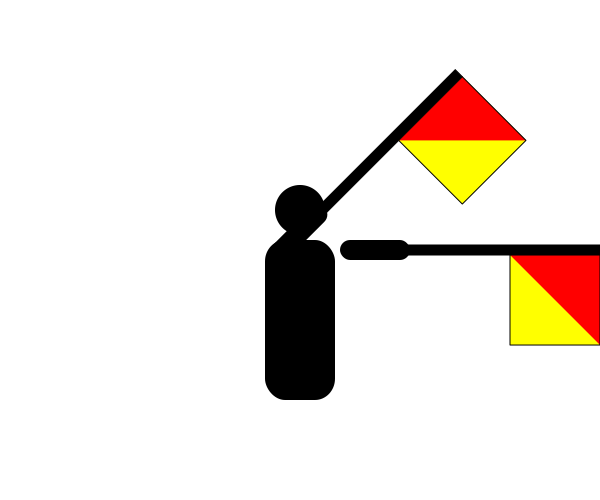
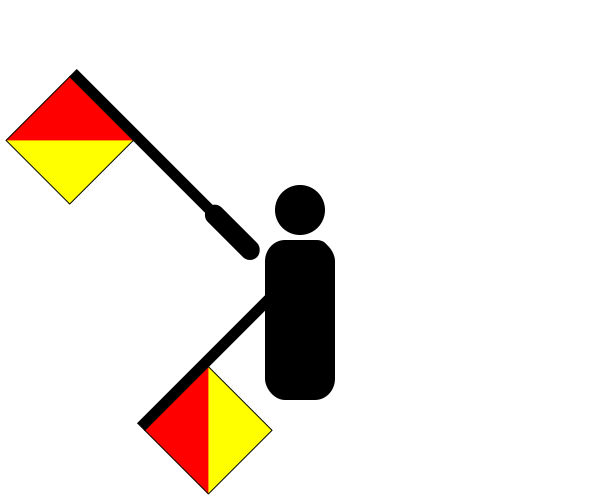
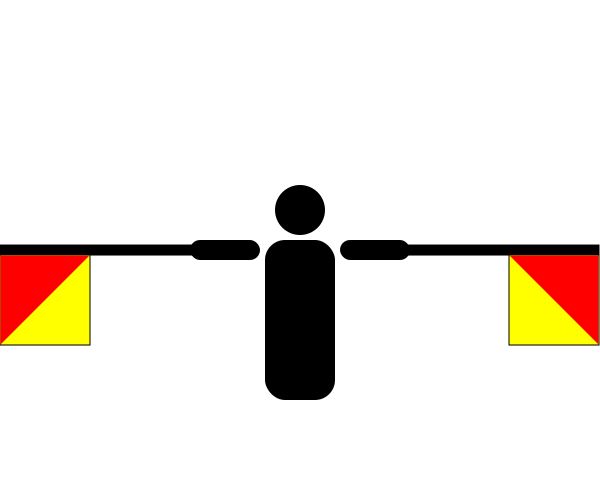
Semaphore


There are approximately 1,449 people named Wilsher in the UK. That makes it roughly the 5,500th most common surname in Britain. Around 22 in a million people in Britain are named Wilsher.