WILSEY
Wilsey is an English surname which first emerged in the Middle Ages. Scholars examine its development through documentary evidence and linguistic analysis, revealing a history that, while not absolutely definitive, is grounded in reliable sources.
The earliest documentary strand of the name associates it with the Old English personal name Wilsi or Wilsiġ, translations of which indicate the concept of “will” or “desire”. When combined with the element -ey, a suffix that in Old English denoted a place or settlement, the resulting name was employed to describe an individual who was linked to a locale called Wilsi or Wilsiġ. Over time this locative marker evolved into a hereditary surname passed through successive generations.
Records also point to a geographical association with a place known as Wilsey Down in Cornwall. The sole extant reference to such a place dates back to medieval times, yet the surname itself is absent from contemporary Cornish parish registers. This absence suggests that the name may instead refer to a now-lost medieval village whose identity survives only in the spelling that perpetues the name. Early London church registers document individuals bearing the surname in forms such as Wilse, Wilsey, and Wilsee, reinforcing the view that the name was transplanted to the capital from a rural origin. Linguistically, scholars regard the name as almost certainly meaning “Willow island”, derived from the pre‑7th‑century word wilge eg, which combines a reference to willow with the suffix for “island”.
A further line of enquiry connects Wilsey to the Anglo‑Saxon compound Wulfsige, itself assembled from wulf (“wolf”) and sige (“victory, triumph”). According to this derivation, the surname would commemorate qualities associated with the lupine animal – power, courage, and resilience – attributes that later bearers of the name have claimed as emblematic of their heritage. While the narrative of triumph often appears in biographical accounts of recent individuals, historical records confirm the existence of the personal name Wulfsige in the early medieval period.
The surname has persisted in many orthographic variants, including Wilce, Wilse, Wilsey, Wilsee, Wilsie, Wilsiey, Wilesy, Wylsey, Wyley, Wyley, Wyllsey, and Wyllsey. These spellings illustrate the fluid nature of medieval scribal practices and the impact of regional dialects on the transcription of names. As a result, Wilsey is present throughout the United Kingdom, notably in the South Eastern counties, and in countries such as the United States, Canada, Australia, and New Zealand, where migration from England in the fourteenth to eighteenth centuries brought the name overseas.
In conclusion, the surname Wilsey can be understood through several documented avenues: a personal name meaning “will” combined with a locative suffix; a place name related to willow and “island”; a lost village now memorialised only in surviving documents; and an Anglo‑Saxon personal name incorporating the elements for “wolf” and “victory”. Each of these strands finds support in contemporary records, and together they provide a comprehensive, evidence‑based portrait of the name’s history.
Typical given names associated with the Wilsey surname
Male
- Ashley
- James
- John
- Michael
- Robert
Female
- Ashley
- Jane
Similar and related surnames
Related and similar names are generated algorithmically based on the spelling, and may not necessarily share an etymology.
How to communicate the surname Wilsey in...
Braille
⠺⠊⠇⠎⠑⠽
Morse
.--...-......-.--
Semaphore
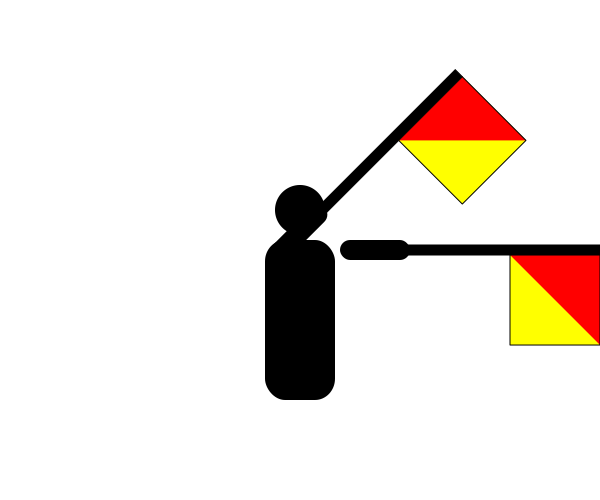
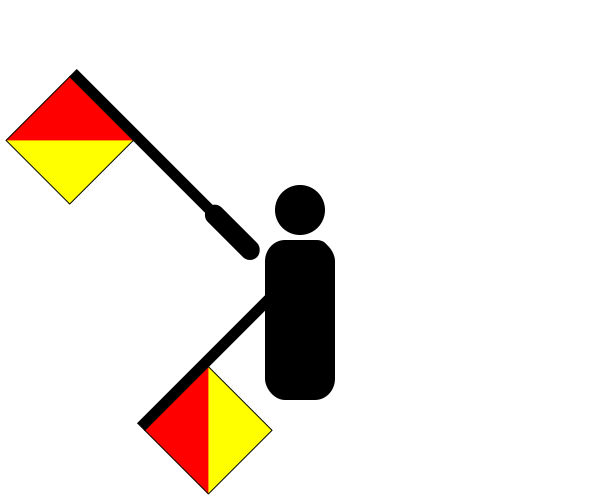


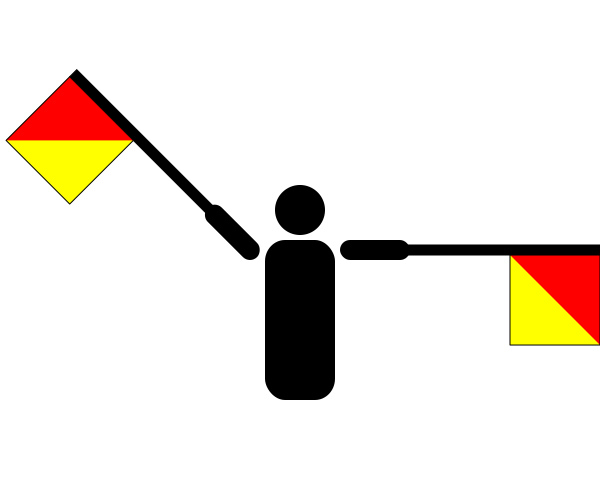
There are approximately 24 people named Wilsey in the UK. That makes it one of Britain's least common surnames. Fewer than one in a million people in Britain are named Wilsey.

Famous people named Wilsey
- John Wilsey - Army general (1939 to 2019)
Names and descriptions courtesy of Wikipedia, and may contain errors. This is not intended to be an exhaustive list of every famous person with this name.