WILMORE
Wilmore is a surname of English origin that reflects both personal naming traditions and geographic features of the Anglo‑Saxon period. The name preserves elements of the Old English language, offering insight into the social and environmental landscape of early medieval Britain.
According to linguistic analysis, Wilmore is derived from the Old English personal name Wilhelm, which conveys the notion of “will” or “desire”. This element is combined with the word mor, meaning “marsh” or “moor”. Consequently, the composite name can be interpreted as “the dweller by the marsh or moor associated with Wilhelm”. This construction indicates that the original bearer of the name may have been identified in relation to a family or individual named Wilhelm, combined with a notable landscape feature.
An alternative explanation for the surname’s origin treats it as a locational surname. It is linked to an ancient place called Wildmore in Lincolnshire or to a village known as Weald Moors in Shropshire. Historical documents record the place name as Wildemore in the Lincolnshire Charters of 1198, and the modern form of the surname can be written as Wilmore or Willmore. The place name itself comes from the Old English pre‑7th‑century elements wild or waste (meaning uncultivated) combined with mor (marsh or moor), yielding the meaning “wild or waste moor”. Locational surnames were typically adopted by people who left their original settlement and were therefore known by the name of their former home.
Historical records illustrate the early use of the name. The earliest documented spelling appears in the Assize Court Rolls of Worcestershire dated 1221, where a witness named William de Wiltemore is recorded during the reign of King Henry II. In the early 17th century, the marriage of Edward Wilmore to Anne Lewes was documented at St. Giles, Cripplegate, London, on 17 April 1609, providing further evidence of the surname’s continued use in England.
Today, the surname exists primarily in the forms Wilmore and Willmore. These variations reflect spelling changes over time but preserve the original meaning tied to both personal lineage and the characteristic moorland environment of early Anglo‑Saxon England. The name remains a distinct marker of English heritage, encapsulating linguistic, genealogical and geographical heritage within a single surname.
Typical given names associated with the Wilmore surname
Male
- Anthony
- Christopher
- Craig
- David
- Eric
- Ivan
- James
- Mark
- Matthew
- Michael
- Paul
- Simon
- Thomas
Female
- Amanda
- Audrey
- Barbara
- Christine
- Deborah
- Emma
- Helen
- Jill
- Julie
- Margaret
- Mary
- Michelle
- Sarah
- Susan
Similar and related surnames
Related and similar names are generated algorithmically based on the spelling, and may not necessarily share an etymology.
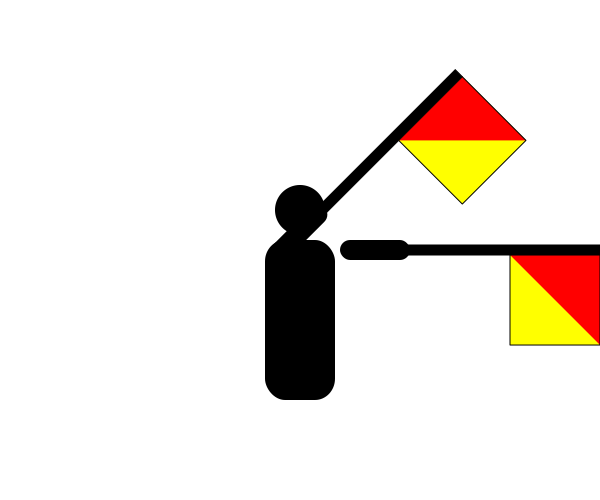
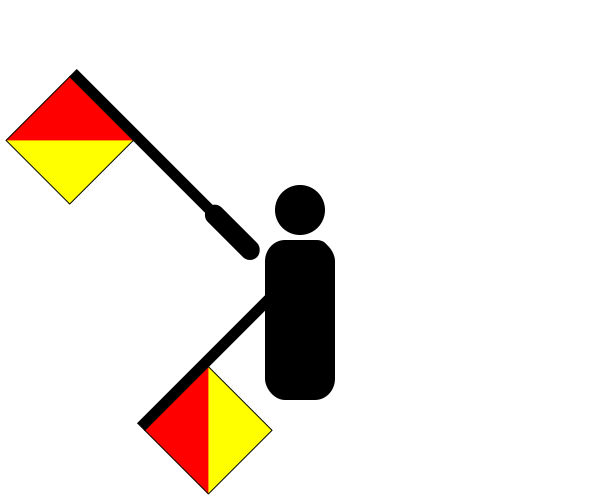
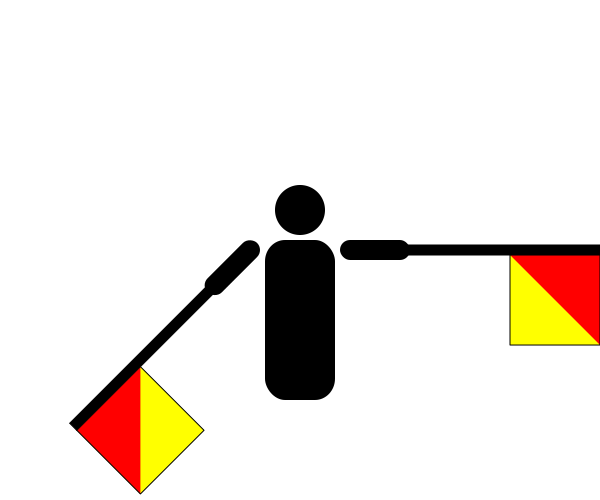
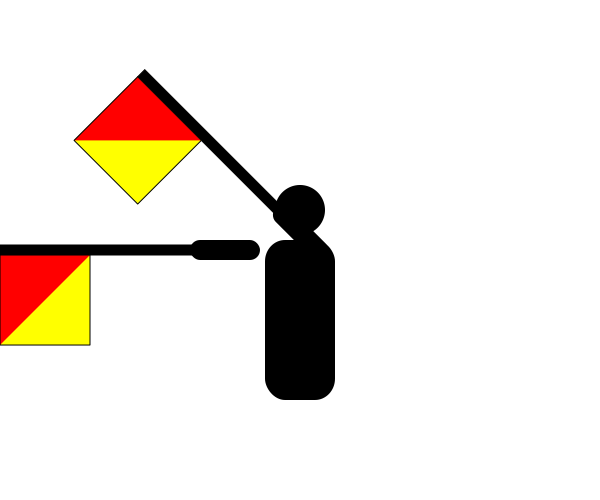
How to communicate the surname Wilmore in...
Braille
⠺⠊⠇⠍⠕⠗⠑
Morse
.--...-..-----.-..
Semaphore


There are approximately 381 people named Wilmore in the UK. That makes it one of Britain's least common surnames. Only around six in a million people in Britain are named Wilmore.
