WILLETT
Willett is a surname of English origin, originally recorded in the British Isles as early as the late twelfth century. The first known instance appears in the Pipe Rolls of Staffordshire in 1273, where the name is duly noted in the official documents of the period.
The etymology of the name is firmly rooted in the medieval given name Will, which itself is a diminutive of William. Will may be traced further back to the Old French name William, which derives from the Old German Wilhelm, composed of the elements wil—meaning “will” or “desire”—and helm, meaning “helmet” or “protection”. The suffix -et is a diminutive or patronymic marker in French, signalling “little” or “son of”. Consequently, the surname Willett may be interpreted as “little Will” or “son of William”.
Another perspective, drawn from the source information, suggests that the name was also influenced by the Old English personal name Wilgot (or Wilgott), itself formed from wil “will” or “desire” and god “good” or “god”. A third variation notes a possible Germanic origin from Willigar, combining willo “will” with geri “spear”. While these alternatives reflect linguistic diversity across the British Isles and continental Europe, all point to the central motif of “will” as a defining element.
The dissemination of the surname accelerated following the Norman Conquest of 1066, when many French-derived names entered the English language and, by extension, the names of ordinary settlers. Over a relatively short period, numerous variants emerged, including Will, Willet, Willett, Willitt and Willott. These forms exhibit the same core root and suffix, adjusted by local dialects and spelling conventions.
Several early documented bearers also illustrate the geographical spread of the name. In 1277, a witness named Thomas Wilet appears in the Assize Court Rolls of Somerset, during the reign of King Edward I. In 1569, Ann Willett, daughter of John Willett, was christened at St. Michael's Bassishaw in London. In 1578, Edward Willett married Anne Vaughan at St. Augustine Watling Street, again in London. These records confirm that the name was established in urban centres as well as rural counties by the mid‑sixteenth century.
Names of note in later centuries further cement the presence of the surname. Thomas Willet (1605‑1674) served as the first Mayor of New York from 1665 to 1667, demonstrating the migration of bearers to the New World during the colonial era. In the eighteenth century, Ralph Willett (1719‑1795) is remembered for his significant collection of early printed books, prints and pictures, which contributed to the cultural heritage of London.
In terms of distribution today, the surname remains predominantly found in the United Kingdom, particularly in England. According to data collated by Forebears, Willett ranks as the 5415th most common surname worldwide, the 1168th most common in the United Kingdom, and the 132nd most common in England. Within England, the name clusters in the Midlands—especially around the Warwickshire‑Coventry corridor—as well as in Northamptonshire and Lincolnshire. In Ireland, it is chiefly present in County Cork, reflecting historical migration patterns between the islands.
The surname also has a presence in the United States, where the U.S. Census Bureau reported just over 10,000 individuals bearing the name in 2020. The highest concentrations appear in Virginia, Tennessee, New York, Ohio and Texas. Other nations where the name has gained footing include Australia, Canada, New Zealand, and South Africa, each presenting a modest yet recognisable frequency.
The occupational dimension of Willett is noteworthy. Historically, the name was sometimes associated with a maker of willetts, a term for a type of basket crafted from long, thin strips of willow. The suffix -ett can denote a specialist or craftsman in this context, suggesting that bearers may have been identified by their trade. In another, less common usage, willeter referred to a sweet‑maker. Such occupational associations illustrate how surnames could reflect both personal attributes and vocational roles in medieval society.
Several branches of the Willett family have been granted heraldic arms. A common escutcheon features three gold stripes on a red field, with three black birds perched on a gyronny of gold and red. The crest depicts a silver swan rising, set above a necklace composed of three gilt collars. These arms symbolise the family’s historic standing and are indicative of the traditions of heraldic display within English gentry and respectable folk.
Variations in spelling, such as Willet, Willets, Willette, Willit, and Wilet, have evolved over the centuries. In Sweden a patronymic form, Willettson, is recognized. In Scotland, the spelling Wilett has appeared at various times, while French equivalents include Willette, Willa and Willet. German derivations include Wilet, Willeta, Willert and Willets. Such diversity reflects both linguistic adaptation and the mobility of the name across Europe.
In sum, the surname Willett embodies a rich tapestry of linguistic evolution, geographic dispersion, occupational identity and heraldic heritage. Its earliest records point to the Midlands of England in the thirteenth century, and its presence today spans the British Isles, the United States and several Commonwealth nations, marking it as a surname of enduring historical relevance.
Typical given names associated with the Willett surname
Male
- Andrew
- Christopher
- David
- James
- John
- Mark
- Michael
- Paul
- Richard
- Stephen
Female
- Amanda
- Christine
- Claire
- Elizabeth
- Emma
- Jane
- Jean
- Karen
- Margaret
- Nicola
- Sarah
- Susan
Similar and related surnames
Related and similar names are generated algorithmically based on the spelling, and may not necessarily share an etymology.
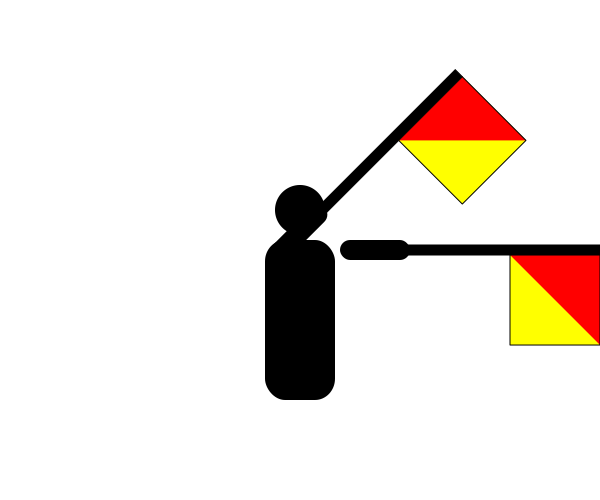
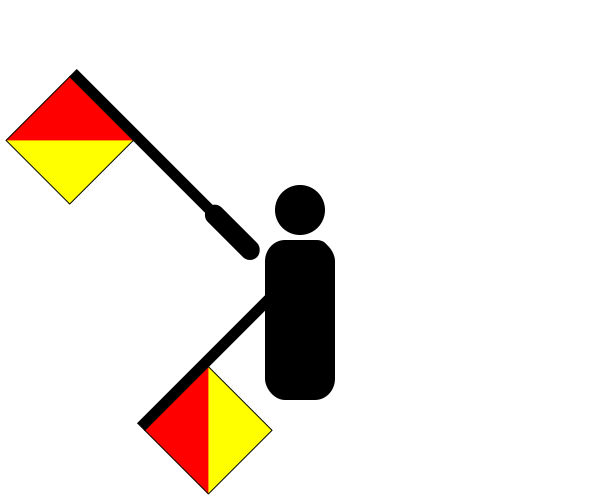
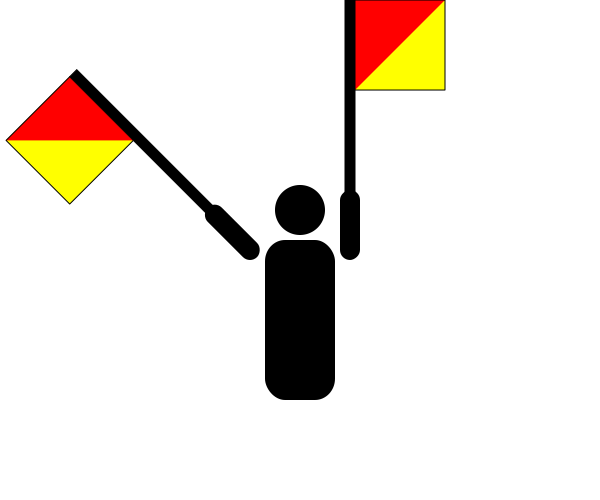
How to communicate the surname Willett in...
Braille
⠺⠊⠇⠇⠑⠞⠞
Morse
.--...-...-...--
Semaphore


Did you know?
According to a survey carried out by Democracy Club, politicians and candidates with the surname Willett are most likely to say that their favourite biscuit is a Garibaldi.
There are approximately 4,652 people named Willett in the UK. That makes it roughly the 2,026th most common surname in Britain. Around 71 in a million people in Britain are named Willett.
Origin: English
Region of origin: British Isles
Country of origin: England
Religion of origin: Christian
Language of origin: English

Famous people named Willett
- Danny Willett - Golfer
- William Willett - Proponent of British Summer Time (1856 to 1915)
- John Willett - Translator (1917 to 2002)
- Allan Willett - Lord-Lieutenant of Kent (1936 to 2015)
- Ernie Willett - Football player (1919 to 1985)
- Elaine Willett -
Names and descriptions courtesy of Wikipedia, and may contain errors. This is not intended to be an exhaustive list of every famous person with this name.