WILDEY
The surname Wildey is of English origin and can be characterised as a toponymic surname, derived from a place name that reflected the surrounding landscape.
According to established linguistic analysis the name is thought to have arisen from the Old English words wilde – meaning “wild” – and eg – meaning “island” or “enclosure”. Thus it would have originally designated a person who lived in or near a wild or uncultivated area.
In addition to this geographic derivation a second strand of origin has been documented. The surname traces back to the Anglo‑Scandinavian personal name Waeltheof, which is itself a short form of the Old Norse Valthiofr. The name consists of the elements val meaning “battle” and thiofr meaning “thief”, giving a literal sense of “one who snatches victory from battle”.
Evidence for the survival of the personal name in the medieval period is found in the Domesday Book of 1086, where it appears under the forms Waltef, Walteu, Walteif and Waldeuus. Additional early recordings are found in the Yorkshire Pipe Rolls of 1192 and the Cumberland Curia Rolls of 1212, whereby the names Waldeon, Waldef and their derivatives are recorded.
From this personal name a wide spectrum of surnames emerged, reflecting both local pronunciation and spelling variation. The list includes Walthew, Waltho, Wilthew, Wealthy, Waldie, Waldo, Waldy, Wild(e)y and Wildee; thus the spelling Wildey is one of the numerous descendants of the original personal name.
A heraldic description traditionally associated with the surname depicts a blue field bearing five black gouttes on a gold chevron, and three gold martlets positioned above and below. This coat of arms is recorded on a number of medieval seals and monumental inscriptions.
The earliest extant spellings of the surname that have survived to the present day include the 1400 record of Adam Waldi, who was admitted as a burgess of Aberdeen in the reign of King Robert I of Scotland (1390‑1406). The orthographic variability of this name illustrates the fluid nature of surname spelling before the standardisation of English spelling techniques.
A further derivation of the surname has been proposed, linking it to the medieval personal names Wilfheard or Wilferd (Old English). Here Wilfheard is believed to combine a Germanic element for “will” with furh (wood) and heard (hard), whereas Wilferd would combine will with farth (journey). Consequently, the surname may have originally signified a “brave traveller” or a “man of the woods”.
Documented evidence places the surname in Shropshire near the Welsh border during the twelfth century, where a certain William de Wilfrido is recorded. This suggests an early and sustained presence of families adopting the name in south‑western England.
In the modern era the surname remains in use in both the United Kingdom and across North America. The 2000 United States Census recorded more than 4,600 individuals carrying the name, with the largest concentrations in Ohio and Pennsylvania. In Canada the Atlantic provinces of New Brunswick and Nova Scotia contain the highest frequencies of the surname.
Within the United Kingdom the 2000 Census recorded 759 people with the surname in England and Wales, though precise birthplaces are not indicated. The population distribution in Britain indicates a continued presence in rural and semi‑urban districts.
The surname has a number of variants which share its etymological roots and have at various points been used interchangeably. These include Wilder, Wildor, Wyldor, Willder, Wylde, Wyllde, Wildman, Wild, Wildoe, Wildgoose and Wildin. Each orthographic variant reflects regional pronunciation and the developmental stages of English orthography over the centuries.
Although the orthographic spellings vary, the core semantic elements across all variants point back to the root meanings of “wild”, “battle” and “journey”, underscoring the martial and adventurous connotations that have historically been associated with bearers of the name.
Consequently, the surname Wildey stands as a testament to the linguistic intermingling of Anglo‑Saxon and Old Norse influences, the geographic specificity of early medieval England, and the eventual dispersal of families through migration to North America while retaining a distinct cultural heritage.
Typical given names associated with the Wildey surname
Male
- Andrew
- Brian
- Christopher
- David
- Ian
- James
- John
- Kenneth
- Michael
- Peter
- Robert
- Stephen
- Steven
Female
- Alison
- Elizabeth
- Helen
- Jennifer
- Kate
- Kerry
- Lisa
- Sarah
- Susan
- Vanessa
Similar and related surnames
Related and similar names are generated algorithmically based on the spelling, and may not necessarily share an etymology.
How to communicate the surname Wildey in...
Braille
⠺⠊⠇⠙⠑⠽
Morse
.--...-..-...-.--
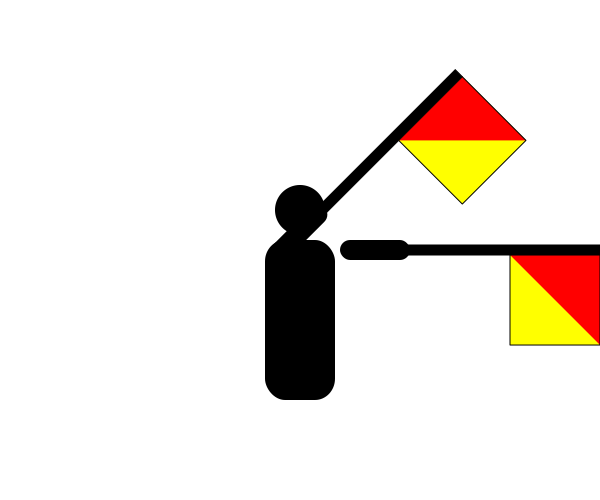
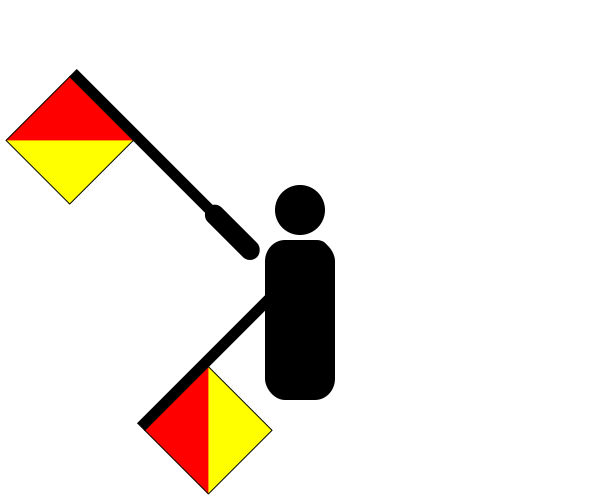
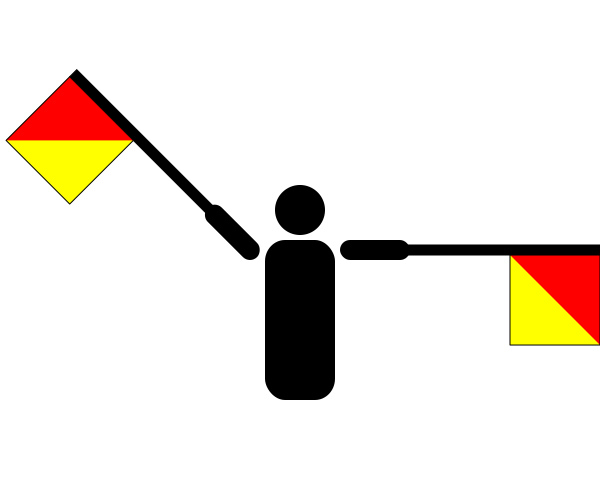
Semaphore


There are approximately 482 people named Wildey in the UK. That makes it one of Britain's least common surnames. Only around seven in a million people in Britain are named Wildey.
