WIGGINTON
Wigginton is an English habitational surname that originates from several places in the country, notably in the historic counties of Hertfordshire, Oxfordshire, Staffordshire and Yorkshire. The name was first recorded in documents such as the Hundred Rolls of 1273 and the Book of Fees of c.1307, demonstrating its establishment in the Middle Ages.
The etymology of the surname combines the Old English elements wic, meaning “dairy farm”, and tun, meaning “enclosure” or “settlement”. In certain instances the place names are derived from the personal name Wicga, a beetle, with the suffix ‑tun indicating a settlement; thus, the original meaning can be interpreted as “Wicga’s settlement”. Alternate derivations point to the Old English word wigan, meaning “dense wood”, coupled with ‑tun, giving a sense of a hamlet within a wooded area.
Examples of early holders of the name include Roger de Wygynton in the Hundred Rolls of Oxfordshire (1273), John de Widington in the Hundred Rolls of Lincolnshire (1273) and Samuel de Wygenton in the Book of Fees (c.1307). The first recorded spelling is that of Guido de Wygynton, dated 1273, mentioned in the same Hundred Rolls during the reign of King Edward I, known as "The Hammer of the Scots".
Throughout the late Middle Ages, greater mobility led individuals to adopt the name of their former village as a form of identification. This practice contributed to the wider dispersal of the surname across England. A notable example from the early modern period is Gyles Wigginton, who married Elizabeth Alport at St. Matthew, Walsall, Staffordshire on 28 October 1599.
Coat of arms traditionally associated with the Wigginton family features a silver shield with a bend between six black lozenges, a design that has been linked to the family in historic heraldic records.
The surname has evolved over time and exhibits numerous alternate spellings, including Wiggington, Wigington, Wiginton, Wigenten, Wiggenstein, Wigingtona, Wiggintona and Wigintonna. These variations arise from differences in medieval orthography and regional pronunciation.
In the 17th century, the surname crossed the Atlantic with Thomas Wigham, a lawyer and member of the Old Colony Club, who arrived in Plymouth Colony in 1630. Since that time, the name has spread throughout the United States, with the greatest concentrations recorded in the Appalachian states of Kentucky, Tennessee, Virginia and West Virginia.
Despite its presence in former British colonies such as Australia and Canada, and in the broader British Isles, the Wigginton surname remains relatively uncommon. Its continued usage is a testament to the persistence of English locational surnames and the enduring legacy of early medieval place names in modern identity.
Typical given names associated with the Wigginton surname
Male
- Andrew
- Clive
- Colin
- Darryl
- David
- James
- John
- Lee
- Mark
- Michael
- Paul
- Peter
- Richard
- Robert
Female
- Amanda
- Caron
- Glynis
- Hannah
- Helen
- Jane
- Janet
- Jennifer
- Joan
- Julie
- Pamela
- Rebecca
- Sarah
- Wendy
Similar and related surnames
Related and similar names are generated algorithmically based on the spelling, and may not necessarily share an etymology.
How to communicate the surname Wigginton in...
Braille
⠺⠊⠛⠛⠊⠝⠞⠕⠝
Morse
.--..--.--...-.-----.
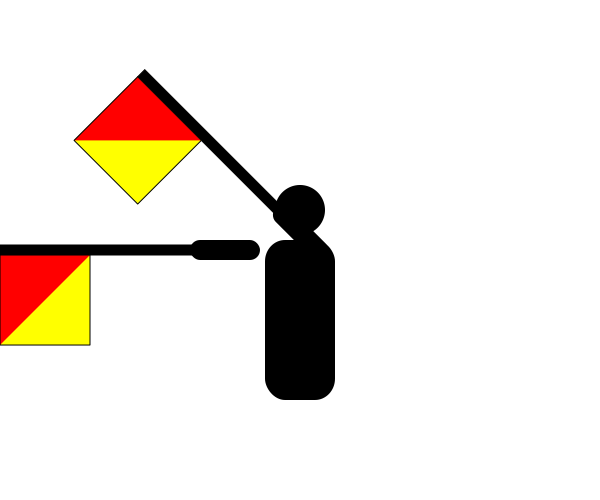
Semaphore
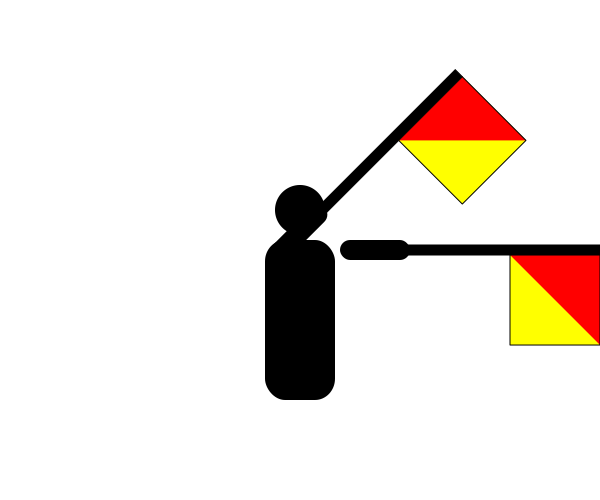
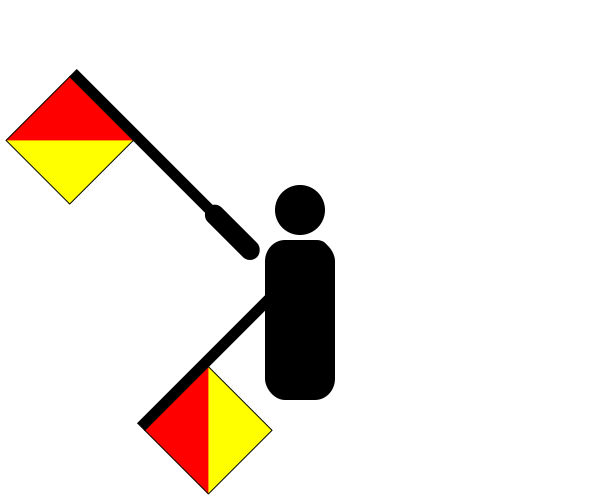

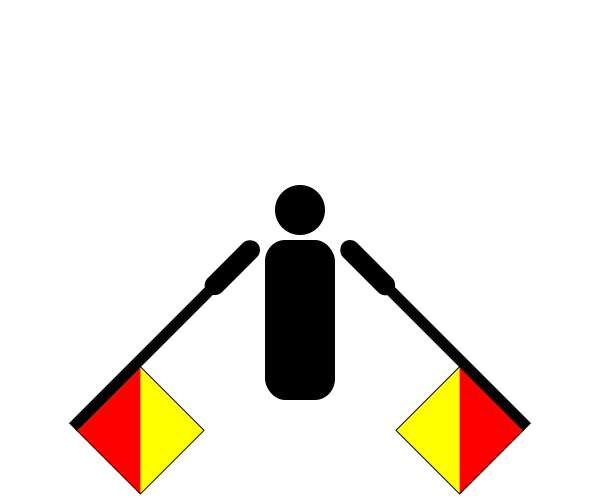
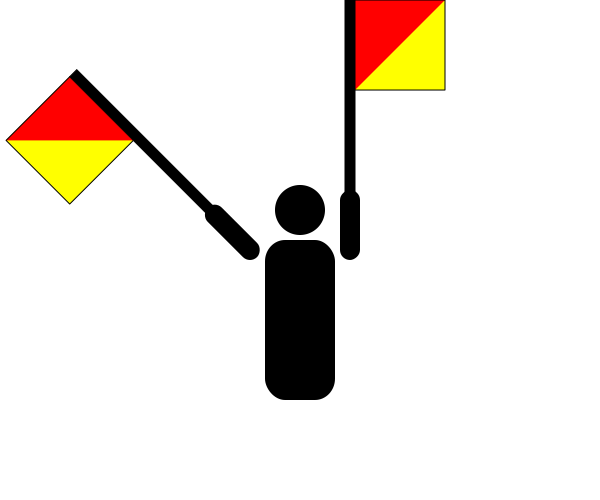
There are approximately 529 people named Wigginton in the UK. That makes it one of Britain's least common surnames. Only around eight in a million people in Britain are named Wigginton.

Famous people named Wigginton
- Nancy Wigginton - Broadcaster (1925 to 2019)
- Searson Wigginton - Cricketer (1909 to 1977)
Names and descriptions courtesy of Wikipedia, and may contain errors. This is not intended to be an exhaustive list of every famous person with this name.