WICKLIFFE
The Wickliffe surname is of English origin and is classified as a locational name, deriving from the Old English element wic, meaning a dwelling or settlement, combined with either lif, meaning life, or leah, meaning a woodland clearing. The village from which the name originates is located in West Yorkshire, at the foot of the White Cliff beside the River Tees.
The place name appears in the Domesday Book of 1086 under the form Witclive, an early spelling which translates as “the white cliff.” The limestone cliffs that give the area its name were well known to the surveyors of the period. The modern spelling Wickliffe first appears in records of the fourteenth century, although the family name was likely in use since the Anglo‑Saxon era.
Variations of the surname are frequent, reflecting the lack of standardised spelling until the early modern period. The recognised forms include Wickliff, Wicklif, Wycliffe, Wyclif, Wyclife, Wycliff, Wicliffe, Wykliffe, Wiclif and Wiclif. These variants are all traceable to the same geographic origin.
The most prominent early bearer of the name was John Wycliffe, a scholar of the University of Oxford who, as Master of Balliol College in 1361, became a catalyst of the religious reform movement in England. His accounts were critical of the excesses of the medieval church hierarchy, and he argued for a separation between temporal and spiritual authority and for the possibility of ignoring papal directives. In 1384 he died in London; in 1424 his body was reportedly disinterred and disposed of in the River Thames, a sanction attributed to his controversial views. Other medieval records mention John Whitcliv of Somerset in 1273, John de Wycliffe of London in 1379, and Johanna de Wyclaf in the Yorkshire poll‑tax rolls of 1379.
During the Middle Ages the surname was common across the British Isles, particularly in England, Scotland and Ireland. The name has a longer presence in the United Kingdom than it did in other English‑speaking countries, but in recent centuries it has become increasingly infrequent, primarily due to smaller family sizes and the tendency for modern families to alter or hyphenate surnames. Contemporary estimates suggest that around 7,500 individuals carry the Wickliffe surname in the United Kingdom and the United States combined.
In the United States the name is most frequently found in the Mid‑western states of Ohio, Michigan, Indiana and Illinois, especially in and around the town of Wickliffe, Ohio. The surname also appears in smaller numbers throughout the remainder of the country, as well as in Canada, Australia and New Zealand, where it remains relatively uncommon.
The Wickliffe surname, whether in its original or one of its many variants, thus represents a lineage grounded in an ancient English settlement, further distinguished by its association with an influential figure of the Reformation. Its continued, though declining, presence across several continents reminds present‑day bearers of their historical roots in a community whose name has endured for over nine hundred years.
Similar and related surnames
Related and similar names are generated algorithmically based on the spelling, and may not necessarily share an etymology.
How to communicate the surname Wickliffe in...
Braille
⠺⠊⠉⠅⠇⠊⠋⠋⠑
Morse
.--..-.-.-.-.-......-...-..
Semaphore
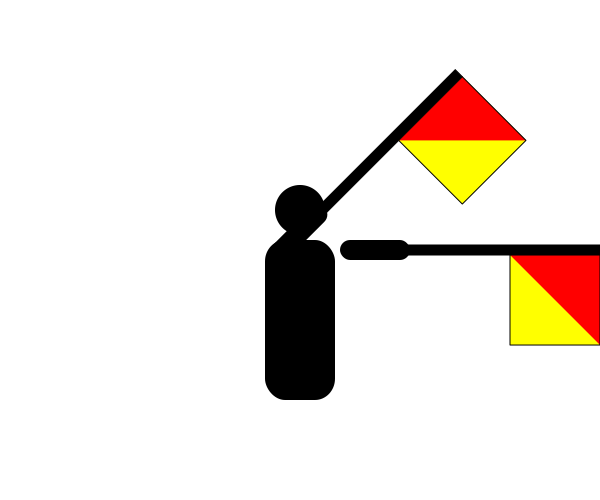
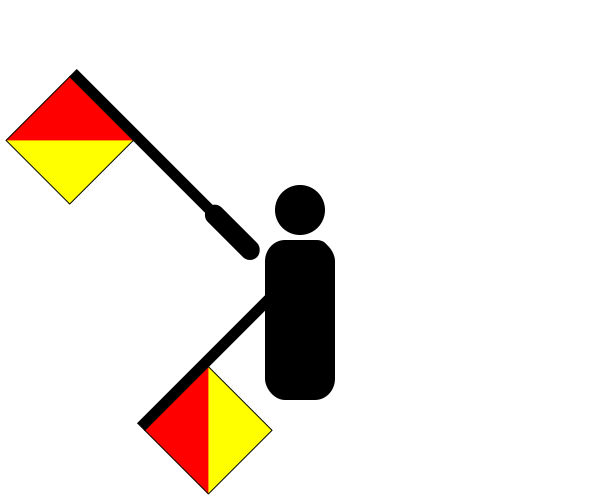

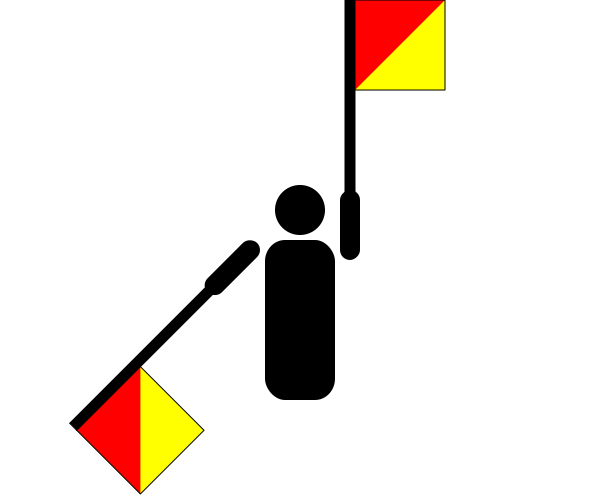

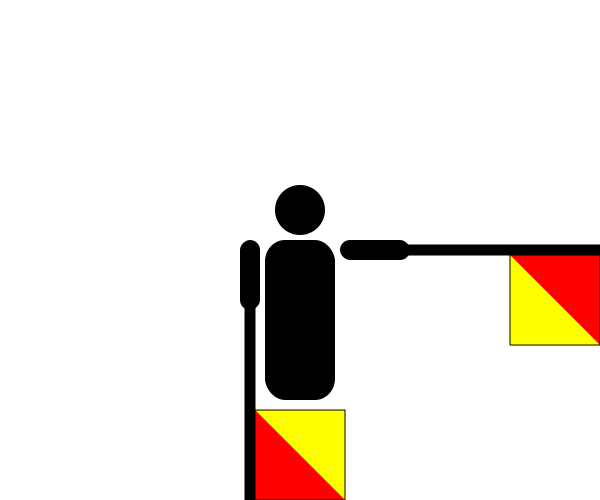

Sorry, we don't have any statistics on this name. That's probably because it's very uncommon in Britain.
