WICK
Wick is a surname of Anglo‑Saxon and Norse origin, first recorded in the British Isles during the Middle Ages. The name derives from the Old English word wic or the Old Norse word vik, both meaning a small settlement or a bay. These terms were used to describe communities situated near bodies of water where trade, fishing or farming took place.
The surname is conventionally understood as a locational identifier. It was adopted by individuals who lived at or adjacent to a wic, or whose occupation involved the management of a dairy farm or a water‑linked settlement. The Latin loan word vicus also contributed to the early sense of “outlying settlement dependant on a larger village.” In this way Wick encapsulates both habitation and occupation in a single name.
Historical documents provide a range of spellings that have survived into the modern day, including Weech, Week, Weeke, Weekes, Wich, Wych, Weetch, Wick, Wickes, Wicks, Wix, Wike, Witch, Wykes, and Whick. Early records mention figures such as Alueredus de Uuica of Somerset (1084), Goscelin del Wich of Worcestershire (1184), and Jordan de la Wike of Gloucestershire (1194). These attestations confirm the surname’s long‑standing presence in England.
In Scotland and Northern Ireland, the surname is particularly common. In England its concentration is strongest in Yorkshire, the North West Midlands and the Metropolitan centres of Manchester, Birmingham, and Liverpool. Outside the British Isles, sizable populations bearing the name are found in Canada, Australia and the United States, especially in Pennsylvania, Ohio, New York, Toronto, Vancouver, and Victoria.
Over the centuries, the spelling of the name has been influenced by local dialects and phonetic spelling. In East Anglia the name appears as Wyke or Wigg; in Northern England it is found as Widge; while in Dorset and Devon Wygge is not uncommon. Variants such as Wicken, Wicking, Wickon, and Wixon are occasionally recorded, often formed by adding a suffix to the core Wick.
The surname remains relatively common within the British Isles and abroad. Its dispersal mirrors the migratory movements of English and Scottish peoples, and it continues to be borne by many families worldwide today.
Typical given names associated with the Wick surname
Male
- Alan
- Christopher
- Darren
- David
- James
- John
- Martin
- Paul
- Peter
- Robert
- Stephen
- Steven
Female
- Carol
- Carole
- Caroline
- Emma
- Hannah
- Jennifer
- Joan
- Jodie
- Julie
- Mary
- Patricia
- Sarah
- Susan
Similar and related surnames
Related and similar names are generated algorithmically based on the spelling, and may not necessarily share an etymology.
How to communicate the surname Wick in...
Braille
⠺⠊⠉⠅
Morse
.--..-.-.-.-
Semaphore
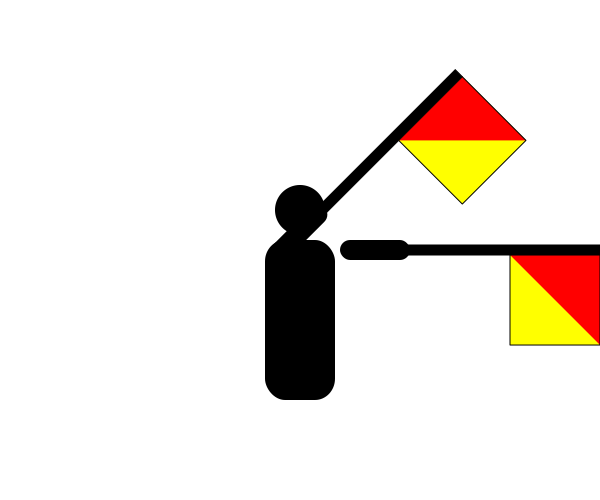
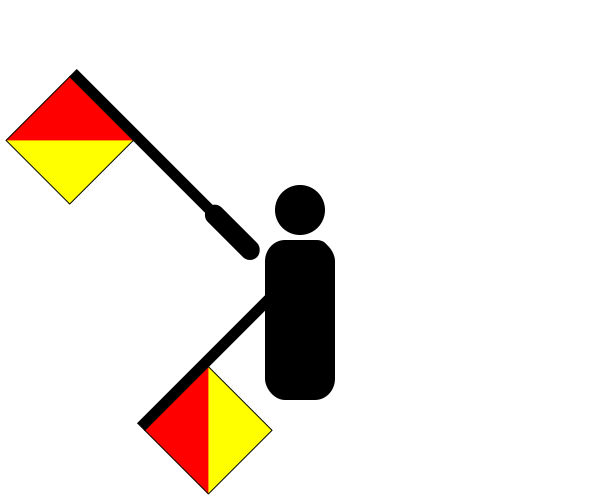

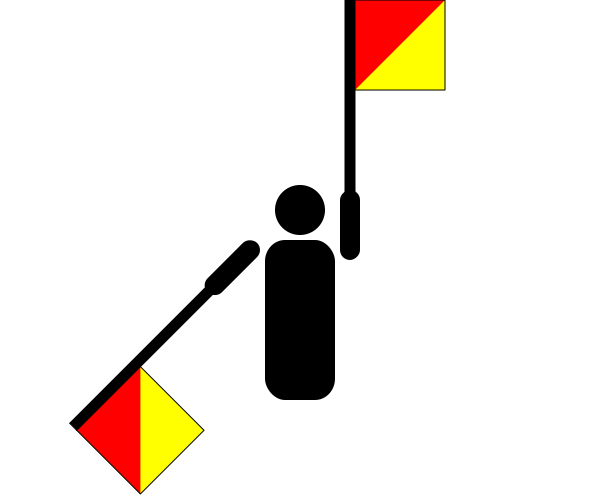
There are approximately 795 people named Wick in the UK. That makes it roughly the 8,813th most common surname in Britain. Around 12 in a million people in Britain are named Wick.
Origin: English
Region of origin: British Isles
Country of origin: England
Religion of origin: Christian
Language of origin: English
