WELLINGTON
Wellington is a locational surname of English origin, deriving from the place name Wellington. The name originates in the Old English elements wella, meaning a spring or stream, and tun, meaning an enclosure or settlement. Consequently, the surname has been interpreted as denoting “one who comes from the settlement by the spring or stream.”
Historical evidence shows that several English towns share this name, in Somerset, Hereford and Shropshire. The earliest recorded form is the pre‑7th century token Weolintun appearing in the Anglo‑Saxon Chronicles for the year 904, referring to the town in Somerset. The 1086 Domesday Book lists all three locations, each bearing the same descriptive meaning.
Early attestations of the surname include Johannes de Welinton of Devon and William de Welynton of Somerset, both mentioned in the Hundred Rolls of 1273. Later, James Wellington was recorded as a student at Oxford in 1581, and in 1661 he married Elizabeth Marriott at St James’ Church in Clerkenwell, London.
The name gained wider renown through the 18th and 19th centuries, most famously through Arthur Wellesley, 1st Duke of Wellington (1769–1852). Although his surname was Wellesley, it shared the same etymological roots as Wellington, both meaning “dweller by the spring at the farm.” Wellesley’s military success at the Battle of Waterloo in 1815 cemented the name in the national imagination, earning him the sobriquet “Iron Duke.” The Duke’s coat of arms is blazoned Quarterly: first and fourth, red, a silver cross between five plates in saltire; second and third, gold, a red lion rampant.
In contemporary usage, Wellington remains a common surname in the United Kingdom, occupying a position within the top five hundred families. The frequency is greatest in the capital, London, where migration and industrialisation have produced a dense concentration. Nationally, the surname is rank 48, reflecting a broad distribution yet modest pre‑industrial frequency.
Across the Atlantic, the surname is reasonably common. According to the United States Census Bureau, there are approximately 56,000 individuals bearing the name, placing it at rank 2,793 among nearly 90,000 surnames recorded. The distribution is correlated with historic migration patterns from Britain to America during the 19th and early 20th centuries.
In the Southern Hemisphere, the name appears at various frequencies. In Australia, Wellington is ranked 2,502 among the twelve thousand most common surnames, and notably it is the tenth most popular name among newly arriving immigrants. In South Africa, the name is rare, with fewer than five thousand bearers, the highest concentration found in the Eastern Cape. In New Zealand the name ranks 128th, and is the fifth most common surname among those of colonial English ancestry.
Variant spellings have existed throughout history. The surname has appeared in forms such as Welllington, Wellinton, Willington, Wilington, Wylinton, while related surnames like Welling, Wiling, Wyling, Wylyng reflect shared origins. Despite orthographic differences, these variations have typically been pronounced identically; the spelling differences arose from visual recording rather than phonetic change.
Beyond the realm of personal nomenclature, the name has served as a toponymic marker for numerous places worldwide. The capital of New Zealand, for example, bears the name, as does a city in the United States, several towns in the United Kingdom, and places in Canada and South Africa, a testament to the influence of British exploration and colonisation.
Because of its association with Arthur Wellesley, the surname has at times symbolised virtues such as courage, resilience, determination, and loyalty. These qualities, attached to the “Iron Duke,” have coloured contemporary perceptions of the name, imbuing it with a historical gravitas beyond its strictly locational origins.
In summary, the surname Wellington encapsulates antiquarian linguistic roots and a notable historical trajectory. Its endurance from early medieval records through imperial triumphs to modern global diaspora illustrates how a place name can evolve into a surname that carries both local and international legacy.
Typical given names associated with the Wellington surname
Male
- Anthony
- Christopher
- David
- John
- Mark
- Michael
- Paul
- Peter
- Richard
- Robert
- Stephen
Female
- Deborah
- Elizabeth
- Emma
- Jane
- Jennifer
- Julie
- Laura
- Lorna
- Margaret
- Patricia
- Rebecca
- Sandra
- Sarah
- Susan
Similar and related surnames
Related and similar names are generated algorithmically based on the spelling, and may not necessarily share an etymology.
How to communicate the surname Wellington in...
Braille
⠺⠑⠇⠇⠊⠝⠛⠞⠕⠝
Morse
.--..-...-....-.--.-----.
Semaphore
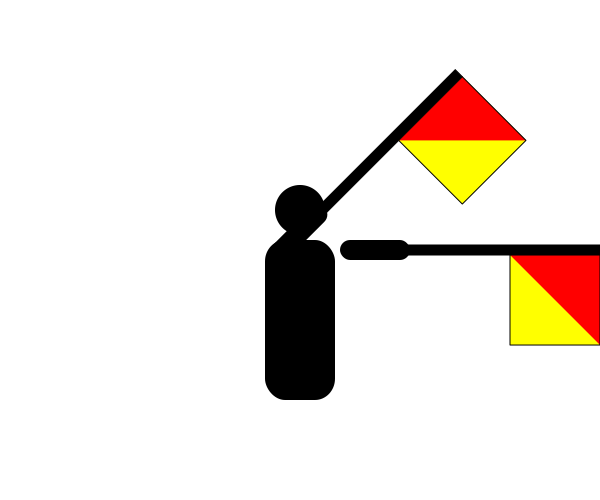


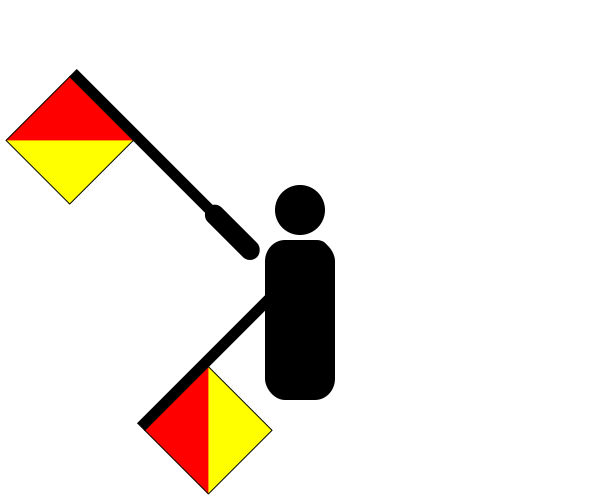
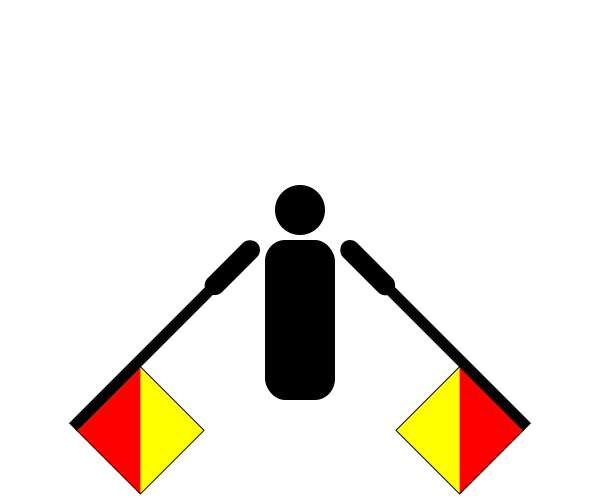

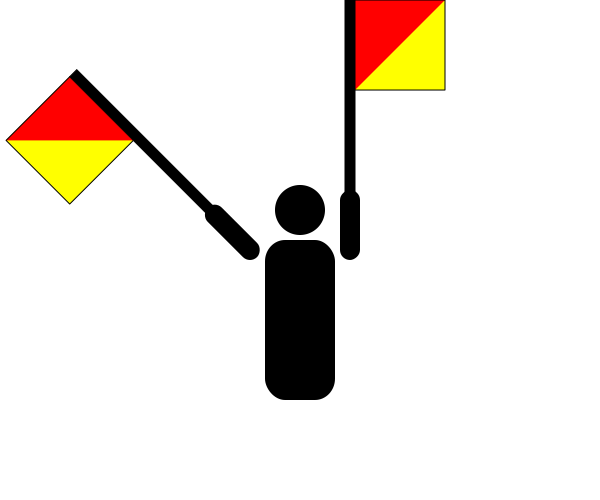
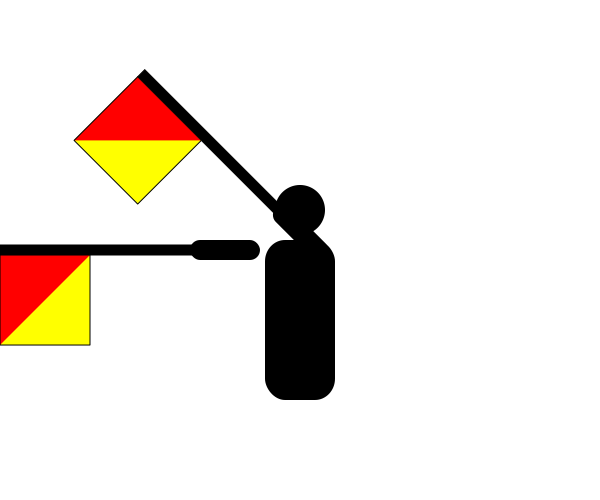
There are approximately 2,804 people named Wellington in the UK. That makes it roughly the 3,186th most common surname in Britain. Around 43 in a million people in Britain are named Wellington.
Origin: English
Region of origin: British Isles
Country of origin: England
Religion of origin: Christian
Language of origin: English

Famous people named Wellington
- Chrissie Wellington - Triathlete
- Calvin Wellington - Welsh rugby union and rugby league football player
- Ben Wellington - Cricketer
- Errol Wellington - Football player
- Margaret Wellington - Swimmer, Olympic athlete, British Empire Games silver medallist (1926 to 2015)
Names and descriptions courtesy of Wikipedia, and may contain errors. This is not intended to be an exhaustive list of every famous person with this name.