WEITZEL
The surname Weitzel is of unmistakably German provenance, with its earliest documented occurrences recorded in the early seventeenth century in the German states of Hesse and Bavaria. The form Weitzel is first attested in a christening witness list in Gross Felda, Oberhessen, dated 27 July 1623, belonging to a Johann Weitzek, a name variant that demonstrates the fluidity of spelling in that era.
Two distinct etymological explanations are supported by credible sources. One derivation traces the name to the medieval personal name Wido or Witold, translating as “wide ruler” or “ruler of the woods”. As a patronymic surname, it would have identified the descendants of an individual bearing that name. The alternative theory associates Weitzel with the Old High German noun weizen, meaning wheat, rendering it an occupational surname for a dealer or seller of wheat. In the Middle High German period, the term Weitzen signalled a wheat trader, a meaning that is also reflected in related surnames such as Weitzmann, Weitzen, Weitzenkorn and Weitzhandler.
Historical documents reinforce the occupational perspective. A junior record from 1470 mentions a Jung Hanss Weit zu Killer in German archives. Subsequent entries in 17th‑ to 19th‑century church registers illustrate the name’s geographic spread: the birth of Hans Kurt Weitzel on 7 July 1627 in Gross Felda, the departure of Adam Weitzel, aged 30, aboard the ship Hansa from Bremen bound for New York in 1863, and the birth of Catharina Freiderika Weitzek, daughter of John Henry Weitzel and Catharina Elizabeth Knight, at 1 Manor Terrace, Kilburn, London, on 29 October 1863. These records demonstrate that the surname was carried to continental Europe and to the British Isles during the late eighteenth and early nineteenth centuries.
By the eighteenth and nineteenth centuries, the community bearing the name had become established in North America, particularly within the Mid‑Atlantic and Midwest United States, where waves of German immigrants sought refuge from religious persecution and political unrest. The name has since been documented in Australia, notably in Melbourne, Brisbane and Sydney, reflecting further patterns of migration within the British Empire.
In heraldic tradition, a coat of arms has been associated with the Weitzel family. Recorded in Rietstap’s Armorial General, the shield is divided quarterly: the first and fourth quarters contain three gold crosses pattee set against a blue field, while the second and third quarters feature a silver bend wavy between two silver stars on a red field. This design encapsulates both the noble aspirations and the agricultural roots of the family.
The surname was also connected with a popular adage in the Middle Ages: “Gut Weitzel hat was gut zeit”, loosely translating to “a good Weitzel brings good time”, underscoring the perceived qualities of hard work, determination and honour associated with the name. This proverb contributed to a wider cultural perception of the Weitzel lineage as exemplifying a strong work ethic and good character.
Spelling variations have proliferated over the centuries, with documented forms including Weitsel, Weitzell, Vatzel, Wetzell, Weisel, Weissel, Weiszell, Weitschel, Wital, Witzel, Weitzeler, Witseler, Wieser, Weiser, Wease, Wieseler, Wecsel and Witse. These variants, while orthographically distinct, are generally recognised as belonging to the same genealogical lineage and share the same Germanic roots.
Today, the surname remains common in German‑speaking countries—Germany, Austria and Switzerland—particularly within the states of Bavaria and Hesse. It is also represented in the United States, Australia and across the wider European diaspora. The name continues to signify a proud heritage, linking individuals to a lineage rooted in German culture, agrarian occupation and a historical narrative of migration and resilience.
Similar and related surnames
Related and similar names are generated algorithmically based on the spelling, and may not necessarily share an etymology.
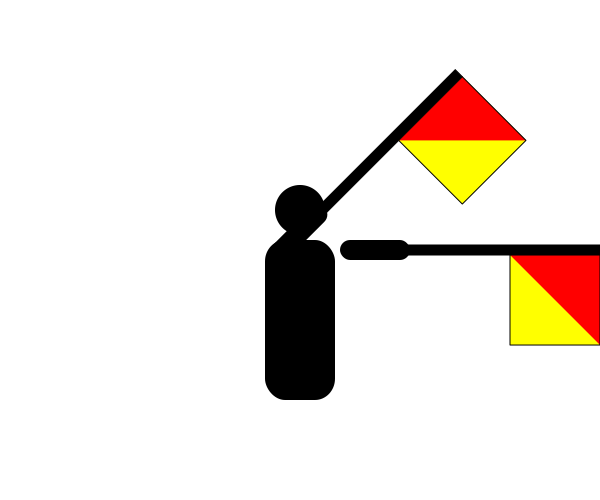
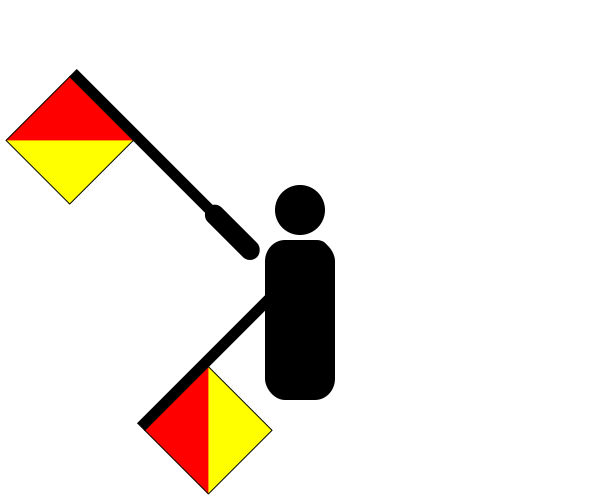
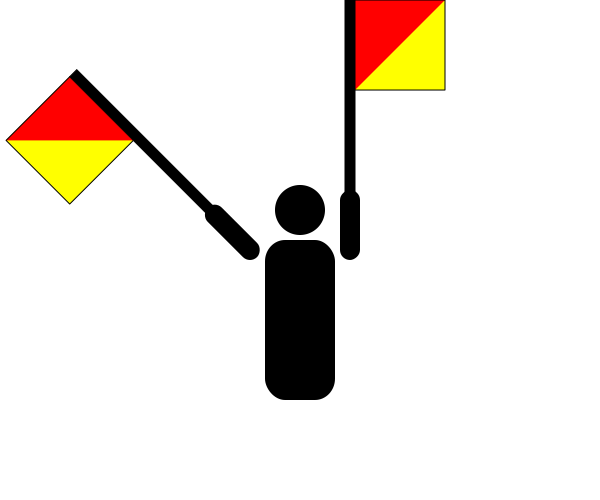
How to communicate the surname Weitzel in...
Braille
⠺⠑⠊⠞⠵⠑⠇
Morse
.--...---....-..
Semaphore



Sorry, we don't have any statistics on this name. That's probably because it's very uncommon in Britain.