WEIR
The surname Weir is of both English and Scottish provenance, whilst references to Old Norse linguistics also illuminate its antiquity. Its earliest attestations trace back to the mid‑thirteenth century within the British Isles, and the name persists in record to the present day.
Topographically, the name is believed to have originated from the Old English word wer, meaning a dam or fish‑trap, and the Old Norse term veir, denoting a wire or fence. Consequently, an individual who lived beside a dam or who maintained a fishing‑weir may have been designated by the collective noun that later evolved into the surname. An alternative etymology links Weir to the North English river known as the Wear, recorded in Ptolemy's “Geographina” as “Vedra”, a Celtic word simply meaning water. In this sense the name is purely locational, marking a dweller of the Wear valley.
Occupational as well as topographic explanations are supported by the ancient practice of naming bearers after their principal line of work. A fisherman or a fish‑trap constructor, for whom the maintenance of a weir would have been central, could have been nicknamed for the very tool of his trade. The nickname theory is also acceptable; the surname may have been applied to someone of a wiry or thin appearance, a figurative mirror of a weir’s slender construction.
The variety of historical forms—Wear, Were and Where—reflects the fluid orthography of the Middle Ages and the hones of English regional accents. Some of these variants appear in the Romanised forms of the name that survived in the Hundred Rolls, where John de la Were and Robert de la Were are recorded in 1273 in Oxford and Gloucestershire respectively. The Subsidy rolls of Sussex also exposit a John atte Wer in 1332.
An earlier and significant cognate is found in Norman records. Various locations in Calvados, Manche, Eure-et-Loire and Orne, all called “Vere”, are thought to contribute the Old Norse element Ver, again meaning dam. A 12th‑century genealogist records an individual named Ralph, or Radulphus de Ver, in the year 1174. In that entry Ralph or Radulphus de Ver is noted as taken prisoner at Alnwick, Scotland, alongside William the Lion during the reign of King William the Lion from 1165 to 1214.
Beyond the common derivations, the Weir surname is associated with a number of locally notable families. The Weirs of Blackwood, Lanarkshire, claim descent from the early holder Ralph; their lineage has been preserved through parish records and land deeds. Another figure of historical note is Thomas Weir (1600–1670), a major in the army and a strict covenanter. Though little is known of his military achievements, Thomas Weir is reputed to have possessed a magic staff and to have been executed with his sister for alleged sorcery.
The ecclesiastical affiliation of families bearing the surname has predominantly been Christian, with early mentions occurring in Gaelic-speaking Scottish communities. The social standing of these families varied over the centuries. In modern times, the surname remains most commonly found within Britain, but descendants are also present in Commonwealth countries, a testament to historical migration streams.
In sum, the surname Weir demonstrates a rich confluence of linguistic roots—Old English, Old Norse and Celtic—and illustrates the ways in which occupational, locational and descriptive elements coalesce in the formation of the English family name. Its documentation from the 12th century onwards provides a tangible link to Scotland’s and England’s shared heritage and the enduring significance of place‑based identities.
Typical given names associated with the Weir surname
Male
- Alan
- Andrew
- David
- George
- James
- John
- Michael
- Robert
- Thomas
- William
Female
- Anne
- Catherine
- Elizabeth
- Helen
- Jean
- Karen
- Margaret
- Mary
- Sarah
- Susan
Similar and related surnames
- Wier
- Wear
- Weare
- Wire
- Ware
- Wair
- Weer
- Wehr
- Waire
- War
- Weers
- Wears
- Wahr
- Warr
- Weary
- Were
- Wearr
- Weaire
- Wei
- Weire
- Weirs
- Weres
- Wero
- Werr
- Werra
- Werro
- Wers
- Wery
- Whear
- Wheare
- Wheer
- Wheir
- Wher
- Where
- Whier
- Whiers
- Whire
- Whur
- Whyer
- Wiers
- Wirr
- Wirz
- Woor
- Wore
- Worr
- Wurr
- Wyer
- Wyers
- Warre
- Wayre
- Wehrie
- Weier
- Werey
- Werry
- Weru
- Whare
- Whery
- Whurr
- Whyers
- Wira
- Wires
Related and similar names are generated algorithmically based on the spelling, and may not necessarily share an etymology.
How to communicate the surname Weir in...
Braille
⠺⠑⠊⠗
Morse
.--....-.
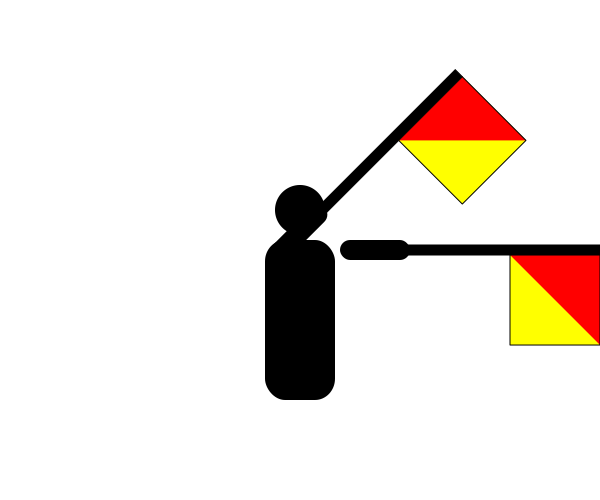
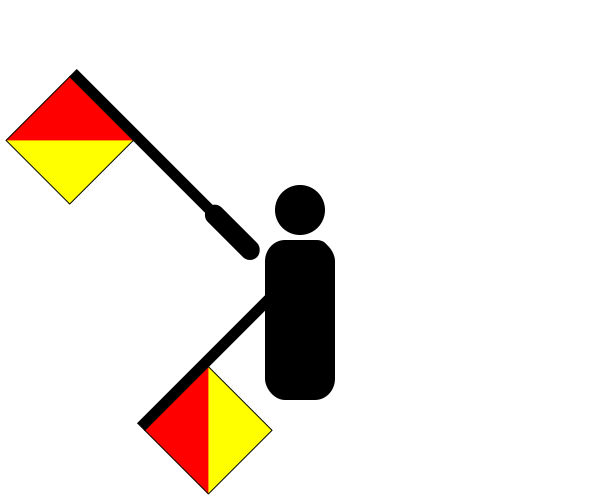
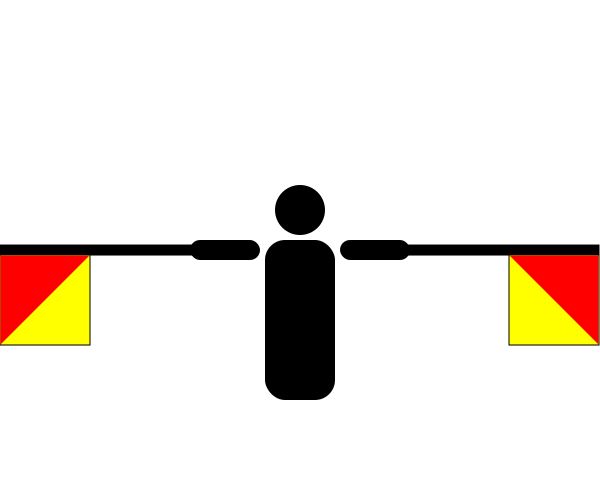
Semaphore

Did you know?
According to a survey carried out by Democracy Club, politicians and candidates with the surname Weir are most likely to say that their favourite biscuit is a Bourbon.
There are approximately 14,139 people named Weir in the UK. That makes it the 631st most common surname in Britain. Around 217 in a million people in Britain are named Weir.
Origin: Celtic
Region of origin: British Isles
Country of origin: Scotland
Religion of origin: Christian
Language of origin: Gaelic

Famous people named Weir
- Arabella Weir - Comedian, actress, writer
- Alison Weir - Historian
- Doddie Weir - Rugby union player and businessman from Scotland
- David Weir - Scottish football player
- Molly Weir - Scottish actress (1910 to 2004)
- Judith Weir - Composer
- James Weir - Football player
- Spencer Weir-Daley - Montserratian football player
- David Weir - Wheelchair racer
- Caroline Weir - Scottish football player
- Tom Weir - Tom Weir, author and broadcaster (1914 to 2006)
- Mark Weir - Martial artist
- Mike Weir - Politician
- Jim Weir - Scottish football player and manager
- Mickey Weir - Scottish football player
- Nick Weir - Television host
- Peter Weir - Northern Irish politician
- Jensen Weir - / Scottish football player
- John Weir - Scottish physician Royal (1879 to 1971)
- William Weir, 1st Viscount Weir - Viscount (1877 to 1959)
Names and descriptions courtesy of Wikipedia, and may contain errors. This is not intended to be an exhaustive list of every famous person with this name.