WEIN
Wein is a German surname which, in its original context, is derived from the Middle High German word wīn, meaning “wine”. Its earliest documentary mentions date back to the thirteenth century in both Germany and England, where it is understood to denote an individual engaged in the production, trade or sale of wine, or a tavern keeper. The usage of the term in medieval Germanic sources suggests that the name functioned as an occupational nickname, rather than a patronymic or locational identifier.
In a broader European perspective, the surname appears in numerous spelling variants across the continent. These include Vine, Vigne, Vyner (England), Lavigne, Devigne, Desvignes, Vinau, Vignaux, Vignault in France, Vingneri, Vignolo, Vignozzi, Vignone in Italy, and Vina, Vinas in Spain and Portugal. These variations point to an origin linked to the Latin word vinum, the ancient term for wine. Consequently, the surname is either topographical, describing someone who lived near or at a vineyard, or occupational, describing someone who produced or sold wine. In some cases, it is also linked to the personal name Vinea, an endearment meaning “sweet wine”.
Historical records support a multipolar distribution of the name in medieval Europe. The earliest identified mention of Robert de Vigne is found in the Latin rolls known as Liber Feodorum for Somerset, England, in 1236. Subsequent entries include Henry de la Vine (1263, London Register), Cunradus Winberg at Weinberg in Metzingen (1271), and Egkehard Weyne of Kassel, Germany (1420). Later registrants such as Isaie Vigneule, son of Els Vigneule, born at Baronviller, Moselle in 1584, and Marguerite Vignaux, who married Paul Tisseire at Belflou in 1795, illustrate the persistent presence of the name across French regions. These entries confirm that the surname, in its various spellings, was firmly established in both southern and central Europe by the late medieval to early modern period.
In Jewish communities, particularly among Ashkenazi Jews, the surname Wein has acquired a significant cultural importance. The role of wine in Jewish religious practice—from the kiddush to the Passover seder—has attached symbolic weight to the name. In addition, a Yiddish derivation of wein translates as “orphan”, hinting that some early bearers of the name may have been adoptees or left‑towards. Consequently, the surname carries both a professional and a communal resonance within those populations.
Present‑day distribution of the name remains largely concentrated in German‑speaking countries. In Germany, it is notably frequent in regions adjacent to the Rhine where viticulture has a long tradition. Austria and Switzerland also report substantial numbers of bearers, reflecting historical migration patterns and the relevance of wine production to those economies. Outside Europe, the surname can be observed in the United States and Canada, where immigration during the nineteenth and twentieth centuries introduced the name into urban and rural communities alike. In the United States, it is notably recorded in towns such as Wein in Illinois and in the south‑side of Kansas City, colloquially referred to as "Weinland". A considerable population of individuals named Wein can also be found in Miami, where records indicate over five hundred bearers.
Across the globe, the surname persists in Africa, particularly in South Africa, as well as in smaller numbers in Kenya and Ethiopia. Its spread is typically associated with modern migration and diaspora, rather than with the historical vocation of winemaking.
There is a rich array of derivatives and related surnames that share the root Wein. The most common is Weinberg, literally meaning "wine hill" or "vineyard". Other variants include Weinmann, denoting a man involved in wine production; Weinstock, implying ownership of a vineyard or stand of vines; and Weinreich, translating as "wine rich". Slightly less frequent forms such as Weingard, Weinglas, and Weinquart also appear, each maintaining an association with the viticultural domain. These surnames have disseminated in conjunction with the original, further emphasising the cultural weight of wine in both linguistic and societal structures.
Documentary evidence demonstrates that the Wein surname may appear in a context of legal or courtly occupation as well. In the Middle Ages, a term win occasionally described individuals involved in legal processes; however, the dominant interpretation remains that of a wine‑related occupation, consistent with the broader European pattern of associating surnames with craft or trade.
Courtiers and musicians in modern times have occasionally drawn inspiration from the name. For example, a classically trained composer produced an aria entitled "Wein", which was later performed by operatic singers. This reflects a continuing fascination with the name beyond its historical roots. Likewise, a New York City vineyard named its wine Wein in homage to the surname's origin, further illustrating how the name persists within contemporary cultural practice.
Similar and related surnames
Related and similar names are generated algorithmically based on the spelling, and may not necessarily share an etymology.
How to communicate the surname Wein in...
Braille
⠺⠑⠊⠝
Morse
.--...-.
Semaphore
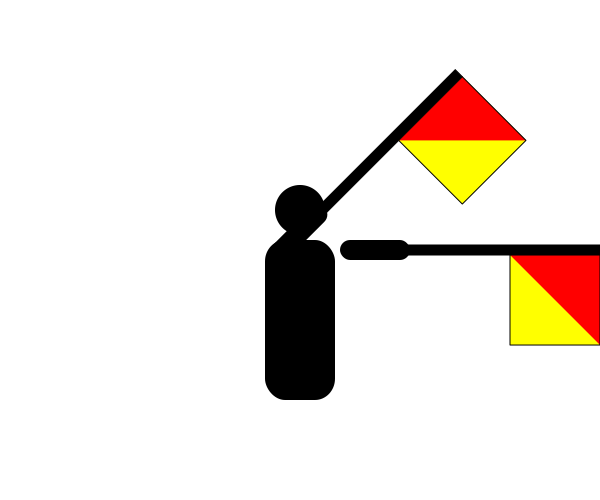

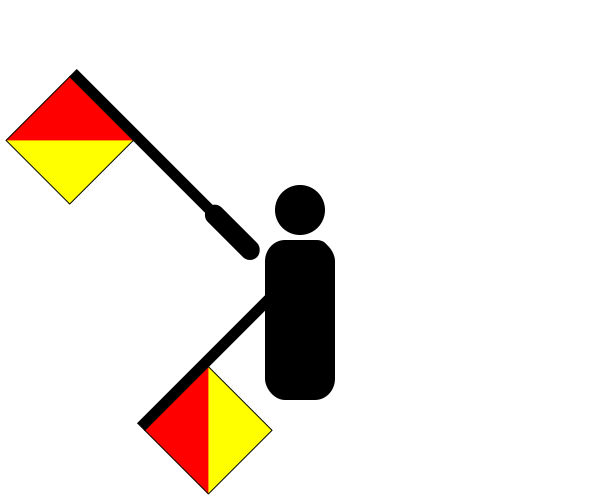
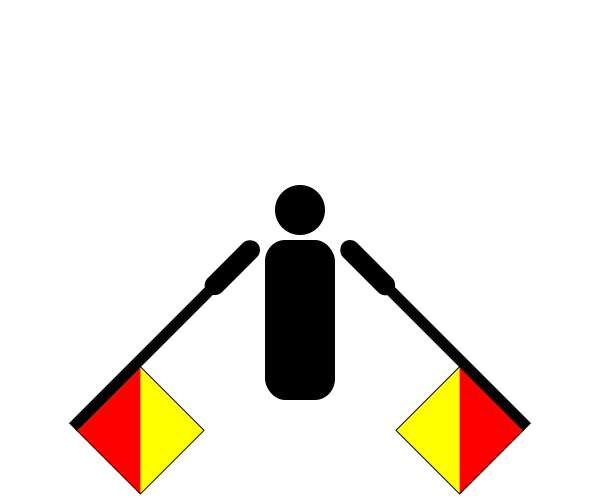
There are approximately 37 people named Wein in the UK. That makes it one of Britain's least common surnames. Only around one in a million people in Britain are named Wein.
Region of origin: Europe
Country of origin: Germany
Language of origin: German

Famous people named Wein
- Elizabeth E. Wein - American young adult novelist
Names and descriptions courtesy of Wikipedia, and may contain errors. This is not intended to be an exhaustive list of every famous person with this name.