WEHNER
The surname Wehner is of German origin and is classed as an occupational name. According to linguistic evidence the name is derived from the Middle High German noun wehner, a word that has been interpreted in various scholarly studies as meaning either “one who laments” or “one who hunts”. Both meanings reflect a specific role in medieval society, either as a person noted for sorrowful complaint or as a huntsman or forester who carried out a vital economic activity.
Historical records first document the name in the early sixteenth century, with entries such as a Simon Mueller married to an Atterna Wagner in Zeitz, Sachsen in 1589, and a wedding record of Alexander Wagen in 1571. The earliest spelling found in medieval archival material is that of Conrad Wegener dated 1290, which appears in the Schontal registers of Germany carried out during the reign of Emperor Rudolf I.
The surname has acquired many orthographic variants over the centuries, a consequence of the numerous German dialects and the lack of standardised spelling in the medieval period. Common forms include Wagner, Wagen, Wegner, Weagener and Wagnerin. Less frequent spellings appear in the records as Wehnerin, Wohner, Wainier and Wannar. The Dutch adaptation Van Wagenen is associated with early settlers in America, notably Geertie Van Wagenen, who was christened in Kingston, Ulster County, New York in 1686.
In contemporary times the surname remains most common in Germany, where it is especially frequent in the federal states of Bavaria, Brandenburg and Slesia. In Switzerland it is ranked eighth among all surnames, and there is a noticeable presence of the name in Austria. Patterns of migration have seen the name appear in the United States, with concentrations in Illinois, California and Pennsylvania. The name also occurs in Israel, where it is regarded as a Jewish surname of Germanic heritage and is sometimes classed alongside the Yiddish surname Weiner because of shared etymological roots.
The heraldic traditions associated with the name are varied, reflecting the multiple occupational origins that are attributed to it. A prominent coat of arms found in the German arms registers displays a gold wheel on a blue field, a motif traditionally linked with the profession of wheelwright or vehicle maker. Other heraldic records describe a deer standing before an evergreen forest set against black and gold colours, symbols evocative of the hunting heritage of the name.
Throughout history the Wehner name has been borne by individuals in diverse fields. In sporting circles Max Wehner, an amateur boxer from Germany, is noted for his achievements in the early twentieth century. Moreover, several civil servants, craftspeople and merchants in medieval Germany carried the name in official court and church documents, testifying to its widespread use across occupational classes.
In sum, the surname Wehner is firmly rooted in German linguistic and cultural history, with documented origins as early as the thirteenth century. Its multiple meanings—ranging from lamentation to hunting—and its proliferation across Europe and the Americas are reflected in the variety of spellings, geographic dispersal and heraldic traditions that accompany the name. Each element of the surname’s record offers insight into the social roles, migratory movements and linguistic diversity that characterised Germanic societies for centuries.
Similar and related surnames
Related and similar names are generated algorithmically based on the spelling, and may not necessarily share an etymology.
How to communicate the surname Wehner in...
Braille
⠺⠑⠓⠝⠑⠗
Morse
.--.....-...-.
Semaphore
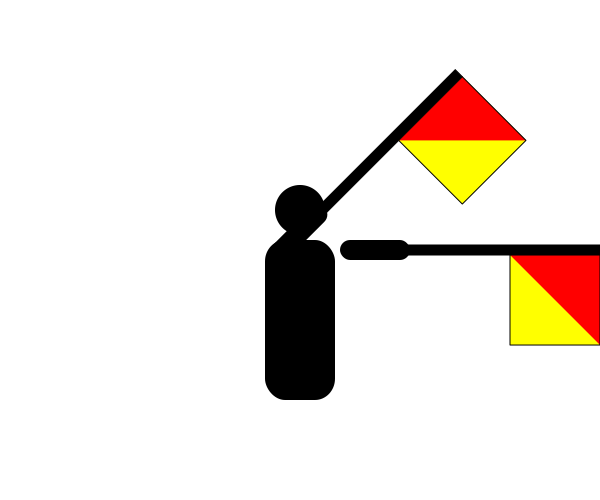


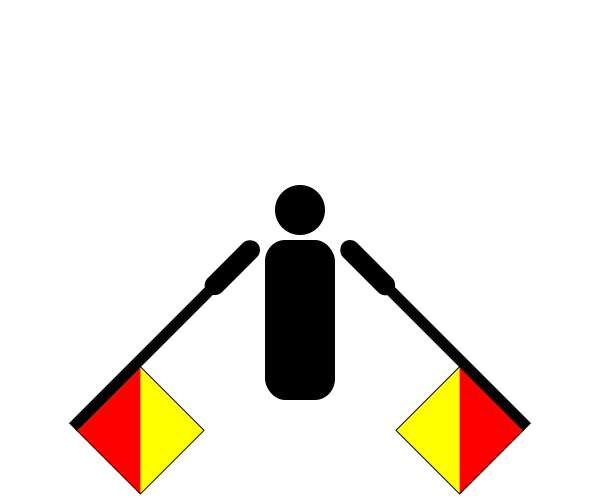
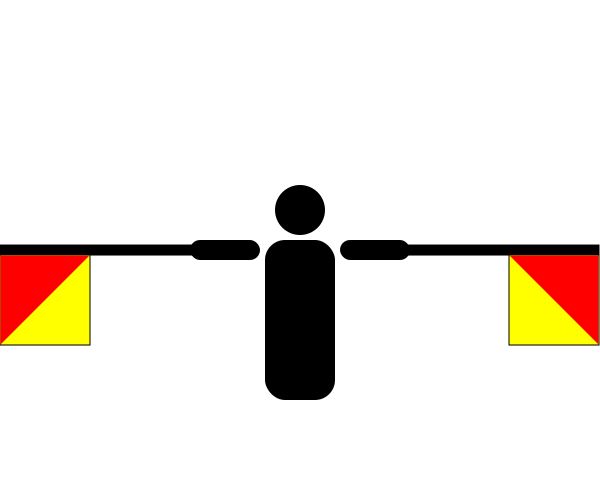
There are approximately 46 people named Wehner in the UK. That makes it one of Britain's least common surnames. Only around one in a million people in Britain are named Wehner.
