WEEKLEY
The surname Weekley is of *English* origin and is classified as a *locational* surname. It is believed to derive from the village of Weekley, situated near Kettering in the county of Northamptonshire. The place name itself is formed from the Old English elements wic, meaning a dairy farm, and leah, denoting a clearing in the woods or a meadow. Consequently, the surname can be understood to signify “dweller at the dairy farm in the clearing” or, more broadly, someone who inhabited or worked upon a specialised dairy farm in that area.
Historical references to the place name are extremely early. The name appears in the Saxon gazetteer known as *Cartulium Saxoni* for the year 843 AD, nearly at the commencement of written English history. In the Domesday Book of 1086 the spelling is recorded as “Wiclei”, which is interpreted as “the enclosure, leah, amongst the elms”. The continuity of the name from the 9th to the 11th century, and its thread through subsequent records, underscores its antiquity.
The surname itself surfaced in the modern era in several spellings, including Weakley, Weekely, Weekley and Weekly. Early instances in the seventeenth and early eighteenth centuries include the marriage of Anne Weekely to Thomas Reyner in Bedford in 1647, and that of Thomas Weekly to Jane Brown at St George’s Chapel, Hanover Square, London, in 1702. These records confirm that the name was in use by that period and that it was worn by individuals of recognised standing.
Variations of the surname are numerous and largely stem from differences in orthographic conventions over time and across regions. Known variants include Weakley, Weekely, Weekly, Wickley, Weckley, Wyckley, Wycliffe, and Wykely, among others. The replacement of the vowel e with i or the loss of e entirely reflects attempts to ease pronunciation and adapt the name to local accents.
Geographical concentration of the surname within the United Kingdom is strongest in the North West. Approximately the highest densities are found in the county of Lancashire and the metropolitan borough of Merseyside, especially within the Pendle area. Significant, though less dense, populations exist in Yorkshire, Hampshire, and parts of Wales, such as Flintshire. Outside the United Kingdom, the name is comparatively rare; there are nevertheless modest numbers of Weekleys residing in the United States and other countries.
Relatively specialised, the Weekley surname remains a clear example of how medieval families identified themselves through place of origin or occupation. Its enduring presence in parish registers, civil documents and land charters attests to a long tradition of continuity. The linguistic analysis of its components, combined with the documented distribution, provides a reliable and comprehensive understanding of this historically rooted surname.
Typical given names associated with the Weekley surname
Male
- Benjamin
- Colin
- Darren
- Derek
- James
- John
- Mark
- Martin
- Michael
- Rhys
- Robert
- Royston
- Timothy
- William
Female
- Alison
- Christine
- Clara
- Denise
- Helen
- Janet
- Jean
- Joan
- Joanne
- Michelle
- Sandra
- Sarah
- Sharon
Similar and related surnames
Related and similar names are generated algorithmically based on the spelling, and may not necessarily share an etymology.
How to communicate the surname Weekley in...
Braille
⠺⠑⠑⠅⠇⠑⠽
Morse
.--..-.-.-...-.--
Semaphore
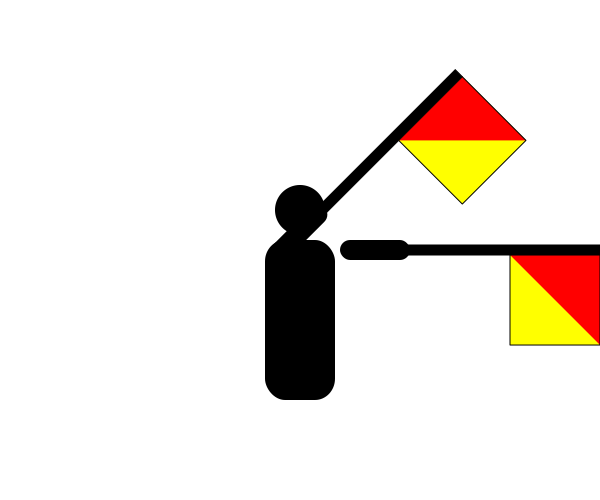

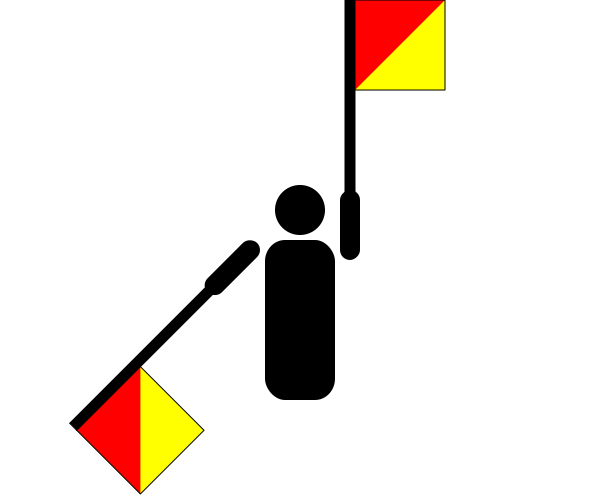

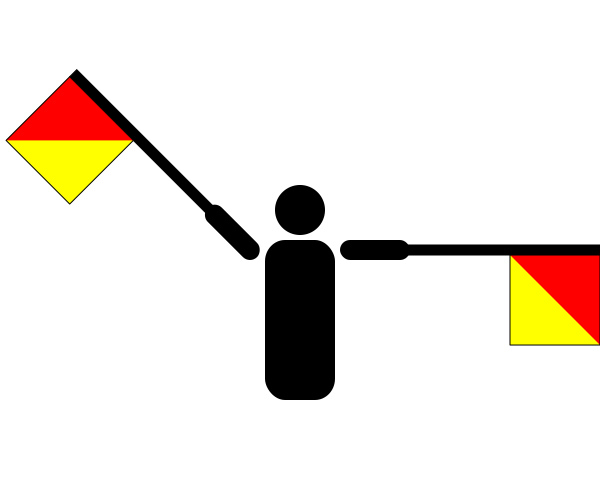
There are approximately 192 people named Weekley in the UK. That makes it one of Britain's least common surnames. Only around three in a million people in Britain are named Weekley.
Origin: English
Region of origin: British Isles
Country of origin: England
Religion of origin: Christian
Language of origin: English