WEDDELL
The surname Weddell is of English origin and is situated within the broader context of Anglo-Saxon nomenclature. It first appears as a patronymic in the medieval record, derived from the Old English personal name Wadda or Wada, each meaning “huntsman” or “hunter.” The suffix -ell indicates “son of,” so the name in its earliest usage signified a individual who was the son of a huntsman or a person associated with hunting activities.
In addition to the patronymic explanation, Weddell also has a Scottish locational dimension. The name is linked to the lands of Wedale, the original name of the parish of Stow in Midlothian. Early documents mention bearers such as Stephen de Wedale, a charter witness to a hospital in 1221, and Thomas de Wedale, a canon of St. Andrews recorded in 1280. The surname spread within Scotland under various spellings, including Waddel, Waddell, Waddle, Weddel, Weedall, Weddell, Wedle and Woddell, reflecting regional orthographic practices of the time.
From an Anglo‑Saxon perspective, the name is also thought to be locational, derived from wella, an Old English word meaning “well” or “spring.” In this view, Weddell would denote “one who dwells by the spring or stream.” Place names such as Weddell in the North Riding of Yorkshire support this theory, suggesting that the original bearers of the surname resided near such springs or streams.
Contemporary distribution of the surname remains heavily concentrated in the UK. In England, clusters can be found in Norfolk and Kent, with Norwich in Norfolk being a notable hub. In Scotland, the name is recorded in smaller numbers in Angus and Aberdeen. Across Ireland, the surname occurs in Cavan and Fermanagh, with adjacent counties of Leitrim, Monaghan, Donegal and Tyrone also showing occurrences. Outside the British Isles, the name appears sporadically in continental Europe—particularly in Germany, Austria, Switzerland, Poland and the Czech Republic—and in former colonies such as the United States, Canada, Australia and New Zealand, usually within migration flows from Europe.
There exist several recognised variants of the surname, all retaining a close phonetic and etymological relationship. These include Weddle, Wedel, Wiedel, Wadell, Wedwell and Weddellson, among others. Some, such as Wedle and Wedsel, stem from the Middle English wedel, meaning a rod, sceptre or staff of authority, and therefore carry an occupational connotation. Other variants reflect regional linguistic influences; for example, Weddmann and Wiedelmann are Germanised forms, while Wadley derives from Middle English wade, meaning “village or low‑lying land,” combined with the suffix ‑ley. These derivations illustrate how a single root name can diversify across languages and regions while preserving a core identity.
Among those who have borne the name, James Weddell stands out as a notable bearer. A British sailor and seal hunter active in the early nineteenth century, his exploratory voyages in the Southern Ocean led to the naming of the Weddell Sea in his honour. This association provides a tangible link between the surname and a specific geographic feature, underscoring how individuals with the name have contributed to wider historical and cartographic records.
Typical given names associated with the Weddell surname
Male
- Alan
- Andrew
- Christopher
- David
- James
- John
- Mark
- Michael
- Peter
- Robert
- Thomas
- William
Female
- Angela
- Ann
- Carol
- Caroline
- Christine
- Eleanor
- Elizabeth
- Georgina
- Laura
- Margaret
- Marie
- Rebecca
- Sarah
Similar and related surnames
Related and similar names are generated algorithmically based on the spelling, and may not necessarily share an etymology.
How to communicate the surname Weddell in...
Braille
⠺⠑⠙⠙⠑⠇⠇
Morse
.--.-..-....-...-..
Semaphore
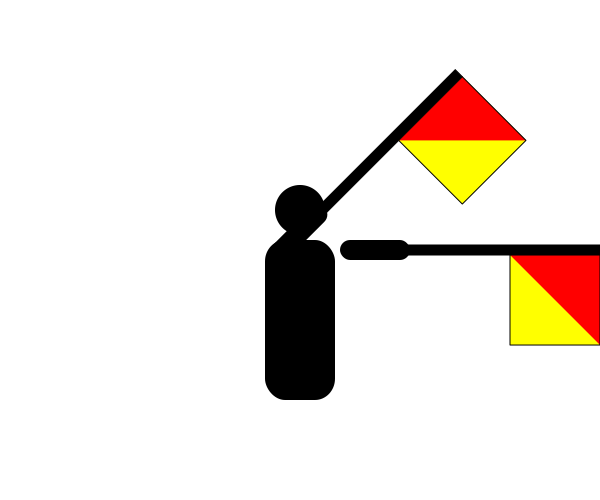


There are approximately 852 people named Weddell in the UK. That makes it roughly the 8,375th most common surname in Britain. Around 13 in a million people in Britain are named Weddell.
Origin: English
Region of origin: British Isles
Country of origin: England
Religion of origin: Christian
Language of origin: English
