WEBER
The surname Weber originates from Germany, where it is routinely encountered as one of the most frequent family names. It is a direct derivation from the Middle High German word wëber, meaning “weaver”. The occupational nature of the name reflects the prominence of the weaving trade throughout medieval Europe, when the production of cloth was a major economic activity in German territories.
Historical records show a variety of early spellings, including Webar, Weber, Webor, and Webermann. These forms demonstrate regional orthographic differences and the evolution of written German during the High and Late Middle Ages. The name is closely related to a group of English surnames such as Weaver, Webber, Webster, and Webb; all are occupational surnames describing a person who worked with yarn or cloth. The English cognates are derived from the Old English verb webbe, which means “to weave”.
Documentary evidence of the surname dates back to at least the mid‑13th century. In 1255, a John le Webber appears in the Fines Court Rolls of Sussex, England, during the reign of King Henry III. The first Germanlically recorded instance is that of Heinricus Weber, a burgess of Basel, Switzerland, in the year 1290. Further examples include Hensli Webermann, a citizen of Freiburg, who is mentioned in the city’s charters in 1472. In the early nineteenth century, a notable bearer was William Henry Weber (or Webber), who worked as an editor of plays and served as secretary to Sir Walter Scott in Edinburgh in 1804.
The widespread distribution of the surname today is largely a consequence of migration and emigration from German-speaking regions. As German communities settled across Europe and North America, the name travelled beyond its country of origin and acquired local variations. In contemporary society, it remains a common surname not only in Germany but also in countries such as the United Kingdom, the United States, Canada, and Australia, where descendants of German emigrants have established long‑standing families.
In summary, Weber is an occupational surname rooted in the medieval craft of weaving, with historical attestations spanning from seventeenth‑century England to late fortieth‑century Germany. Its evolution in spelling and its translation into cognate English surnames illustrate the linguistic interconnection between Germanic and Anglo‑Saxon cultures during the Middle Ages. The name continues to be widely used and recognised across linguistic and national boundaries today.
Typical given names associated with the Weber surname
Male
- Andreas
- Anthony
- David
- Franklyn
- James
- John
- Karl
- Mark
- Michael
- Paul
- Richard
- Stephen
- Thomas
- Trevor
Female
- Anna
- Caroline
- Christine
- Helen
- Joan
- Julie
- Mary
- Rachel
- Stephanie
- Susanne
Similar and related surnames
Related and similar names are generated algorithmically based on the spelling, and may not necessarily share an etymology.
How to communicate the surname Weber in...
Braille
⠺⠑⠃⠑⠗
Morse
.--.-.....-.
Semaphore
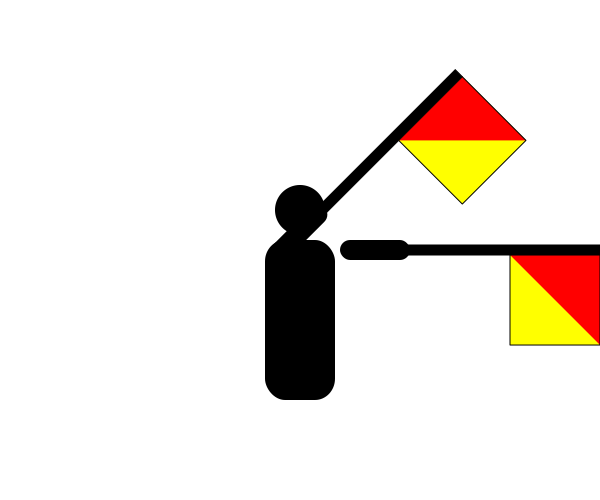

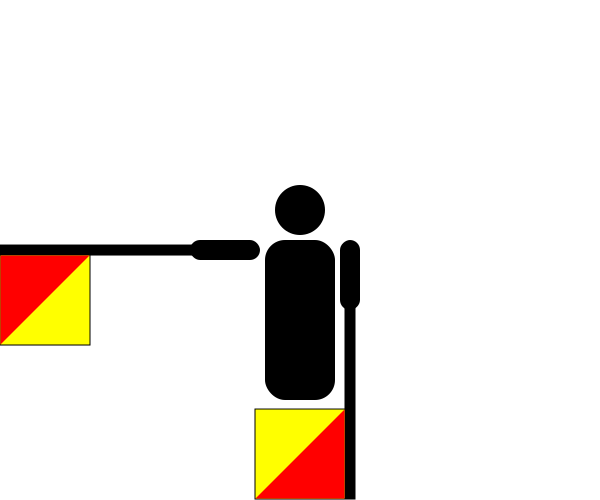
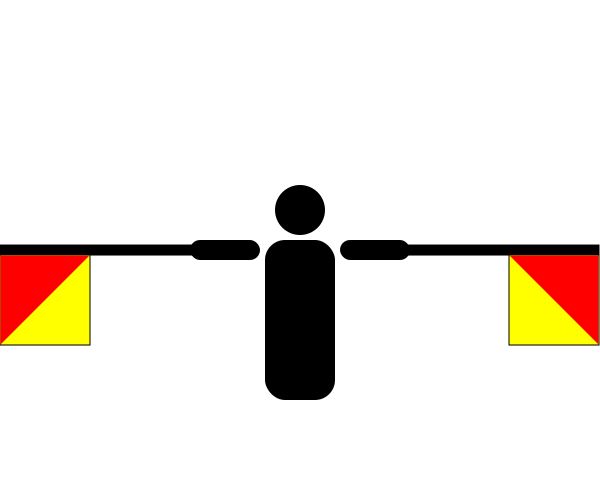
There are approximately 1,449 people named Weber in the UK. That makes it roughly the 5,500th most common surname in Britain. Around 22 in a million people in Britain are named Weber.
Region of origin: Europe
Country of origin: Germany
Language of origin: German

Famous people named Weber
- Jake Weber - Actor
- Max Weber - German sociologist, philosopher, and political economist (1864 to 1920)
- Charlie Weber - American actor
Names and descriptions courtesy of Wikipedia, and may contain errors. This is not intended to be an exhaustive list of every famous person with this name.