WAYT
Wayt is a surname of English provenance, originating from the Old English word waite, signifying a watchman or guard. The name was originally borne as an occupational identifier for individuals tasked with keeping watch or guarding specific locales.
The etymology of the surname can also be traced to a French influence following the Norman Conquest of 1066. Derived from the word guait, the surname was applied predominantly to watchmen within fortified towns. Over subsequent centuries the spelling and pronunciation evolved, giving rise to a variety of forms such as Waite, Waith, Weight, Waight, Whate, and Whayte.
Early documentary evidence records the name in various shapes. The earliest known appearance is that of Roger le Wayte in 1221 within the County Records of Suffolk, during the reign of King Henry I. Subsequent entries include the christening of Francis Weight on 11 March 1631 at St. Olave's Church in London, and the marriage of Henry Wayte and Elizabeth Jefferes on 8 July 1639 at St. Dunstans in East Stepney.
The occupational role of a Wayt is exemplified in medieval literature, where watchmen were sometimes also musicians. A reference from Geoffrey Chaucer’s “Le Morte d’Arthur” (1485) mentions a watchman, or “wait”, who shepherded the townsfolk upon the walls.
In modern usage, the surname has numerous spelling variations—over fifteen have been identified—reflecting linguistic shifts and regional dialects across England. The extended list includes Waite, Wayt, Weight, Waight, Whate, Whayte, Wight, Waith, and Waid, among others.
Geographically, the surname is most prominent in the United States, with 548 recorded instances according to the 2018 U.S. Census Bureau data. It is chiefly concentrated in the Southern states—Tennessee, Alabama, Missouri, and Kentucky—particularly within the Southern Appalachian Mountain region. Outside North America the name appears in smaller numbers in Canada and New Zealand, and it remains present in England, Germany, and Wales.
Additional scholarly discussion suggests that the name may have an Anglicised Welsh–Gaelic origin, derived from “Wight” or “Vanderwight”. This form would have been introduced to England during the early Anglo‑Saxon settlement period of the fifth century, possibly reflecting a noble family loyal to Welsh kings.
The surname Wayt is therefore a rare and historically rich family name. Its multitude of spellings and extant records reveal a long tradition of cultural exchange, migration, and occupational designation that has spanned from medieval England to contemporary societies across the globe.
Typical given names associated with the Wayt surname
Male
- Alexander
- Andrew
- David
- Francis
- Graham
- James
- Karl
- Mark
- Paul
- Peter
Female
- Alexa
- Elizabeth
- Ellen
- Emma
- Jennifer
- Margaret
- Michelle
- Sarah
- Susan
- Teresa
Similar and related surnames
Related and similar names are generated algorithmically based on the spelling, and may not necessarily share an etymology.
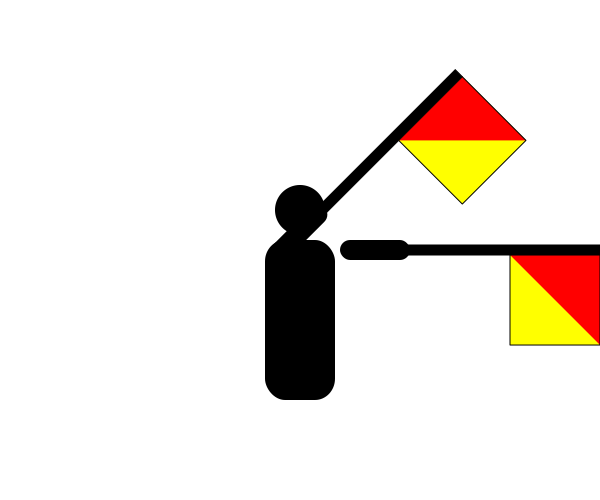
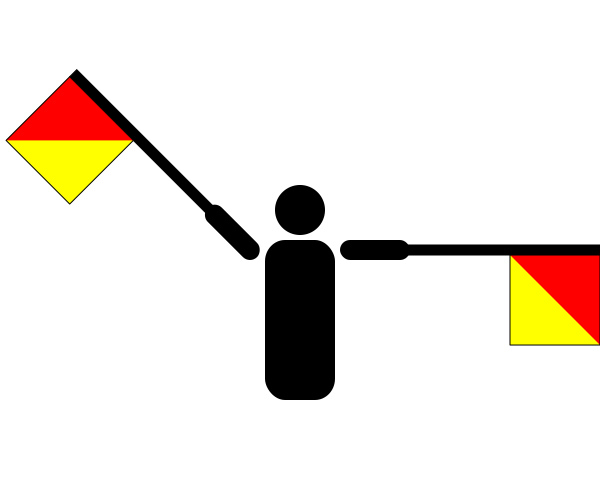
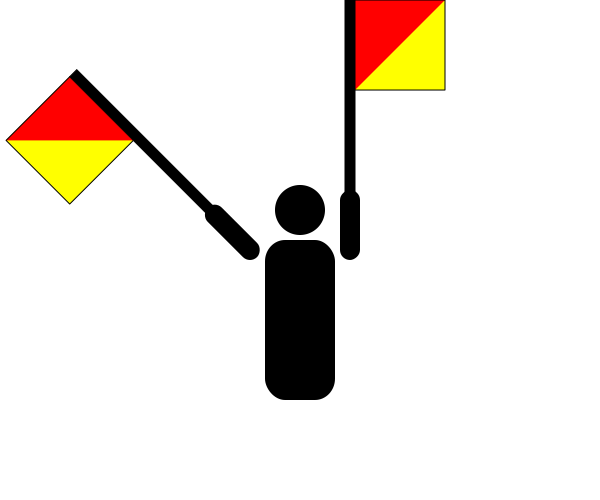
How to communicate the surname Wayt in...
Braille
⠺⠁⠽⠞
Morse
.--.--.---
Semaphore

There are approximately 146 people named Wayt in the UK. That makes it one of Britain's least common surnames. Only around two in a million people in Britain are named Wayt.
