WALLES
Walles is an English surname whose origins lie in the Old English word weall, meaning a vertical structure of stone or brick. It is therefore normally understood to be a topographic name, applied to a person who lived near a prominent wall or who was associated with the construction of such walls. A second, Arabic less frequent, theory posits that the name derives from the Old English waella “spring wall”, indicating a dwelling by a watery wall or a spring that was enclosed by masonry. In either case the surname could equally have arisen as a nickname for one perceived to possess the strength and solidity of a wall.
During the 12th century the surname appears in a number of English records. In 1156 the Book of Seals of Warwickshire records Osbert Waleis, and in 1168 the Pipe Rolls of Norfolk name Robert Walleis. The first mention in Scotland occurs in 1190 when Richard Waleis witnesses a charter relating to Kelso Abbey, pointing to an early presence of the name on the English‑Scottish border.
Another set of evidence recognises Walles as a variation of the Norman French name walais, which was itself a loan from the Latin whaler and conveyed the sense “foreigner”. This interpretation is supported by the ancient designation walensis for inhabitants of the old kingdom of Strathclyde, a region which extended into the contemporary border counties that now belong to both England and Scotland. The influence of the Norman Conquest of 1066 introduced many such surnames, including those that would eventually evolve into the modern spellings of Wallis, Wallace and Walles.
Among the most celebrated bearers of the related name is Sir William Wallace (1272‑1305), the Scottish patriot who led the resistance against Edward I of England. Although his surname is commonly rendered as Wallace, historical documents acknowledge the variant Waleis in the period of his life, and the surname remains a subject of study for those interested in the fluid nature of medieval orthography.
The modern distribution of the surname reflects the movement of families from the British Isles to the wider Anglosphere. In the United Kingdom the name is most frequently found in Scotland and in the Irish border counties, as well as in England and Wales. In Canada the surname is largely concentrated in Ontario and British Columbia; in Australia it is common in Victoria, New South Wales and the Australian Capital Territory. The United States Census records show the name in states such as North Carolina, Pennsylvania and Virginia, with its earliest appearances dated to the colonial era of the 1700s.
In addition to the spellings Walles, Wallace, Wallice and Wallis, the surname has yielded a number of related variants including Wallas, Waleis and the anglicised Walashon. Each form is recognisable as indicating the same ancestral heritage, despite the occasional change in orthography over centuries of documentation.
In conclusion, the surname Walles encapsulates a lineage that crosses linguistic and geographical boundaries. Its roots in the Old English description of walls or springs, its identification as a foreigner in Norman France, and its survival through medieval records into contemporary usage, together demonstrate the rich tapestry of history that underpins a single family name.
Typical given names associated with the Walles surname
Male
- Andy
- Barry
Female
Similar and related surnames
Related and similar names are generated algorithmically based on the spelling, and may not necessarily share an etymology.
How to communicate the surname Walles in...
Braille
⠺⠁⠇⠇⠑⠎
Morse
.--.-.-...-......
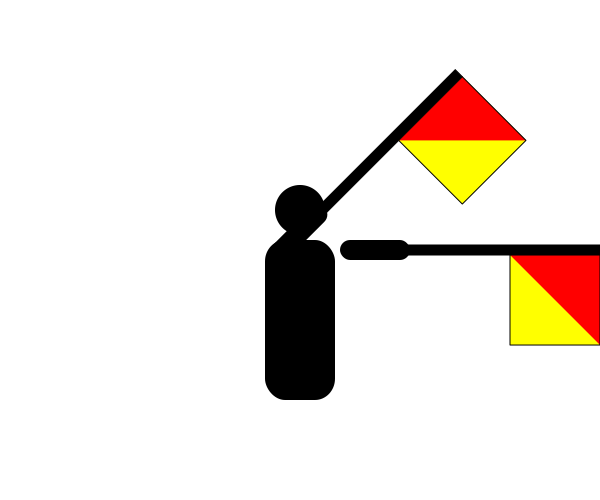
Semaphore


There are approximately 83 people named Walles in the UK. That makes it one of Britain's least common surnames. Only around one in a million people in Britain are named Walles.
