WAGG
The Wagg surname is a distinct English family name that traces its roots to the British Isles. It is a feature‑based surname that emerged in the medieval period and has persisted largely within the United Kingdom.
The earliest known derivation of the name comes from the Old English verb wagian, which means “to shake” or “to move to and fro.” As a nickname it was likely applied to someone of a lively or restless disposition, a character trait that was noteworthy in the small communities of early England and which eventually became hereditary.
Another possible source of the name is the pre‑7th Centuriege wag, meaning “to shake with laughter.” In this sense the surname could have been reserved for a jovial or jolly person. Yet a third possibility links it to the personal names Wag, Wig, Wigod and Wigot, which itself may translate as “war‑god” from the elements wig (war) and god (god or perhaps good). The name Wigot is recorded in the Domesday Book of 1086 in Sussex, Bedfordshire and Berkshire, whereas Wigod appears in Devonshire, indicating that the Christianised personal names were in use until the fourteenth Century when they began to give rise to surnames.
The surname first enters documentary evidence in the twelfth Century. The earliest surviving instance is that of John Wiget in the Pipe Rolls of Worcestershire, dated 1180 during the reign of Henry II (1154‑1189). The name appears in other contemporaneous sources, such as John Wagg of Yorkshire in the Hundred Rolls of 1273 and Henry Waget of Lincolnshire, also in 1273. Church records from the Elizabethan and Stuart eras record individuals such as John Waggat of Farnham, Surrey (christening, 13 July 156), Thomasen Wagg buried at St James, Clerkenwell, London (9 December 1607), and John Waggitt who married Margarett Bowring at Berwick‑upon‑Tweed, Northumberland (13 October 1656). The first known emigrant bearing the name to America is Thomas Waggitt, aged 17, who left London aboard the ship Thomas and John bound for Virginia in 1635.
During the medieval period the name was recorded in several variants: Wagg, Wagge, Waggatt, Waggett, Waggit, Waggot and Waggott. These forms reflect regional spelling practices and the lack of standardised orthography. The diminutives Waggatt and Waggett are particularly attested in the south of England, while Waggit and Waggott appear more frequently in the north.
In contemporary times the surname remains uncommon and is predominantly found within the United Kingdom. Its rarity has meant that the name has preserved many of its early forms and that detailed genealogical records can be traced back several centuries. The persistence of the Wagg surname offers a valuable window into the linguistic and social history of early modern England, illustrating how personal characteristics and place‑based identities were codified into family names that endure to the present day.
Typical given names associated with the Wagg surname
Male
- Andrew
- Christopher
- David
- James
- Jeremy
- Matthew
- Michael
- Peter
- Philip
- Richard
- Robert
- Stephen
- Thomas
Female
- Alison
- Caroline
- Catherine
- Janet
- Joanne
- Karen
- Kathryn
- Margaret
- Mary
- Sarah
- Sheila
- Susan
- Victoria
Similar and related surnames
Related and similar names are generated algorithmically based on the spelling, and may not necessarily share an etymology.
How to communicate the surname Wagg in...
Braille
⠺⠁⠛⠛
Morse
.--.---.--.
Semaphore
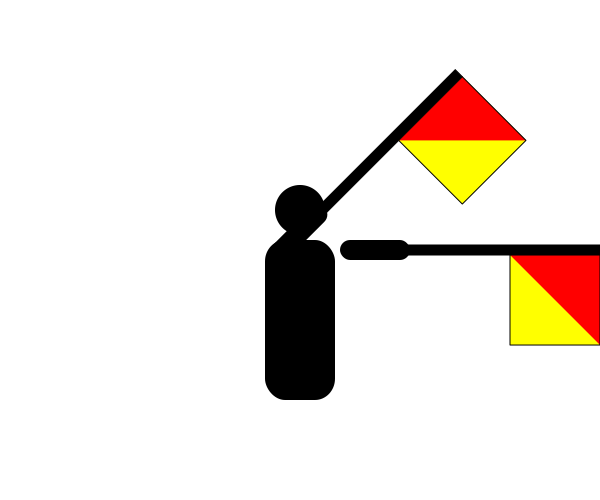


There are approximately 1,246 people named Wagg in the UK. That makes it roughly the 6,229th most common surname in Britain. Around 19 in a million people in Britain are named Wagg.
Surname type: Location or geographical feature
Origin: English
Region of origin: British Isles
Country of origin: England
Religion of origin: Christian
Language of origin: English

Famous people named Wagg
- Graham Wagg - Cricketer
Names and descriptions courtesy of Wikipedia, and may contain errors. This is not intended to be an exhaustive list of every famous person with this name.