VINT
The surname Vint is recognised as having an English origin, with its earliest documented usage in the British Isles. It is typically classified as a topographic surname, indicating a person who lived in proximity to a marsh or fen.
This particular derivation comes from the Old English word fenn, which means ‘marsh’ or ‘fen’. The use of the name would have thus served to describe an individual who resided near or worked within a wetland area. In this context, the surname functions purely as a geographic identifier without any known occupational connotation beyond the setting itself.
Alternative etymologies have also been proposed. One suggests that the name may be of Norman‑French provenance, with early forms such as Vinter, Vintor, or Winter recorded in medieval documents. According to this line of inquiry, the name could be a metonymic reference to a keeper of a vineyard, though the evidence remains unproven. The earliest surviving references include a Saxon record of Saulefus Vineter at Oxford in 1170 and a later mention of Richard le Vyntener in Lancashire in 1327.
Several documented matrimonial entries highlight the name’s persistence through the early modern period. In 1592, a baptism record for Anthony Vynt appears at St. Giles Cripplegate; in 1611, Mary Vent married Robert Ashby at St. Bartholomew The Less; and in 1622, Margaret Vint married George Tayler at St. Martin in Vintry, London. The first definitive spelling of the family name is attributed to Elizabeth Vinte, who married Thomas Wingar at Tottneham Church, London in 1589 during the reign of Queen Elizabeth I.
In contemporary demographic records, the surname is relatively common in English‑speaking countries. The 2000 United States census identified over 2800 individuals bearing the name in the southern states of Texas, Tennessee, Georgia, and Alabama, with additional concentrations in Mississippi, Virginia, Kentucky, and North Carolina. In the United Kingdom, England and Wales maintain a frequency of more than 450 cases per million people, while Scotland records slightly less than 300 per million. Canada shows a frequency exceeding 800 per million, whereas Australia and New Zealand each record around 300 per million. Smaller populations also exist in South Africa, Germany, and Poland.
Other etymological explanations link the name to the Latin verb vincere ‘to conquer’, through the personal name Vincent. This perspective accounts for a variety of spelling variants observed in historical and modern records, including Vint, Vynt, Vent, Vently, Vented, Vont, Vant and Vaunt. In non‑English contexts, the surname appears adapted to local orthographies, for example as Väntz in German and Austrian dialects, or Wint in Dutch. Incidental combinations with other surnames occasionally produce forms such as Hawthornvint or Vintington.
Typical given names associated with the Vint surname
Male
- Alan
- Andrew
- Charles
- David
- George
- James
- John
- Michael
- Richard
- Robert
- William
Female
- Amanda
- Angela
- Ann
- Catherine
- Clare
- Debbie
- Elizabeth
- Helen
- Louise
- Margaret
- Mary
- Susan
- Wendy
Similar and related surnames
Related and similar names are generated algorithmically based on the spelling, and may not necessarily share an etymology.
How to communicate the surname Vint in...
Braille
⠧⠊⠝⠞
Morse
...-..-.-
Semaphore
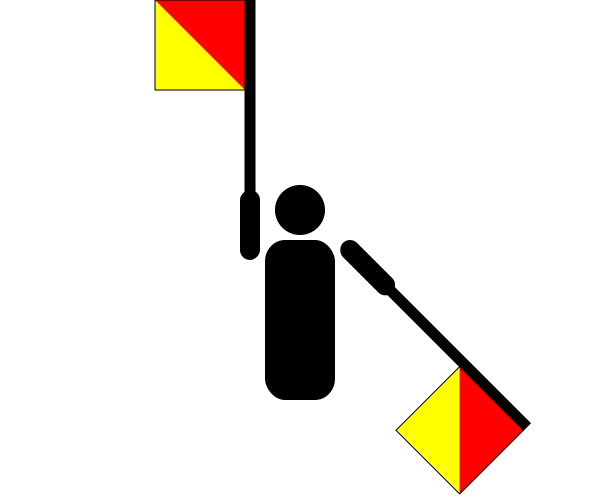
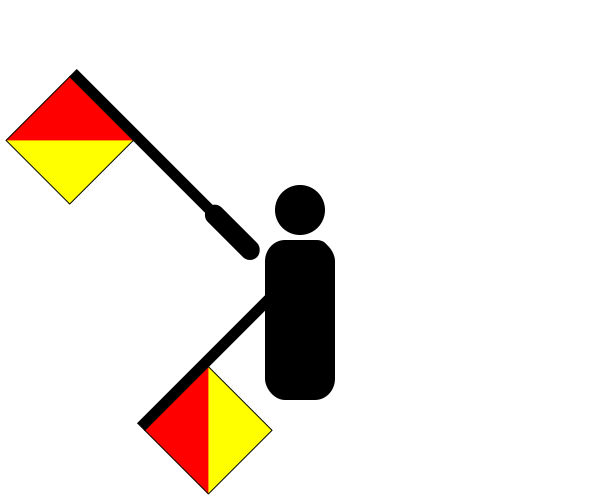
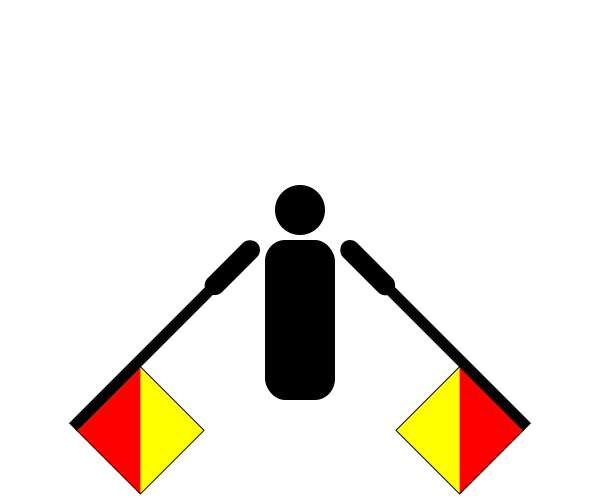
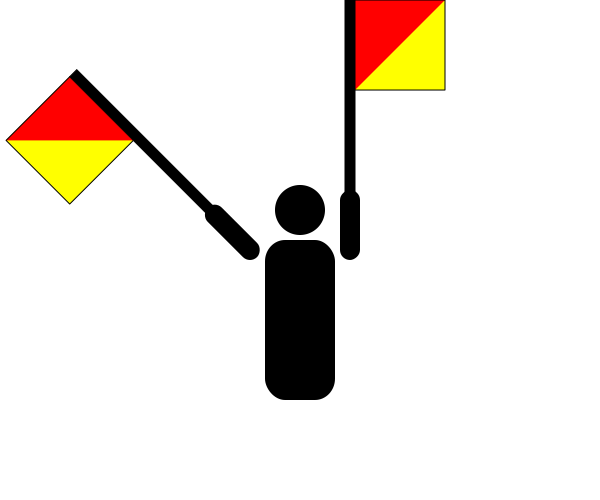
There are approximately 593 people named Vint in the UK. That makes it one of Britain's least common surnames. Only around nine in a million people in Britain are named Vint.
Origin: English
Region of origin: British Isles
Country of origin: England
Religion of origin: Christian
Language of origin: English

Famous people named Vint
- Rebecca Vint - Ice hockey player
Names and descriptions courtesy of Wikipedia, and may contain errors. This is not intended to be an exhaustive list of every famous person with this name.