VINK
Vink is a surname of Dutch and Frisian origin, the word vink in the Dutch language meaning “finch”. The name is traditionally understood to be either a toponymic designation – given to someone who lived near a place where finches were common – or an occupational identifier for a person who bred, sold or otherwise dealt in finches, the small, colourful bird celebrated for its song. The tradition of assigning surnames derived from occupation or natural surroundings dates back to the Middle Ages, when people were often distinguished by a notable feature of their lives or environment.
Historical records show the surname appearing in a number of variant forms. Germanic clerks and record‐keepers noted spellings such as Fink, Fincke, Finker, Vinck and Vinker in German provincial documents; the Swiss and Dutch archives record Vink and Vincke; Romanian registers contain Finicj; and English accounts record Finch. This diversity of orthography is typical of medieval nomenclature, where spelling was largely phonetic and individual clerks wrote names as they heard them.
The earliest extant entries referring to a bear of the name, or variations thereof, appear in several significant European documents. Gilbert le Finch is recorded in the Curia Regis rolls of Norfolk, England, in 1205. A year later, Walther Vinck is noted in the city of Zurich, Switzerland, in 1225, and Johannes Finck is mentioned in Freiburg, Germany, in 1322. These entries indicate that individuals bearing the name or its cognates were established across different parts of Europe well before the Norman period. The first confirmed spelling of a cognate surname, that of Godric Finc, is dated to 1049 in the Old English Byname Register and links the name with England during the reign of King Edward the Confessor.
In the Dutch heartland, the surname was adopted by families as a distinctive marker of identity in the late Middle Ages. The symbol of the finch, regarded as a charming bird, was adopted for heraldry by some lineages. A surviving coat of arms belonging to the Vink family depicts an arm holding a finch; the crest is interpreted as a representation of loyalty, fertility and courage, attributes associated with the bird. Such heraldic devices were used in Europe to signify social standing and familial heritage, and they serve today as a reminder of the long lineage of those who carried the name.
In the modern era the surname remains most prevalent in the Netherlands. Official civil registration records, maintained by the Dutch government, currently record roughly 40,000 people bearing the name, constituting about 0.4 % of the national population. The majority of these individuals live in the provinces of Noord‑Holland and Zuid‑Holland, with notable clusters also in Gelderland and Utrecht. In Belgium the surname is also found, particularly in the Flemish region. An estimate places the number of people with the surname in Germany at several thousand, mainly in North‑West Elbe and Lower Saxony, reflecting historical migration patterns within the Germanic linguistic sphere.
Outside Europe, the name was carried by Dutch and Flemish emigrants to North America in the 18th and 19th centuries. In the United States the surname is now fairly common in the Mid‑Atlantic states, especially New York and Pennsylvania, where there are more than 11,000 bearers. The total number of people in Canada with the surname is roughly 500, with about 70 % living in British Columbia and Ontario. In other nations the frequency of the name is much lower; Norway has only a few hundred holders, Australia fewer than 200, and if it does appear it is usually in the form of a record from early colonial settlement or immigration logs. In all these occurrences the spelling remains unchanged due to the relatively high stability of the Dutch name.
Researchers tracing Dutch ancestry should be mindful of the full spectrum of orthographic variants that could appear in historical documents. The list includes Van Vinken, Van Vincke, Van Vyncke, Van Wyngen, Van Winkle, Winke, Wink, Wynke, Winki and Minke. Common clerical errors, such as Vnick, Vwnk and Vnican, are also reported, and any comprehensive search of genealogical records should consider these possibilities. By consulting a range of civil, church, tax and military archives across the Netherlands, the United States, Canada and other speaking Dutch areas, a reliable picture of the genealogical lines associated with the surname can be assembled.
Similar and related surnames
Related and similar names are generated algorithmically based on the spelling, and may not necessarily share an etymology.
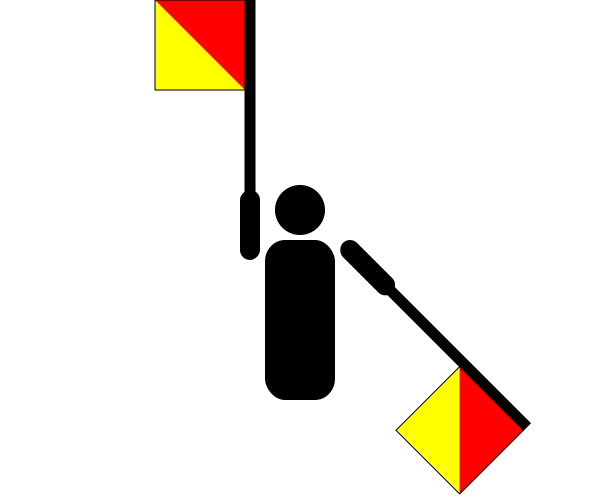
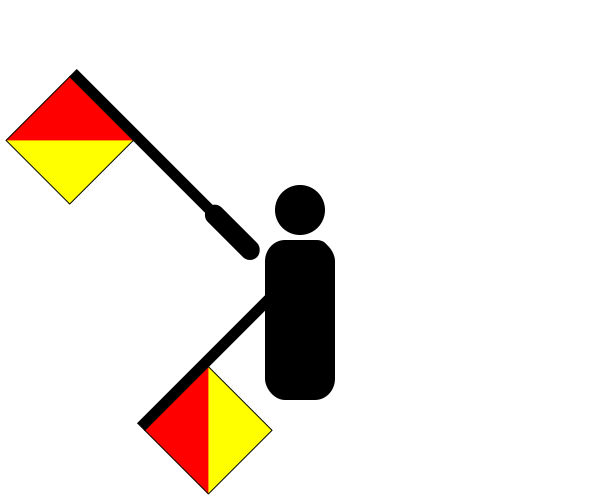
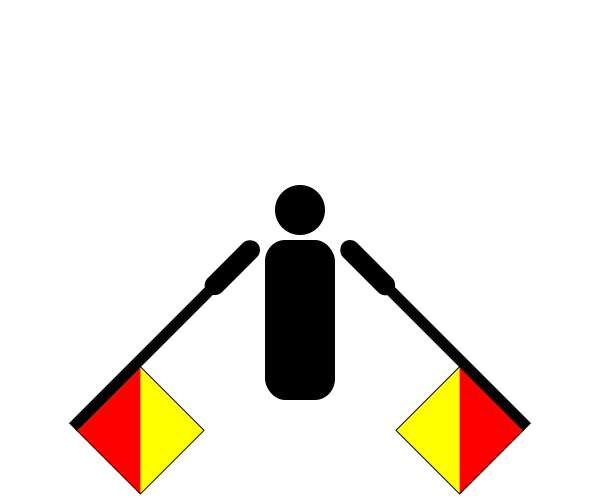
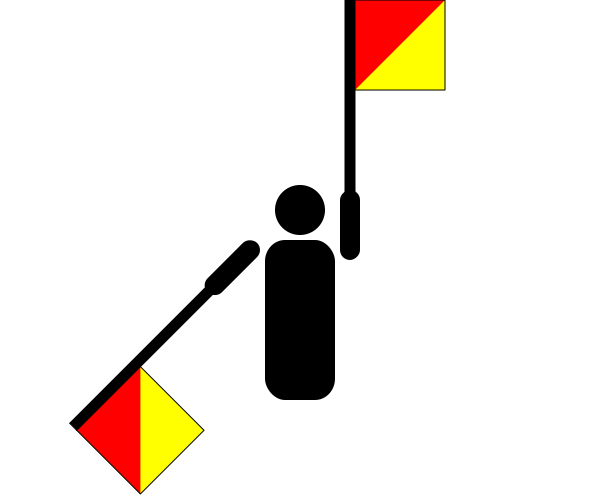
How to communicate the surname Vink in...
Braille
⠧⠊⠝⠅
Morse
...-..-.-.-
Semaphore
There are approximately 142 people named Vink in the UK. That makes it one of Britain's least common surnames. Only around two in a million people in Britain are named Vink.