VERMA
Verma is a surname of Indian origin, derived from the Sanskrit word Varman which translates to “armour” or “protection.” The name was historically attributed to individuals who were skilled in warfare or who played a protective role within their community. Over the centuries it has become a common surname among a wide range of Hindu castes and is now borne by people in a variety of professions and social backgrounds.
The use of the surname is strongly linked to the Hindu community of India, where it is typically spoken in Hindi and is associated with cultural traditions that emphasise honour and duty. The etymological meaning of the name reflects the martial heritage of those who first adopted it, and this heritage continues to be recognised in contemporary society through the adherence to values of service and steadfastness.
In addition to its Indian roots, comparable surnames such as Vermier, Vermier, Vermeer and Vermer appear in Flemish and Dutch contexts. These names are topographical in origin, describing a person who lived by a “maas” or river, or by a “mere,” a pool or pond, and are derived from the Old Germanic language with the medieval Dutch prefix ver meaning “of the.” These European forms are historically distinct from the Indian Verma, but the similarity in spelling has occasionally led to confusion in genealogical research.
Recorded instances of the surname in England date back to the seventeenth and eighteenth centuries. For example, George Vermer was christened at St. Olave’s church in Southwark on 1 September 1693, and James Vermier was christened at St. Sepulchre in London on 6 December 1752. The first English record that is commonly accepted as belonging to the family name is that of John Vermiere, dated 7 February 1630 at St. Giles Cripplegate. Another noted example is Thomas Thios, whose surname appears as part of the early English documentation during the reign of King Charles I; he was documented as a supporter of the cause now referred to as “The Martyr” between 1625 and 1649.
The surname Verma remains a testament to a legacy of protection and service that transcends contemporary professions. Its linguistic roots in Sanskrit, along with its documentation in both Indian and European records, highlight the surname’s enduring presence across cultures while preserving its original meaning of armour and guardianship.
Typical given names associated with the Verma surname
Male
- Ajay
- Amit
- Anil
- Rahul
- Raj
- Rajesh
- Rakesh
- Ravi
- Sanjay
- Sanjeev
- Vijay
Female
- Anita
- Asha
- Kavita
- Monica
- Neelam
- Pooja
- Poonam
- Priya
- Santosh
- Sonia
- Sunita
- Veena
Similar and related surnames
- Forma
- Ferm
- Ferman
- Varma
- Farma
- Verm
- Faram
- Farm
- Farme
- Farram
- Fayram
- Fearm
- Fermar
- Ferme
- Fermi
- Fermie
- Fermo
- Firm
- Firme
- Firmo
- Foram
- Form
- Formay
- Forme
- Foroma
- Frahm
- Fraim
- Fraime
- Fram
- Frame
- Fream
- Freame
- Freem
- Freema
- Freeme
- Frema
- Freme
- Frim
- Frome
- Fromm
- Fromme
- Froom
- Froome
- Frum
- Frume
- Pharma
- Varman
- Veerman
- Vermaak
- Vermaas
- Vermaat
- Vermall
- Verman
- Vermani
- Vermast
- Vermaut
- Verme
- Vermee
- Vermer
- Vermes
- Verta
- Viram
- Vroom
- Vroome
- Vurma
Related and similar names are generated algorithmically based on the spelling, and may not necessarily share an etymology.
How to communicate the surname Verma in...
Braille
⠧⠑⠗⠍⠁
Morse
...-..-.--.-
Semaphore
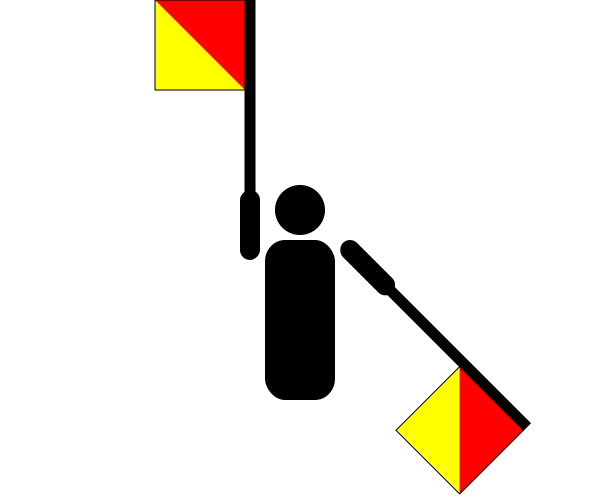

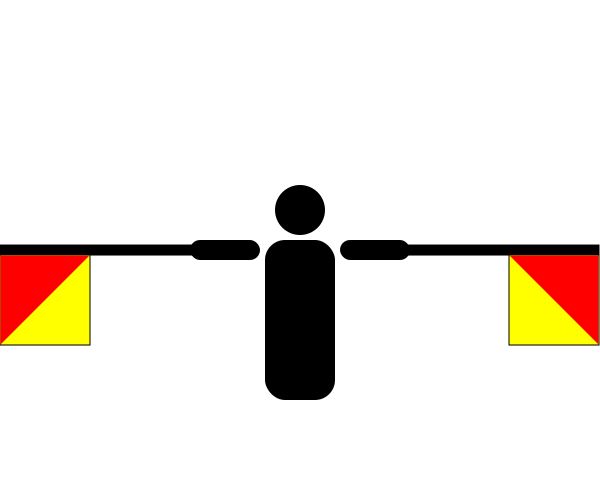
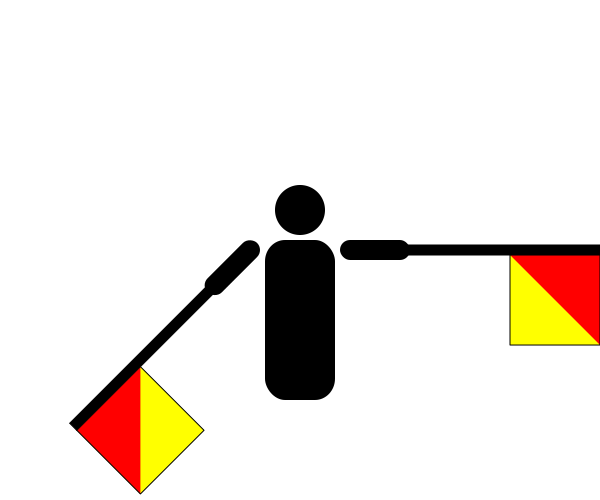

There are approximately 3,606 people named Verma in the UK. That makes it roughly the 2,550th most common surname in Britain. Around 55 in a million people in Britain are named Verma.
Region of origin: Asia
Country of origin: India
Religion of origin: Hindu
Language of origin: Hindi

Famous people named Verma
- Sandip Verma, Baroness Verma - Politician
- Aman Verma - Football player
Names and descriptions courtesy of Wikipedia, and may contain errors. This is not intended to be an exhaustive list of every famous person with this name.