VENNER
The surname Venner is of English origin, with occasional appearances in French, Dutch and German contexts. In the British Isles it is typically regarded as an occupational name derived from the Old French word veneur, meaning a hunter. Vener appears in medieval English documents as a term for a huntsman, and the surname was frequently given to individuals who practised that trade.1
Alternative derivations point to the Old English word fenn, meaning a marsh or fen. In this view the name would have described a person dwelling near such a landscape, or possibly an engineer who undertook the draining of wetland areas. The latter interpretation is supported by the presence of a surname variant, Fehner, recorded in the 18th century when the name is linked to a known wetlands engineer brought from the Low Countries to assist in drainage projects in England and Ireland.2
The earliest surviving record of a name closely resembling Venner is that of Walter Le Venneur, dated 1195 in the pipe rolls of the county of Cambridge during the reign of King Richard I. Subsequent medieval references include Geoffrey le Venour of Salop in 1273 and Robert Veneur of Lincoln in 1293, demonstrating the continuity of the name in various spellings throughout the late twelfth and thirteenth centuries.2
In later centuries the spelling settled on Venner, but other variations such as Fenner, Venn and Fehner remain in use. The form Fehner first appears in England in 1805 when George Fehner, son of Richard and Elizabeth, was christened at High Halston, Kent.3 The intrusion of the letter h is not found in earlier English records, suggesting a later development in the spelling tradition.
Across the British Isles, particularly in the north and east of England, the surname has been associated with families involved in both hunting and land drainage, reflecting its dual occupational and locational origins. While the name was occasionally used as a variant of Venn, the use of Venner as a distinct surname is well documented from the early medieval period onwards, with a clear lineage that can be traced through archival sources. The combination of French and Old English elements in the name provides a linguistic window into the cultural interactions of medieval England, where Norman and Anglo‑Saxon traditions intertwined.
Typical given names associated with the Venner surname
Male
- David
- Gary
- Ian
- Jack
- John
- Mark
- Matthew
- Michael
- Paul
- Peter
- Richard
- Thomas
Female
- Adrienne
- Alison
- Amanda
- Annabel
- Christine
- Elizabeth
- Jean
- Joyce
- Julie
- Katherine
- Linda
- Rebecca
- Sarah
- Sophie
- Susan
Similar and related surnames
- Fainer
- Faner
- Fannar
- Fanner
- Fannier
- Fannor
- Fayner
- Feener
- Fehners
- Feiner
- Fener
- Fenier
- Fennar
- Fenner
- Fennier
- Fennor
- Pfanner
- Vagner
- Vainer
- Vanar
- Vaner
- Vanier
- Vanner
- Vannier
- Vayner
- Veener
- Veiner
- Venear
- Veneear
- Veneer
- Vener
- Venere
- Veneri
- Venerio
- Veners
- Venert
- Venerus
- Venier
- Vennard
- Vennart
- Venne
- Vennear
- Venneear
- Vennel
- Venneri
- Venners
- Vennor
- Venoor
- Venor
- Venour
- Ventner
- Vernner
- Viener
Related and similar names are generated algorithmically based on the spelling, and may not necessarily share an etymology.
How to communicate the surname Venner in...
Braille
⠧⠑⠝⠝⠑⠗
Morse
...-.-.-...-.
Semaphore
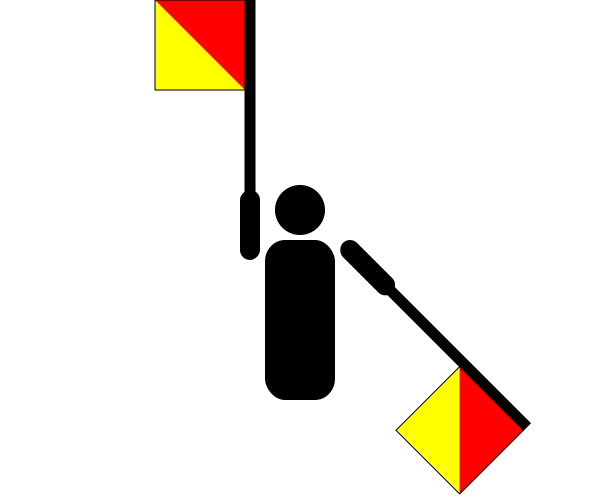

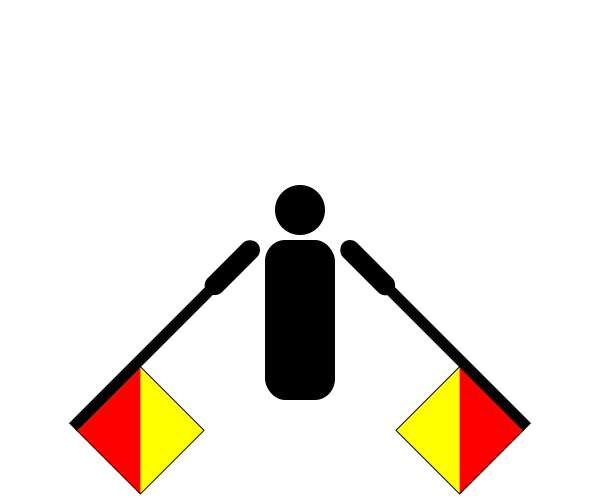
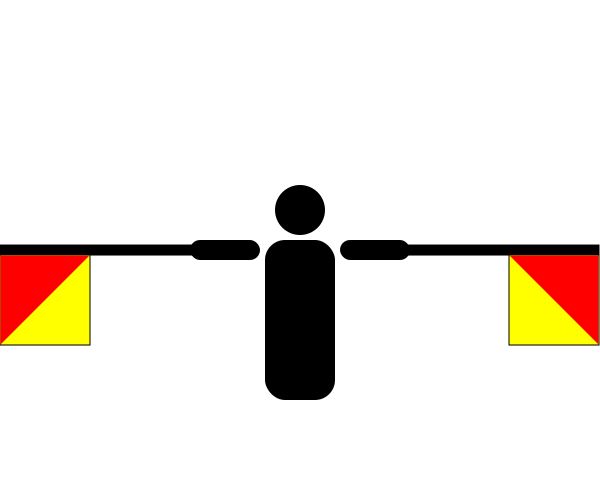
There are approximately 1,061 people named Venner in the UK. That makes it roughly the 7,050th most common surname in Britain. Around 16 in a million people in Britain are named Venner.
Surname type: Occupational name
Origin: English
Region of origin: British Isles
Country of origin: England
Religion of origin: Christian
Language of origin: English
