VATER
Origins and Etymology
The surname Vater is firmly rooted in German linguistic tradition. It derives from the Middle High German word vater, meaning “father.” In the medieval period this term was not merely descriptive; it was often employed as a status nickname bestowed upon individuals who exemplified paternal authority or authority within a community, an approach that parallels the use of the English surname Father.
Historical records reveal several early forms, including Fader, Vader, and Vater. The earliest documented bearer, Reinbold Vader of Cologne (Cologne, Germany), appears in the year 1135. A later example, Roger Fader, is recorded in the 1195 register of the abbey of Bury St Edmunds in England. These entries underline the surname’s spread from northern Germany to the English-speaking world during the late Middle Ages.
Possible Occupational Significance
While the literal translation is “father,” the contemporary scholarship suggests that the name probably evolved as a nickname for someone who fulfilled a paternal role within a small community or served as a religious teacher. By the time surnames became hereditary, between the twelfth and fifteenth centuries across Northern Europe, such occupational or status-based names often solidified into family names. The surname remains distinct from priestly titles; a direct association with the clergy is not substantiated by the available evidence.
Heraldry
The German coat of arms granted to the Vater family is described heraldically as “per pale, red and gold.” On the red field an iron triangle is depicted, while the gold field bears a pair of crossed dumbbells. These symbols may reflect the family’s attributes or local traditions, though the exact rationale for each charge is not detailed in the surviving blazons.
Notable Bearers
Several individuals bearing the surname have achieved recognition in their respective fields. Gustav Vater (born in the late eighteenth century) was a German physician who authored influential texts on operative surgery that became standard references. Karl Vater (born in the early twentieth century) was a German lawyer whose textbook on criminal law, published in 1931, remains cited in academic circles.
Geographical Distribution
In contemporary times the surname is most frequently encountered in Germany, particularly in the Rhineland region. It also appears in Austria, France, Italy, Switzerland, the Netherlands, Sweden, and the United Kingdom. According to the most recent United States Census, Vater ranks among the two-hundred most common surnames in the country, with higher concentrations in Ohio, Pennsylvania, Arizona, Florida, New York, Michigan, California, Oregon, and Illinois. The dispersion of the name in North America and South America is largely a result of historic migration patterns from German-speaking Europe.
Some bearers of the surname are documented as belonging to Jewish communities across Europe, indicating that, for certain families, the name may have been adopted or retained within a Jewish context. The presence of the surname in multiple cultural settings reflects the broader diaspora of people with German ancestry.
Variants and Spelling Differences
While the core spelling Vater persists, numerous variants have occurred over time and across regions. Legitimate orthographic alternatives include Vatter, Vader, Fater, and Fender. In some cases, phonetic differences led to forms such as Vetter or Fother. Not all similarly sounding surnames are etymologically related; for example, Voigt or Vogel are distinct in origin and should not be conflated with Vater.
The evolution of spelling has often coincided with the process of assimilation in new linguistic environments, a phenomenon that is well documented in the experience of immigrant families. Nonetheless, the root meaning tied to the notion of a fatherly figure or community authority remains a persistent feature across all recognised forms of the surname.
Conclusion
The surname Vater encapsulates a heritage that intertwines linguistic, social, and historical strands from medieval Germany to contemporary multinationals. Its derivation from the Middle High German word for father, coupled with early medieval records and a presence that spans several European and North American regions, demonstrates the enduring legacy of a name that once denoted paternal authority within a community.
Typical given names associated with the Vater surname
Male
- Andrew
- David
- John
- Josiah
- Kevin
- Markus
- Michael
- Nicholas
- Paul
- Richard
- Stephen
- Victor
Female
- Amber
- Ann
- Anne
- Barbara
- Gillian
- Janine
- Jean
- Joan
- Kirsty
- Laura
- Susan
Similar and related surnames
Related and similar names are generated algorithmically based on the spelling, and may not necessarily share an etymology.
How to communicate the surname Vater in...
Braille
⠧⠁⠞⠑⠗
Morse
...-.--..-.
Semaphore
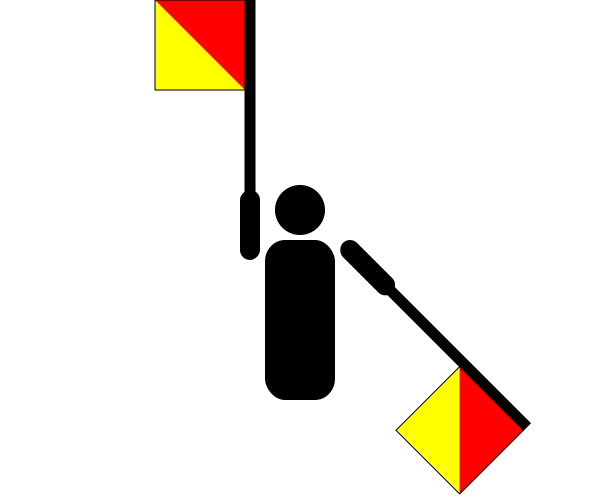

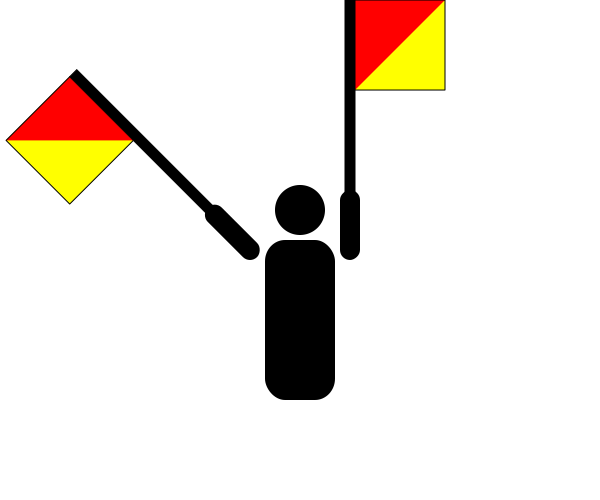

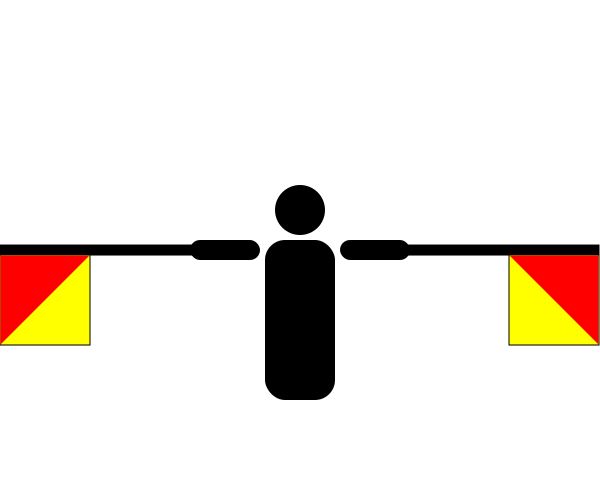
There are approximately 356 people named Vater in the UK. That makes it one of Britain's least common surnames. Only around five in a million people in Britain are named Vater.
