VALENTA
Valenta is a surname of Czech and Slovak origin, derived from the word valent, meaning “strong” or “healthy.” The name is patronymic, traditionally identifying the descendants of an ancestor named Valentin or Valentine.
The Latin root valens has been utilised as both a locational name—most notably in the Spanish city of Valencia—and as a personal or baptismal name such as Valente or Valentin. In each instance the meaning remains that of health and vigour. It is plausible that Roman legions of the first century A.D. chose such a name for what they perceived as a healthy and successful settlement, and the idea has since spread throughout Europe.
Over centuries, the surname has developed numerous spelling variants, all stemming from the same root. These include Valenti (used in Portuguese and Spanish contexts), Vallentin (French), Valentine (English), Faltin and Foltin (German), Walenta and Walesa (Polish), Balint (Hungarian), Velte (Czech), and many others. The widespread nature of these variants illustrates the enduring popularity of the name across the continent.
Early documentary evidence shows the name appearing in authentic church and civil records. An example is Francisco Ros Valencia marrying Murillo de Cuende at Sante Fe, Spain, on 10 January 1588, and another instance of Quiteria Valenciano being christened at El Baslasteros, Albacete, Spain, on 14 January 1788. Further records include Simeon Maximo Valenzuela, christened at San Diego, California, on 20 February 1791, and Maria Perfecta de Patrocina Valencia, at Santa Barbara on 20 April 1846. In the United States, Samuel Valentino was recorded on 13 August 1906 at San Francisco.
One of the earliest recorded spellings appears in the register of Ramsey Abbey, Huntingdon, England. The entry for Matilda Valentyn is dated 1251, during the reign of King Henry III, a period known as "The Frenchman." This demonstrates the name’s presence in England at least two centuries before the modern era.
The heraldic representation of the Valenta surname features a blazon described as per saltire gold and silver, with a black eagle displayed in chief and base, and a red lion rampant in the left and right quarters. This imagery conveys the strength and courage implied by the name.
In contemporary times the surname remains most common in the Czech Republic and Slovakia, where it is frequently seen in cities such as Prague, Brno, and Ostrava. Emigration over the past century has spread the name to other countries, notably the United States, Australia, and Germany. In the United States, significant concentrations are found in the Midwestern states of Illinois, Ohio, Indiana, Nebraska, Kansas, and Wisconsin. Australia hosts a small but notable community of Valentas in Wayville, South Australia.
Variations of the surname also exist in spelling forms such as Valade, Valata, Valta, Valeta, and Valneta. All derive from the same root, reflecting regional linguistic influences over time. Similar surnames, including Valiant, Walton, Valle, Valant, Valenze, Vallance, and Valen, share a common origin and are often found in the same areas.
In sum, the surname Valenta reflects a legacy of strength, health, and bravery, roots that can be traced back to ancient Latin and Slavic languages, and a history that extends across Europe and into the wider world through migration and cultural exchange.
Similar and related surnames
Related and similar names are generated algorithmically based on the spelling, and may not necessarily share an etymology.
How to communicate the surname Valenta in...
Braille
⠧⠁⠇⠑⠝⠞⠁
Morse
...-.-.-...-.-.-
Semaphore
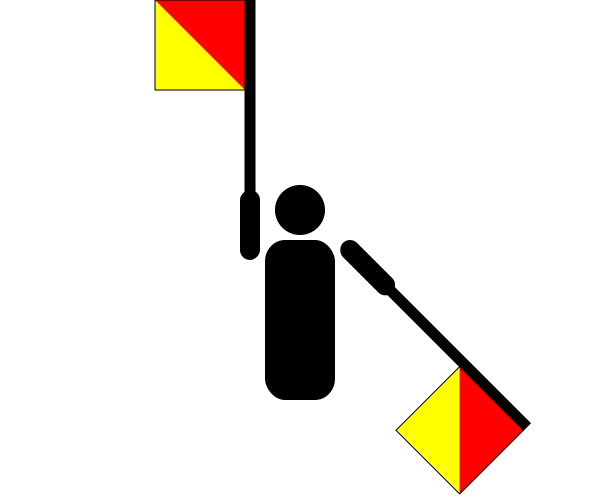


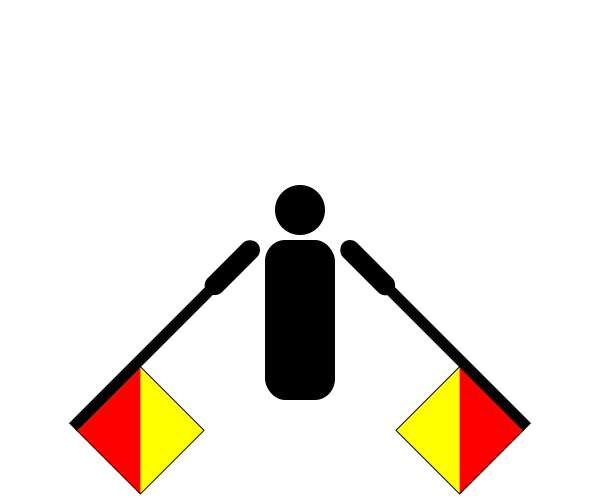
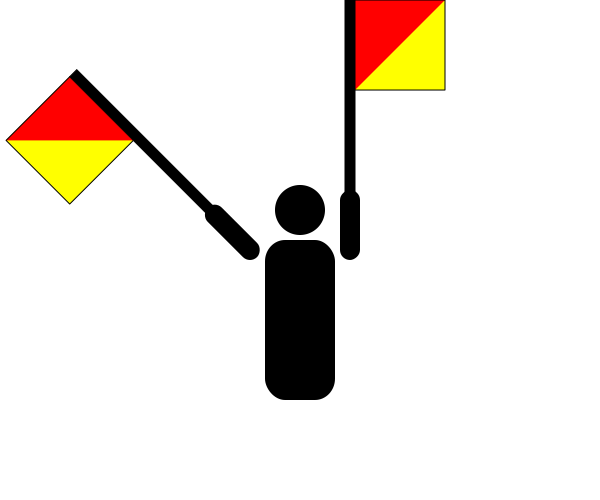
There are approximately 44 people named Valenta in the UK. That makes it one of Britain's least common surnames. Only around one in a million people in Britain are named Valenta.
