VALENCIA
Valencia is a surname of European origin, rooted primarily in the Spanish language. The name is associated with the city of Valencia in eastern Spain, a place of considerable historic significance along the Mediterranean coast.
The etymology of the name derives from the Latin word Valentia, meaning strength or vigor. Latin influence is evident in the historic Roman name Valens, which has been used both as a locational designation for the city and as a personal name in pre‑medieval baptisms, such as Valente and Valentin. The meaning of health and vigour is shared across all these usages.
As a locational surname it indicates that the original bearer of the name either came from, lived in, or was otherwise connected to the city of Valencia. Such locational surnames were common in medieval Spain, reflecting the practice of identifying individuals by their place of origin.
A distinctive feature of the Valencia name is the multitude of orthographic variants that have developed over the centuries. Thirty‑plus versions exist, including Valenti (Portuguese and Spanish), Vallentin (French), Valentine (English), Faltin and Foltin (German), Walenta and Walesa (Polish), Balint (Hungarian), Velte (Czech), and many others. These variants arise from the same root and share the sense of strength and health.
Historical records show that the earliest attested spelling of the surname is that of Matilda Valentyn, dated 1251 in the register of Ramsey Abbey, Huntingdon, England, during the reign of King Henry I of England (referred to as “The Frenchman”). Subsequent authentic church records further attest to the surname’s use, for instance Francisco Ros Valencia who married Murillo de Cuende at San Fe, Spain, on 10 January 1588, and Quiteria Valenciano, christened at El Baslasteros, Albacete, Spain, on 14 January 1788. Records also exist of Simeon Maximo Valenzuela christened at San Diego, California, on 20 February 1791, Maria Perfecta de Patrocina Valencia at Santa Barbara on 20 April 1846, and Samuel Valentino on 13 August 1906 at San Francisco.
The name is connected with the saint and martyr Valentinus, whose martyrdom on 14 February in the early Roman calendar marked the arrival of spring. This association has led to a popular tradition linking the surname to a time of renewal and vigour.
The heraldic achievement traditionally attributed to the Valencia family is described as per saltire gold and silver, with a black eagle displayed in chief and base, and a red lion rampant in the left and right positions. This blazon is recorded in heraldic sources and reflects the martial and noble qualities implied by the name.
Today, the surname Valencia is widespread throughout Spanish‑speaking populations and beyond. It can be found in Europe and in diasporic communities across the Americas, reflecting the migration and historical movements of people bearing this name. The name continues to be a marker of cultural heritage and historical continuity.
Typical given names associated with the Valencia surname
Male
- Christopher
- Daniel
- David
- Fernando
- Francisco
- Jack
- Jose
- Luis
- Marco
- Matt
- Paul
Female
- Carmen
- Clara
- Doris
- Esther
- Gloria
- Lydia
- Maria
- Miriam
- Sandra
- Sarah
Similar and related surnames
Related and similar names are generated algorithmically based on the spelling, and may not necessarily share an etymology.
How to communicate the surname Valencia in...
Braille
⠧⠁⠇⠑⠝⠉⠊⠁
Morse
...-.-.-...-.-.-....-
Semaphore
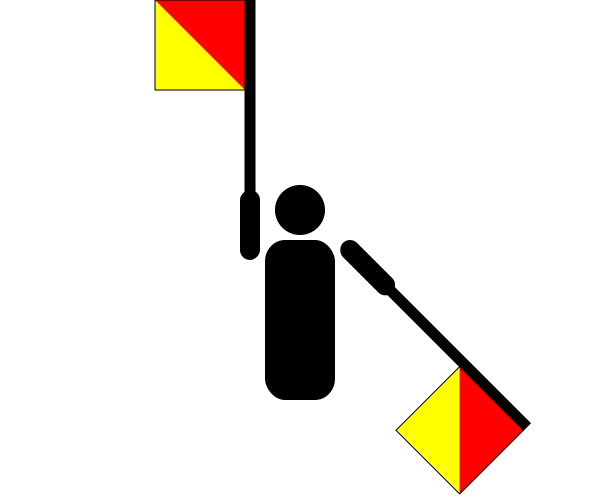


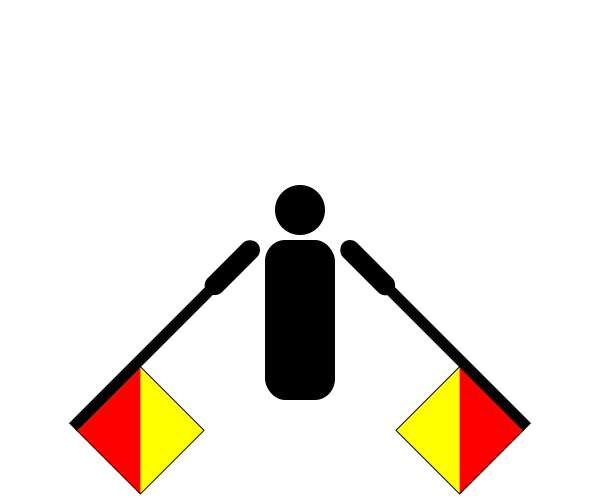

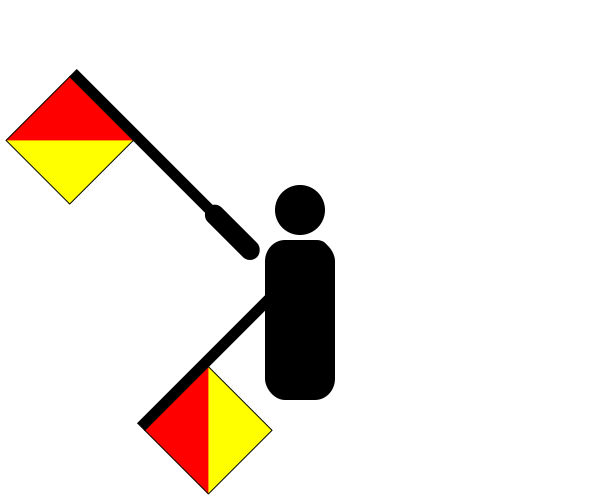
There are approximately 371 people named Valencia in the UK. That makes it one of Britain's least common surnames. Only around six in a million people in Britain are named Valencia.
Origin: Iberian
Region of origin: Europe
Country of origin: Spain
Religion of origin: Christian
Language of origin: Spanish
