TROOP
Troop is a surname of English origin, first recorded within the British Isles during the twelfth and thirteenth centuries. The name is traditionally associated with Christian society, as demonstrated by its presence in ecclesiastical and secular documents of the period.
The etymology of Troop can be traced to the Middle English word troupe, which denoted a group or company of people. As an occupational surname, it was most likely used as a nickname for an individual who served in a military or cavalry unit, or for someone employed as an attendant in a noble household. In this sense, the name conveys a sense of camaraderie and association with an organised group.
Over time the spelling of the name has varied considerably. Recorded forms include Thorp, Thorpe, Throp, Trop, Troop, Troup, Troupe, Thrupp, Trippe and others. These variants reflect a common orthographic practice of the period and the lack of standardised spelling.
The surname has Scandinavian Viking origins. It is locational in nature, deriving from the many English placenames known as Thorp or Thorpe, or from the older Old English forms such as Throp dating to before the seventh century. As a placename, the term signified a small outlying hamlet or village, often dependent on a larger settlement a few miles distant. In medieval society, residential or locational surnames were frequently adopted by individuals who had moved from their place of origin in search of work or by the local lord of the manor.
Early documentary evidence of the surname is found in the Hundred Rolls of 1327, where a John de Trope is recorded in the county of Worcester. Another documented bearer is William Thorp, an early emigrant to the English colonies, who departed London on the ship Expectation in April 1635 bound for the Island of Providence. He travelled with his wife, Elizabeth, and their two‑year‑old daughter.
The earliest surviving spelling of the family name appears in the Pipe Rolls of Northumberland in 1158, during the reign of King Henry I, who ruled from 1100 to 1135. The record names a William de Torp, illustrating the medieval use of an alternate spelling that would later evolve into the forms recognised today.
The heraldic badge commonly associated with the surname features a silver shield charged with a red lion in a salient pose, surrounded by an orle of blue fleurs-de-lis. This blazon has been recorded as a family coat of arms in several posts‑medieval armorial registries.
In sum, the surname Troop embodies a combination of occupational and locational heritage, with roots stretching back to the Viking presence in England, the medieval practice of surname adoption based on place of origin, and the social functions of the written record. Its continued use into the present day reflects the enduring nature of English surnames and their capacity to convey a rich tapestry of linguistic, cultural and genealogical history.
Typical given names associated with the Troop surname
Male
- Daniel
- David
- John
- Jonathan
- Michael
- Peter
- Philip
- Richard
- Robert
- Stephen
- Thomas
Female
- Alison
- Caroline
- Claire
- Emma
- Gillian
- Helen
- Janet
- Jean
- Karen
- Patricia
- Sandra
- Sarah
- Suzanne
Similar and related surnames
Related and similar names are generated algorithmically based on the spelling, and may not necessarily share an etymology.
How to communicate the surname Troop in...
Braille
⠞⠗⠕⠕⠏
Morse
-.-.------.--.
Semaphore
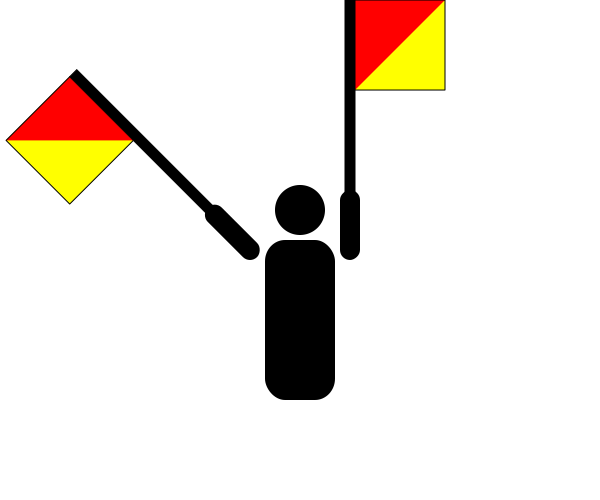
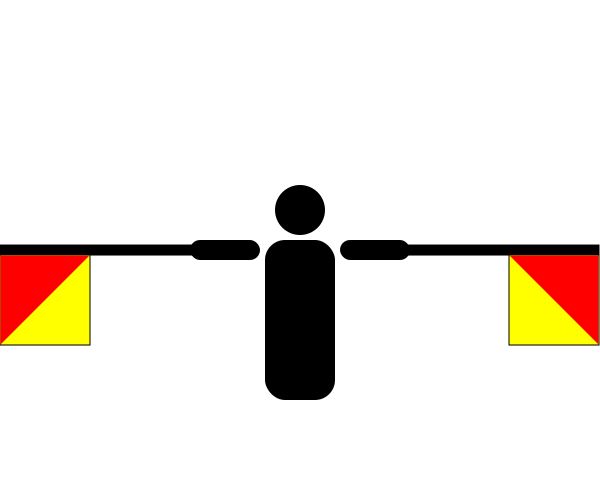
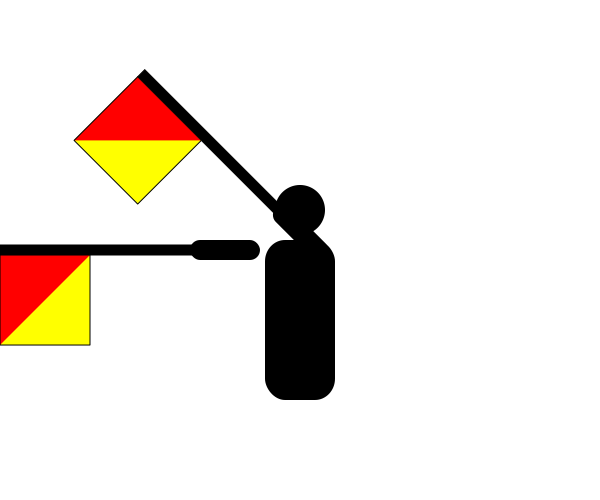

There are approximately 537 people named Troop in the UK. That makes it one of Britain's least common surnames. Only around eight in a million people in Britain are named Troop.
Origin: English
Region of origin: British Isles
Country of origin: England
Religion of origin: Christian
Language of origin: English
