TRIBE
Tribe is a surname of English provenance that has a recorded presence in the British Isles, particularly within England, since the mid‑seventeenth century. It is associated with the Christian community and is predominantly found within church registers where spelling variations such as Trybe, Tribb, Trebe and Trubb have been documented.
The surname is derived from the Middle English word tribe, a term that denoted a group of people who shared a common ancestry or engaged in a particular occupation. Translated literally, it conveyed the notion of belonging to a defined community or collective. Consequently, Tribe may have originally served as a nickname for a person who was identified with a specific tribe or community.
Alternatively, the name could have denoted a person living in proximity to a tribal settlement, thus functioning as a topographic identifier. In this context, the surname would reflect an individual's habitual presence near a communal gathering or a settlement that attracted members of a particular tribe.
Other scholarly accounts point to a Germanic influence, reflecting a metonymic occupational derivation from the Middle High German trube (old High German (t)ruba), meaning a bunch of grapes. In this sense, the surname might have originally identified a vine‑grower or vintner. The same sources note that it could also arise from Old German trieb (force, impulse) or trub (gloomy, sad), indicating a possible nickname based on personality or circumstance.
The surname is examined within the context of Christian practices in England, where church records have played a crucial role in preserving its history. The first spellings documented in Sussex show the name in use from the early 1550s onward.
For example, on 9 November 1556, Peter Tribe and Rose Loder entered into matrimony at Fernhurst, Sussex. On 24 November 1588, the christening of Peter, son of William Trybe was recorded in Rogate. Later, on 15 August 1612, the baptism of Robert Trubb was duly noted at St. Andrew by the Wardrobe in London. These entries illustrate the surname’s persistence across generations and its extension beyond Sussex into other parts of England.
A heraldic example associated with a branch of the family is the coat of arms granted to the Trubb family of Bavaria. The blazon features a silver shield with a red bend charged with a silver crown situated between two red stars. The bend is interpreted as representing the shoulder strap of a warrior and symbolizes defence. While this heraldic tradition is located in Bavaria, it demonstrates the surname’s broader diaspora.
The earliest church record naming the surname appears in the christening of William Tribe on 3 January 1553 at Fernhurst, Sussex. This event took place during the reign of King Edward the Fourth, who was the nominal ruling monarch, often referred to as the “Boy King” between 1547 and 1553. This date not only marks the first recorded appearance of the surname but also situates it within a specific historical context of Tudor England.
Typical given names associated with the Tribe surname
Male
- Andrew
- Christopher
- David
- James
- John
- Keith
- Michael
- Paul
- Peter
- Richard
- Robert
- Stephen
Female
- Caroline
- Clair
- Claire
- Deborah
- Elizabeth
- Emma
- Georgina
- Jacqueline
- Janet
- Joanna
- Mary
- Sarah
- Susan
- Victoria
Similar and related surnames
Related and similar names are generated algorithmically based on the spelling, and may not necessarily share an etymology.
How to communicate the surname Tribe in...
Braille
⠞⠗⠊⠃⠑
Morse
-.-...-....
Semaphore
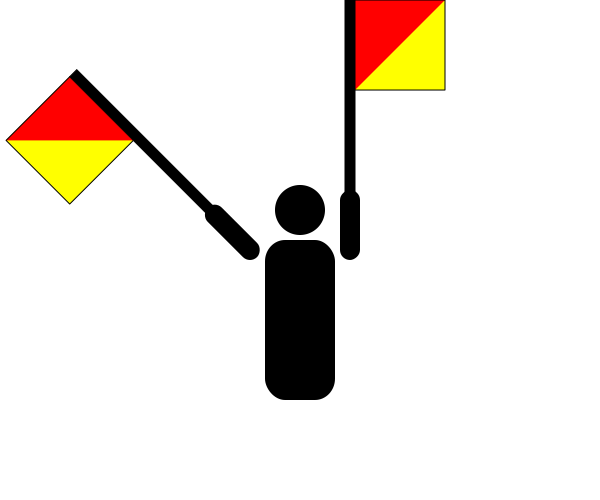
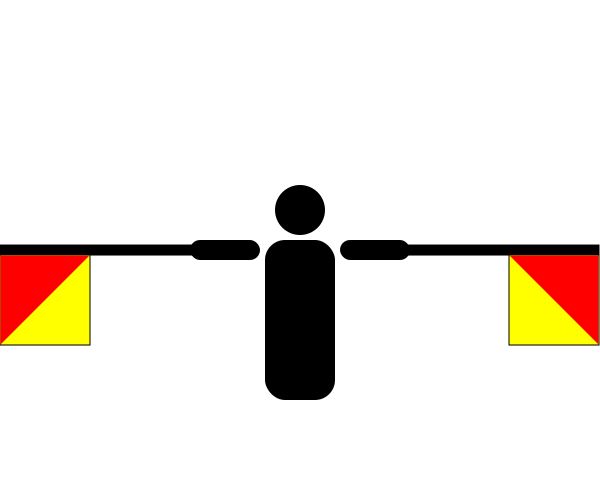
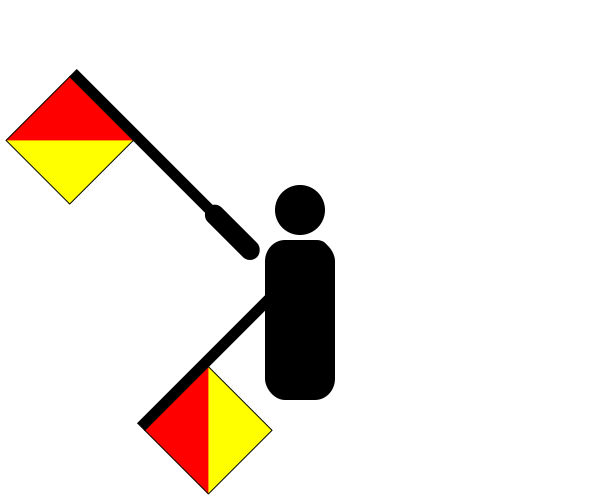
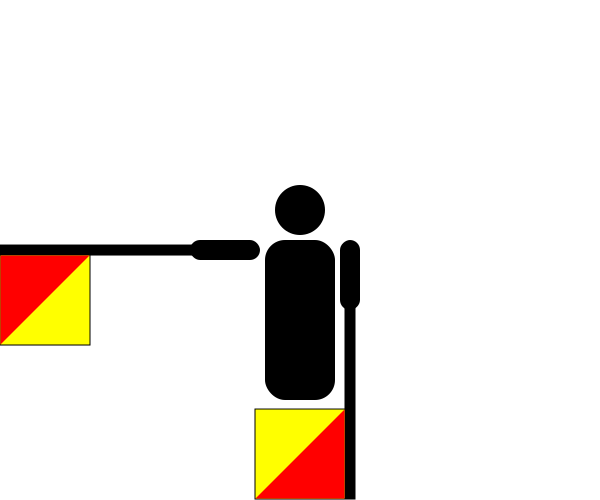

There are approximately 1,571 people named Tribe in the UK. That makes it roughly the 5,162nd most common surname in Britain. Around 24 in a million people in Britain are named Tribe.
Origin: English
Region of origin: British Isles
Country of origin: England
Religion of origin: Christian
Language of origin: English
