TOLE
Tole is a surname of English origin, belonging to the group of names that developed in the British Isles during the early medieval period. The earliest documentary evidence for the name is found in the Hundred Rolls of Wiltshire, dated 1275, when a man named Nicholas Tolle appears. The surname is recorded in the Assize Court Rolls of Lincolnshire in 1218 under the form Tolle le grangier, showing a long tradition of use within England.
The name is derived from the Old English word toll, meaning a tax or levy. Historically, this word was applied to a toll gate, bridge, or a collector of tolls. Consequently, Tole may have been originally a topographic name for someone living near a toll station, or an occupational name for an official charged with the payment of dues. The connection to the collection of taxes places the surname within a common medieval practice in which personal names reflected the social role of the bearer.
In addition to the Anglo‑Saxon origin, the surname shows traces of Anglo‑Scandinavian influence. The Old Norse personal name Toli, a shortened form of compounds such as Thorleifr or Thorleikr—which combine the divine name of the god Thor with elements meaning relic or play—has been linked to the same root. This dual linguistic heritage is reflected in variant spellings that range from Towle and Towell to Toole, Tole, and Toll. The variety of forms illustrates the fluid spelling conventions of the period and the influence of regional dialects on name adoption.
Marriage and baptismal records provide further evidence of the spread and endurance of the name throughout the British Isles. For example, the union of Richard Towell and Joane Franck was recorded at St. Giles' in Cripplegate, London, on 30 April 1564, and a 1775 New York christening witness can be identified as Ebenezer Towell. These references document the persistence of the name in both England and the early American colonies, with the latter recorded as a bearer named Ebenezer Towell of the First Presbyterian Church in New York.
While the name is historically tied to England, it has also appeared, in varying forms, in France, Scotland, and Ireland. The Norman influence introduced variations such as Toul and Tolle, while in Scotland and Ireland the form Tol is found. In contemporary times, it is an uncommon surname in the United States, ranking around the eight thousandth position with roughly 2,500 bearers, and it can also be found in countries such as Canada, Australia, Germany, Greece, and Albania. The distribution beyond Britain is largely the result of migration during the 19th and early 20th centuries, which accounts for the surname's presence in states such as California, New Jersey, Florida, and New York.
In modern usage, the surname is most often rendered in the simple form Tole, though differing orthographies persist in genealogical records. Scholars agree that the name’s origin is firmly anchored in the medieval English context of toll collection and locational identity, and that any other meanings or derivations are secondary and regionally specific. The study of Tole therefore offers insight into the broader patterns of surname development, linguistic borrowing, and social function within early English society.
Typical given names associated with the Tole surname
Male
- Alan
- Brian
- Christopher
- David
- James
- John
- Joseph
- Michael
- Richard
- Roger
- Stephen
- Thomas
Female
- Anne
- Beryl
- Brenda
- Catriona
- Christine
- Florence
- Kathryn
- Lavinia
- Lorraine
- Margaret
- Maria
- Rachel
- Rebecca
- Susan
- Vanessa
Similar and related surnames
Related and similar names are generated algorithmically based on the spelling, and may not necessarily share an etymology.
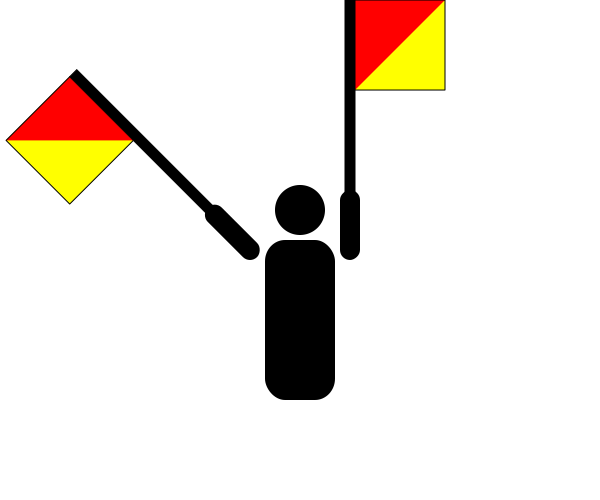
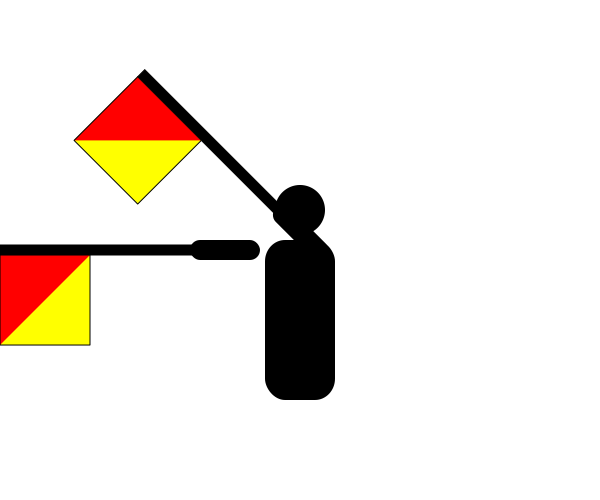
How to communicate the surname Tole in...
Braille
⠞⠕⠇⠑
Morse
----.-...
Semaphore


There are approximately 209 people named Tole in the UK. That makes it one of Britain's least common surnames. Only around three in a million people in Britain are named Tole.
Origin: English
Region of origin: British Isles
Country of origin: England
Religion of origin: Christian
Language of origin: English
