TOLAND
Toland is a surname of Irish origin, derived from the Gaelic patronymic Ó Tuathail which signifies “descendant of Tuathal.” The element Tuathal itself is composed of the Gaelic words tuath, meaning “people” or “tribe,” and gal, meaning “valor” or “might.” Consequently, the surname can be interpreted to mean “descendant of the valorous tribe” or “descendant of the mighty people.”
Over the centuries the original Gaelic name O'Tuathalain underwent a series of anglicisations. Recorded variants include O' Tolan, O' Twolan, Tolan, Toland, Toolan, Toolin, and occasionally Thulis or O' Toole. The evolution of the name has produced further forms such as Toal, Toole, and Toland, particularly in Northern Ireland. The surname is also associated with the pre‑13th century Gaelic form Ó Tuathalain, a variation that suggests a possibly religious connotation, as some medieval sources describe the name as “the male descendant of the follower of the lord.”
The surname has strong connections to the western part of the British Isles. Originally linked to County Donegal, a significant number of Toland septs moved southward to County Mayo in the seventeenth century, where they lost the O' prefix. Historical records also locate members of the clan in County Sligo; for instance, a Petrus O'Tuathalain served as vicar of Killaspugbrone in the barony of Carbury in 1306. These accounts demonstrate the antiquity of the surname, which dates back at least to the early thirteenth century.
In the early modern period, the Toland family were involved in the political unrest of the time. According to contemporary histories, they were followers of the O'Donnells and participated in an abortive rebellion against English rule in 1602. Such involvement places the surname within the broader context of Irish resistance to English domination, underscoring its historical significance.
During the seventeenth and eighteenth centuries, many Irish surnames underwent anglicisation as a consequence of English political hegemony and the suppression of the Irish language. Toland was no exception, and its various forms became widespread throughout English‑speaking countries. Today it remains a common surname, particularly in the United States and Ireland, with an estimated population of around 15,000 in the United States and about 250 in Ireland.
Modern bearers of the name often possess distinct heraldic traditions. Several branches of the Toland family have adopted unique coats of arms and family mottos, reflecting both the heritage of the surname and the individual histories of each family line.
In summary, the Toland surname encapsulates a rich tapestry of linguistic, geographical, and historical threads that trace back to ancient Gaelic Ireland and extend into contemporary societies across the globe.
Typical given names associated with the Toland surname
Male
- Daniel
- David
- James
- John
- Joseph
- Kevin
- Mark
- Michael
- Patrick
- Paul
- William
Female
- Abigail
- Angela
- Bernadette
- Caroline
- Claire
- Elizabeth
- Karen
- Margaret
- Mary
- Michelle
- Patricia
- Sandra
- Susan
Similar and related surnames
- Tolan
- Tolani
- Tola
- Tolands
- Tolans
- Dalland
- Dayland
- Deland
- Delande
- Delenda
- Delinde
- Delnatte
- Delonnette
- Deuland
- Dewland
- Dilland
- Dillnot
- Dillnutt
- Dilnot
- Dilnott
- Dilnutt
- Doland
- Dolente
- Dolland
- Dollente
- Dollond
- Dooland
- Douland
- Dowland
- Doyland
- Doylend
- Talant
- Talent
- Taliente
- Taliento
- Talland
- Tallant
- Tallent
- Telland
- Tiland
- Tolaini
- Tollan
- Tollance
- Tolland
- Tollands
- Tolond
- Towlan
- Towland
- Tulland
- Tylenda
- Tolaney
Related and similar names are generated algorithmically based on the spelling, and may not necessarily share an etymology.
How to communicate the surname Toland in...
Braille
⠞⠕⠇⠁⠝⠙
Morse
----.-...--.-..
Semaphore
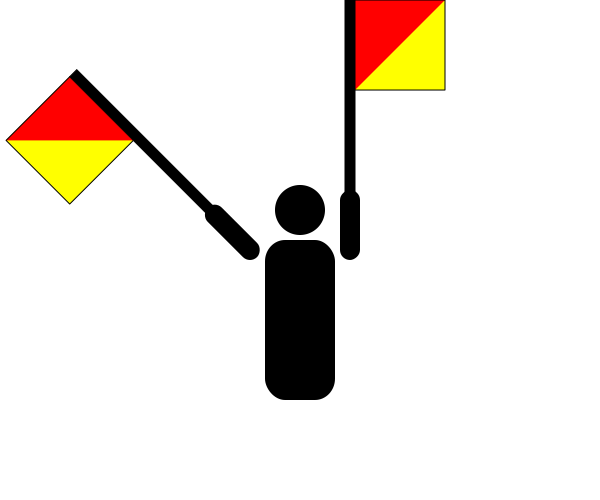
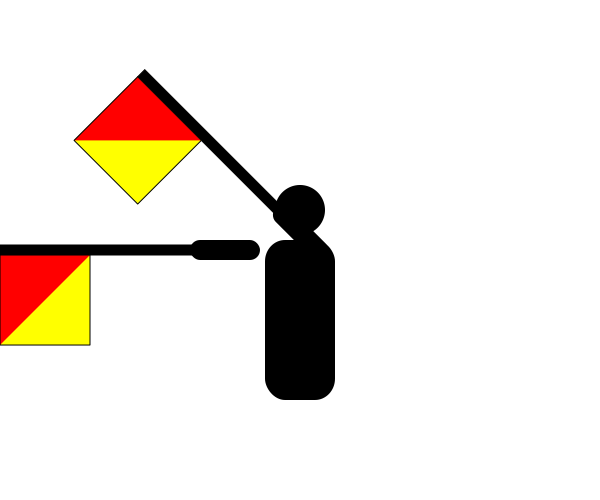


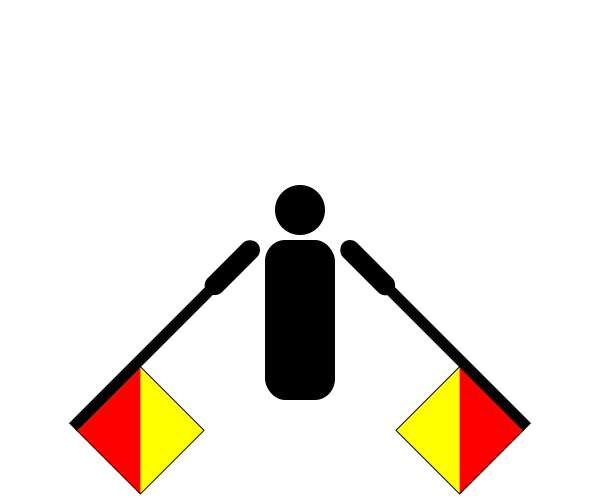

There are approximately 764 people named Toland in the UK. That makes it roughly the 9,087th most common surname in Britain. Around 12 in a million people in Britain are named Toland.
Surname type: Location or geographical feature
Origin: Celtic
Region of origin: British Isles
Country of origin: Ireland
Religion of origin: Christian
Language of origin: Gaelic
