TANG
The surname Tang is of Chinese origin and is one of the most common family names in Asia.
Its meanings are diverse. It may refer to the illustrious Tang dynasty (618–907), a period typically regarded as the golden age of Chinese civilisation. Alternatively, it can be derived from the Chinese word tang, meaning “sugar” or “candy.” In some contexts it is a variant of the surname Deng, which translates as “lamp” or “light.” These interpretations reveal historical, cultural and even literal connotations tied to Chinese heritage.
Geographically, the name historically signified a link to the era of the Tang dynasty. People who lived in or near the former realm of that dynasty, or who wished to commemorate its splendour, may have adopted the name. The character itself implies great, expansive qualities, echoing the reputation of the dynasty as a cosmopolitan centre of power. Across different cultures and languages, the interpretation of the surname can vary, but it consistently carries a sense of prosperity and breadth.
In contemporary China, the Tang surname accounts for approximately 4.7 % of the population and is therefore one of the country’s most widespread family names. Outside mainland China it is particularly prominent in Southeast Asia. In Vietnam it is the most common surname, with an estimated six‑hundred thousand bearers. In Singapore it represents about 1.8 % of residents, while in Malaysia it accounts for 5.4 % of the populace. Thai families adopting the name arrived there during the 18th‑century political turmoil. The surname can also be found, though less frequently, in the United States, Canada, Australia, New Zealand and the United Kingdom, and it ranks among the one hundred most popular surnames in North America.
The spelling Tang is the Wade‑Giles romanisation of the Chinese surname. In Hanyu Pinyin the name is rendered Dong, and it is rendered Tong in Cantonese and other dialects. Other minor spells and variations include Tan, Don, Tanh, Thang, Teng, Tangs, Thai, Tonq, Tanq and Tangd. The Vietnamese adaptation is written the same as the Chinese and is pronounced slightly differently in the northern and southern regions of Vietnam.
Because the original Chinese character for the surname is often linked to the word for “country” or “state”, it is thought that the surname may have formed among the citizens of a ruling family of a state. Over the centuries, individuals bearing the name have occasionally adopted different surnames to escape persecution or to align with local naming conventions. Nevertheless, the name remains an enduring marker of both Chinese and broader East Asian identity throughout the world.
Typical given names associated with the Tang surname
Male
- Alan
- Chi
- Chun
- Chung
- David
- Kwok
- Michael
- Peter
- Raymond
- Stephen
- Wai
- Wing
Female
- Jennifer
- Kam
- Kim
- Lai
- Linda
- Lisa
- Mei
- Pui
- Wai
- Wing
- Ying
- Yuen
- Yuk
Similar and related surnames
Related and similar names are generated algorithmically based on the spelling, and may not necessarily share an etymology.
How to communicate the surname Tang in...
Braille
⠞⠁⠝⠛
Morse
-.--.--.
Semaphore
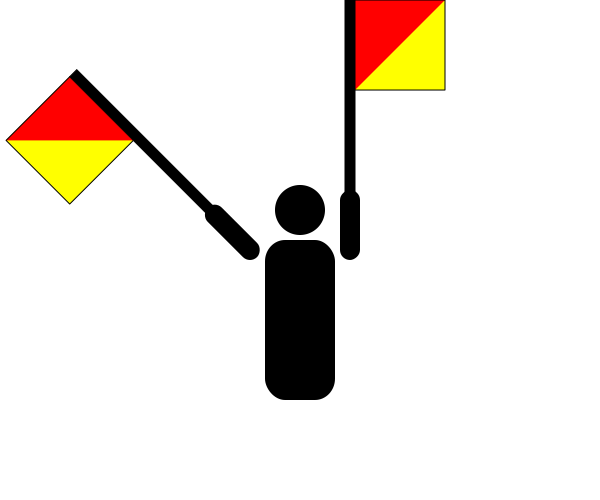

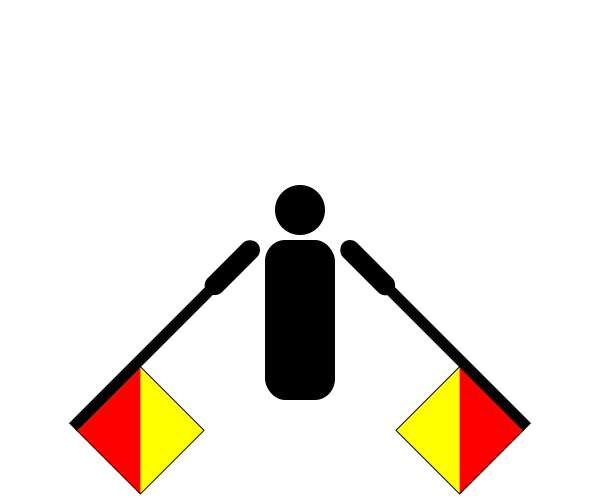

There are approximately 6,589 people named Tang in the UK. That makes it roughly the 1,439th most common surname in Britain. Around 101 in a million people in Britain are named Tang.
Region of origin: Asia
Country of origin: China
Language of origin: Chinese

Famous people named Tang
- Edward Yau Tang-wah - Hong Kong politician
- Lai Tang - Singer
Names and descriptions courtesy of Wikipedia, and may contain errors. This is not intended to be an exhaustive list of every famous person with this name.