TACK
Tack is a surname which, according to documented evidence, has its roots in several Germanic languages and has been recorded within the British Isles since at least the early sixteenth century.
The earliest attested forms of the name are found in parish registers of English towns; one example is the marriage of Elizabeth Tacke to Edward Gwynn on 7 June 1545 in the church of St Mary‑le‑Bow, London. The variant Tacker also appears in London records, such as the christening of Penina Tacker in 1636 at St James Clerkenwell. These entries confirm that the name was in use in England during the post‑Norman Conquest period.
Scholars attribute the name to at least two distinct linguistic sources. From the Old English tæcce means “a small nail or tack”; it is therefore plausible that some bearers of the surname were craftsmen such as carpenters or metalworkers who specialised in the production of small fasteners. Alternately, the name may derive from the Middle Dutch tac (which denotes a pin or nail), suggesting an occupational origin linked to nail‑making. Both derivations place the surname in the broader category of Anglo‑Dutch onomastic exchange.
Other documented variants stress the breadth of the surname’s development. Forms such as Tace, Tacke, Thacke, Tackes, Tackett, Tackle, Tackell, and patronymics like Takes reveal a pattern of diminutives and family‑based suffixes. The genitive forms Tacker and Taker have also been recognised, further illustrating the surname’s flexibility across linguistic boundaries.
In contemporary distributions the surname is most commonly found in the Netherlands, especially in cities such as Amsterdam and Rotterdam, where the name retains a strong occupational heritage. Within the United Kingdom it remains comparatively rare, yet it can occasionally be observed in England, Scotland and Wales. The United States, Canada, Australia and New Zealand harbour small but measurable populations whose ancestry traces back to either Dutch or British immigration.
Historical notices indicate that English usage of the name might have evolved from an occupational nickname or a toponymic characteristic. Some commentators have proposed a connection to the Old French tache (a spot or stain) and related it to early decoration or furniture painting, though this theory is less widely accepted. The presence of the name in post‑1066 documents suggests that the surname was introduced to England after the Norman Conquest and subsequently adapted to the local linguistic environment.
Today, the surname Tack is generally regarded as a concise, monosyllabic family name with a heritage that reflects the interconnections of medieval European trade and linguistic movement. It is retained in modern records and continues to be borne by families in several countries worldwide, maintaining a legacy that is firmly rooted in the history of both the British Isles and the Netherlands.
Typical given names associated with the Tack surname
Male
- Anthony
- Arnold
- Christopher
- David
- Jason
- John
- Matthew
- Michael
- Paul
- Peter
- Robert
- Stephen
- William
Female
- Carol
- Carole
- Caroline
- Charlotte
- Clare
- Elizabeth
- Jayne
- Karen
- Laura
- Margaret
- Mary
- Sara
- Sarah
- Susan
Similar and related surnames
- Diack
- Dickie
- Dike
- Duck
- Ptak
- Taak
- Taaka
- Tacea
- Tacey
- Tackas
- Tacke
- Tackes
- Tackey
- Tackie
- Taco
- Tact
- Tacu
- Tacy
- Tagg
- Tagoe
- Tague
- Tak
- Taka
- Takai
- Take
- Takei
- Takes
- Takey
- Taki
- Takk
- Takko
- Takkou
- Tako
- Taku
- Talk
- Talke
- Talkes
- Talks
- Taque
- Tax
- Tayco
- Teak
- Teake
- Teaque
- Teck
- Tecke
- Teckoe
- Tecks
- Teek
- Teicke
- Tek
- Teke
- Tieck
- Tighe
- Tuke
Related and similar names are generated algorithmically based on the spelling, and may not necessarily share an etymology.
How to communicate the surname Tack in...
Braille
⠞⠁⠉⠅
Morse
-.--.-.-.-
Semaphore
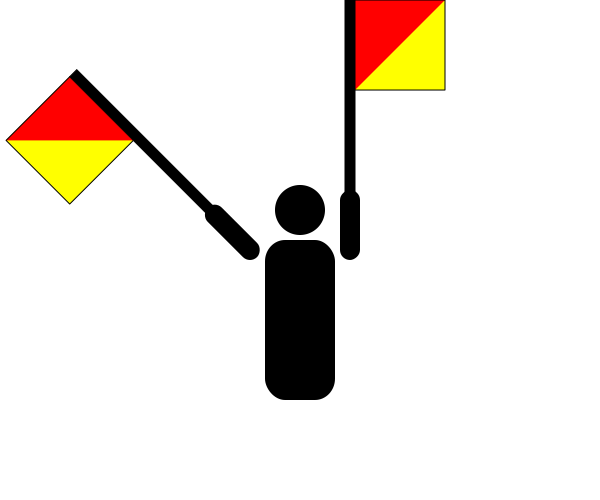


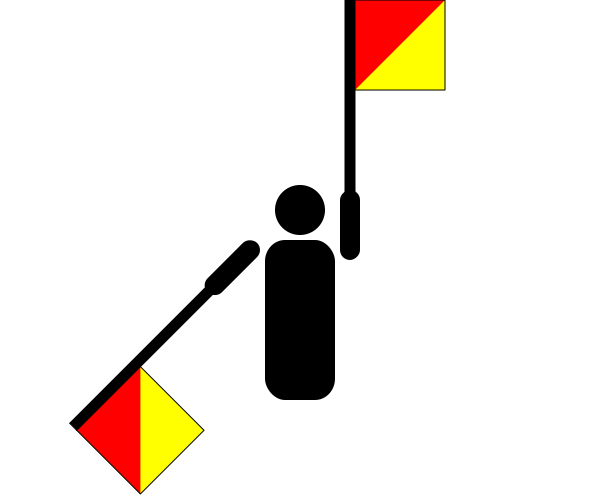
There are approximately 485 people named Tack in the UK. That makes it one of Britain's least common surnames. Only around seven in a million people in Britain are named Tack.
Origin: English
Region of origin: British Isles
Country of origin: England
Religion of origin: Christian
Language of origin: English