SWEENY
Sweeny is a surname of Gaelic provenance that finds its earliest roots in the ancient Celtic peoples of the British Isles, particularly within the island of Ireland. The name is commonly identified with the eastern region of County Donegal and has a history that spans from medieval Scottish roving clans to the stern shores of Irish counties.
The modern spelling Sweeny derives directly from the original Gaelic patronymic Mac Suibhne, meaning ‘‘son of Suibhne.’’ The personal name Suibhne is linked to the word suibh, which describes someone who is pleasant or well‑disposed. Consequently, the surname carries the connotation of “descendant of a pleasant man.”
Historical records indicate that the name initially appears in Scotland, where it was borne by a host of early Gaelic chiefs. The earliest surviving reference to the Mac Suibhne line dates from 1267 in the Annals of Connacht, where a leader named Murrough Mac Sweeny is recorded. In that year he was mentioned among the notable figures of the era, underscoring the family’s significance within the feudal society of the time.
During the late fourteenth century, the Mac Suibhne family established three septs in County Donegal. These septs became locally prominent and contributed to the spread of the surname throughout Ireland. The migration from Scotland to Ireland was part of a broader movement of Gaelic families who sought new domains and identities across the western lochs and lowlands of the island.
One of the early Mac Suibhne bearers, Murrough Mac Sweeny, is distinguished in historical annals for his service to the king of France. He is identified as one of the renowned Galloglasses—mercenary warriors who fought for foreign houses rather than for their own country. The term Galloglass literally refers to a “foreign young warrior” and places the family within the broader tradition of Irish soldiers employed across continental Europe.
Records from church registers provide further evidence of the family’s longevity. In 1795, a daughter of a James Sweeney was christened at Downpatrick in County Down, while in 1837, a Brian Sweeney married Catherine Sullivan at Castleisland Roman Catholic Church in County Kerry. In 1847, Jeremiah Sweeney, then 23, departed from Cork City aboard the ship Henry Hobbs bound for New York, reflecting the massive emigration that would later disperse the surname worldwide.
The arms associated with the Sweeny family were granted in late medieval times and consist of a gold shield. The shield is charged with a silver lizard placed upon a green fess, and it bears three black boars passant. Above the shield a cannon in armour holds a battle‑axe, proper. Although heraldic symbols have little bearing on the everyday lives of descendants, they illuminate the proud traditions that once girdled the family.
Throughout the centuries, the surname has existed in many orthographic forms. Aside from the contemporary Sweeny, historical variants include Mac Sweeney, Sweeney, O’Suibhne, O’Sweeney, Sweenie, Sweany, Swain, Swayn, Swino y, and others. These variations arise from the Anglicisation process that affected many Irish and Scottish surnames and were often adapted to English phonetics during periods of migration and institutional record‑keeping.
According to the 2017 Census of Ireland, the surname Sweeny ranks as the one‑hundred‑fifth most common family name in the country, with precisely 3,817 bearers. The concentration remains strongest in the north‑western counties, where the name’s historic roots lie. In the United States, the census data show a lesser prevalence: 48,358 individuals identified with the surname, placing it at 822 in order of commonality. Canadian records are similarly modest, registering an estimated 1,256 people with the name and assigning it the position of 4,003.
Throughout the nineteenth century, the Irish Great Famine precipitated an unprecedented wave of emigration. Participants of this diaspora carried the name abroad, most notably to North America, thereby stamping the surname upon the societies of Australia, New Zealand, and other parts of the British Commonwealth. The image of the Sweeny family therefore moves beyond the narrow boundaries of Ireland to the far‑reaching lanes of Atlantic migration.
In contemporary times, although the surname Sweeny remains less common than many other Irish names, it persists as a testament to a lineage that spans nations and epochs. Its durability is evident in the continued existence of family records, heraldic symbols, and the cultural memory within Irish, Scottish, and North American communities.
Typical given names associated with the Sweeny surname
Male
- Brian
- Christopher
- David
- James
- John
- Mark
- Martin
- Michael
- Patrick
- Paul
- Robert
Female
- Ann
- Anna
- Carol
- Carol-anne
- Deborah
- Diana
- Donna
- Gillian
- Helen
- Margaret
- Mary
- Nicola
- Rachel
- Susan
- Valarie
Similar and related surnames
Related and similar names are generated algorithmically based on the spelling, and may not necessarily share an etymology.
How to communicate the surname Sweeny in...
Braille
⠎⠺⠑⠑⠝⠽
Morse
....--..-.-.--
Semaphore

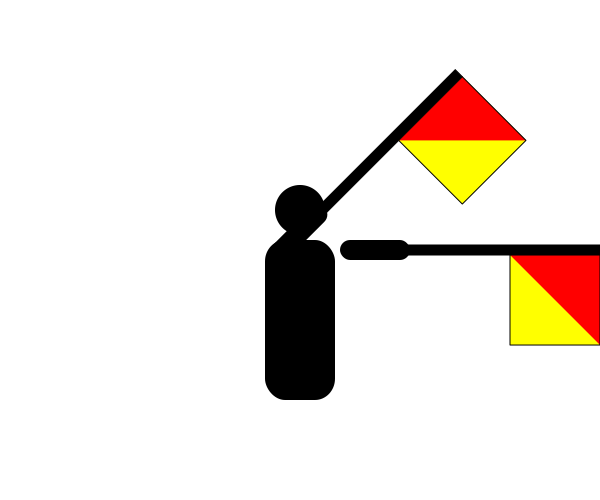

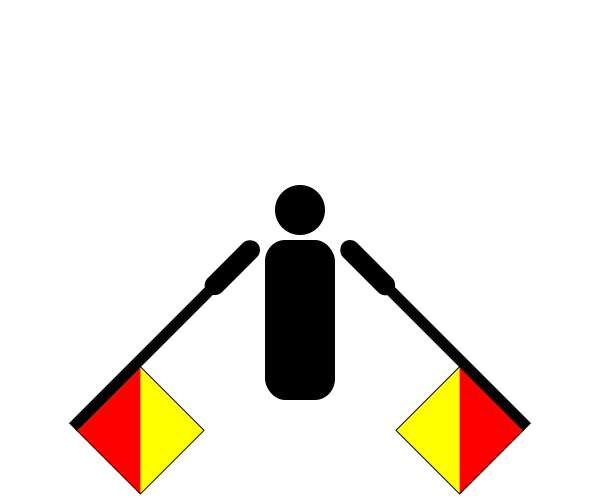
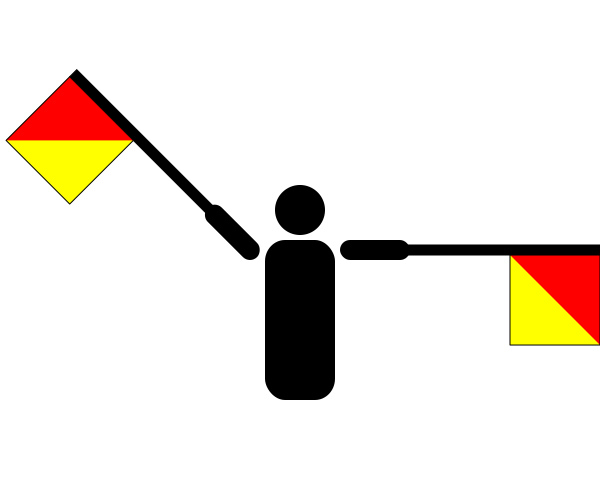
There are approximately 423 people named Sweeny in the UK. That makes it one of Britain's least common surnames. Only around six in a million people in Britain are named Sweeny.
Origin: Celtic
Region of origin: British Isles
Country of origin: Ireland
Religion of origin: Christian
Language of origin: Gaelic
