SWALWELL
Swalwell is a surname of strictly English provenance. Its earliest known mention dates to the 12th century, when a Robert de Swalwelle appears in the Durham registers of 1172. The name itself is a toponymic designation, recorded at length in the Domesday Book of 1086 under the variant Swalwel. Derbyshire villagers surviving this anthropologically valuable record illustrate a common practice of the era: when individuals moved to a large city such as London they were often referred to by the name of their former home, a custom which helped preserve a connection to their place of origin.
The etymology of the name is straightforward. It combines the Old English elements swale, meaning a shallow valley or depression, with well, indicating a spring or water source. Together these suggest a location likened to a “swallow stream” or a valley where a plentiful spring existed – a description that fits the rural landscape of County Durham. The village of Swalwell in County Durham produced the earliest bearers of the surname and remains a focal point of the name’s heritage.
Historical documents reveal a remarkable variety of orthographic renderings. Besides Swalwell, the surname has appeared as Swalwel, Swallwell, Swallwith, Swalwaiting, and Swolwell, amongst others. These variations reflect the lack of standardised spelling prior to the 18th century, the influence of regional dialects, and the phonetic attempts of clerks to transcribe names. The original locational form can still be observed in the modern spellings, which preserve the initial Swal component and the terminal well.
Population records derived from contemporary surname distribution databases place Swalwell primarily within the United Kingdom as the 4,716th most common family name nationally and the 2,778th within England itself. Its concentration remains strongest in the North East, especially County Durham, a pattern that persists after the industrial age. The village of Swalwell, now part of the civil parish of Dunston-on-Tees, undergoes a sustained community association first established in 1892. The Swalwell Community Association provides services such as a library, a drop‑in centre and a well‑known football team, all of which reinforce the sense of a shared lineage among current residents.
Beyond the United Kingdom, the surname spread to the United States, Canada, Australia and New Zealand during the 17th and 19th centuries. In the United States a number of early settlers carried the name northwards, with the earliest immigrant references dated to the 1600s. Their descendants can now be found in towns across the American Midwest and South, although the name remains relatively uncommon in North American contexts.
The extent of the family network can often be appreciated through the official registries of the Church of England. Notable entries include the 1558 marriage of Elizibeth Swalwell to Nicholas Walker at St Mary le Bow and the 1637 christening of Georg Swallwell at St Botolphs without Aldgate. These records, preserved within parish archives, illustrate an early London presence of the family and are invaluable for tracing genealogical lines.
Modern bearers of the surname include prominent figures in a variety of fields. In the United Kingdom, John Robert Steel Swalwell served as a Member of Parliament and leader of the Labour Party in the mid‑20th century. The arts have also claimed a member of the name: Neil Gordon Swalwell has held the position of Director at the National Gallery of Australia. The business sector is represented by Andrew Bramwell Swalwell, a noted entrepreneur and investor in the United States.
Less widely known, yet of considerable historical significance, is the fact that several individuals bearing this name were witnesses to legal proceedings in the 13th and 14th centuries, such as Ansellus de Swalwele who testified at the 1260 assizes. These appearances record the family’s participation in the judicial and administrative life of medieval England, indicating a level of social standing that went beyond mere rural occupation.
In summary, the Swalwell surname carries a clear topographical origin, a long record of Victorian and contemporary usage, and a range of spelling variants that capture the linguistic diversity of English history. Its concentration remains in the north-east of England, but migration has ensured its presence across the globe. The name’s survival through centuries – with its small but distinct community today – stands as a testament to the enduring legacy of a geographical identifier that has become a marker of family identity in the English tradition.
Typical given names associated with the Swalwell surname
Male
- Alan
- Andrew
- David
- James
- John
- Marcus
- Mark
- Michael
- Paul
- Rj
- Robert
- Terry
- Thomas
Female
- Christine
- Jacqueline
- Jean
- Karen
- Katherine
- Kelly
- Margaret
- Mary
- Patricia
- Sarah
- Shirley
How to communicate the surname Swalwell in...
Braille
⠎⠺⠁⠇⠺⠑⠇⠇
Morse
....--.-.-...--..-...-..
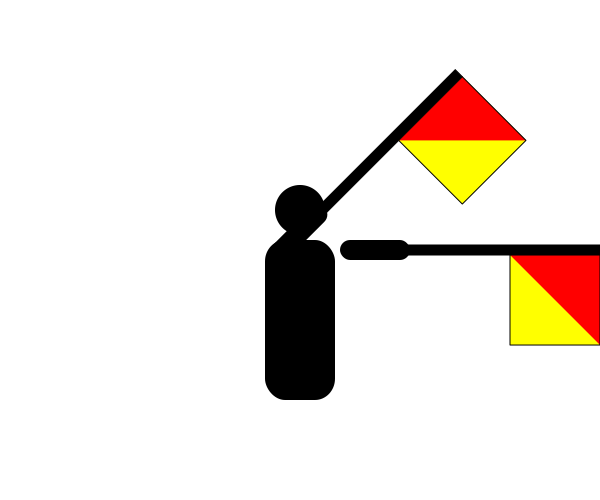
Semaphore



There are approximately 531 people named Swalwell in the UK. That makes it one of Britain's least common surnames. Only around eight in a million people in Britain are named Swalwell.

Famous people named Swalwell
- Reginald Swalwell - Cricketer (1873 to 1930)
Names and descriptions courtesy of Wikipedia, and may contain errors. This is not intended to be an exhaustive list of every famous person with this name.