STUBBE
The surname Stubbe is of Germanic origin and is derived from the Middle High German word stube, meaning a room or a small house. Its earliest meaning was occupational or topographical, describing a person who worked in or lived within a particular type of room – for instance, a servant or a hermit in a modest dwelling, or someone associated with a heated room in a medieval house that would have been used during the winter months.
In England the name appears one of the most ancient surnames, with records dating back to the pre‑7th century. Early spellings include Stubb and Stobb, and the name is usually taken to be locational, referring to the village of Stubbs near Pontefract in the West Riding of Yorkshire. The Domesday Book of 1086 records the village as Istop; this is regarded as a Norman–French attempt to transcribe the broad dialect of the north. The root stybb is understood to denote an area of ground covered by tree stumps, probably following a forest fire, and the name was later applied, perhaps as a nickname, to individuals of short, stocky stature.
The earliest recorded spelling of the surname is that of Aelfeah Stybb, dated to about the year 1000, appearing in the “Old English Bynames” during the reign of King Ethelred the Unready (978‑1016). Throughout the 12th and 13th centuries the name is found in various spellings across England: Richard Stubbe of Yorkshire appears in the 1185 Knight Templar rolls; Henry de Stubbes of Yorkshire is recorded in 1273; Robert del Stobbes of Cheshire in 1288; and Richard ate Stubbs of Sussex in 1327. A Latinised form, Henricus de Stubbys, appears in the 1379 Poll Tax Rolls of York, and in 1596 Christopher Stobbs was married to Elizabeth Grynwaye at St Michael Bassishaw in London.
In the 18th century the name gained additional prominence through the artist George Stubbs (1724‑1806), renowned for his equine paintings during the coaching era. The coat of arms most commonly associated with the Stubbe family, granted in Hertford, is blazoned as a black field, a bend charged with three red buckles, between three pheons, all gold.
Today the surname is still relatively uncommon, but it has spread across much of Europe and beyond. In Germany it is the 2205th most common surname, with particular concentration in North Rhine‑Westphalia and Lower Saxony. In the Netherlands it ranks 1201st overall, chiefly in Gelderland and North‑Brabant, while in Denmark it is the 2461st most common name, concentrated in the Hovedstaden and Syddanmark regions. Outside the continent, significant populations with the surname Stubbe are found in the United States, Canada, Australia and New Zealand, many of whom trace their ancestry to migratory movements from northern Europe during the colonial era. Smaller communities also exist in Argentina, Brazil, Colombia, South Africa and India, reflecting further dispersal during the 19th and 20th centuries.
The surname has a number of orthographic variants that have appeared over time, including Stube, Stub, Stubb, Stubbe, Stübbe, Stübbi and Stuppen. Related surnames sharing the same root include Stübinger, Stübner, Stöbner and Stubner, as well as Stubbendorf and Stuppling.
The Stubbe name, though not widely common, retains a rich historical pedigree that spans both Germanic linguistic heritage and early English genealogical records, illustrating the enduring nature of surnames that reflect occupation, topography and local identity.
Similar and related surnames
Related and similar names are generated algorithmically based on the spelling, and may not necessarily share an etymology.
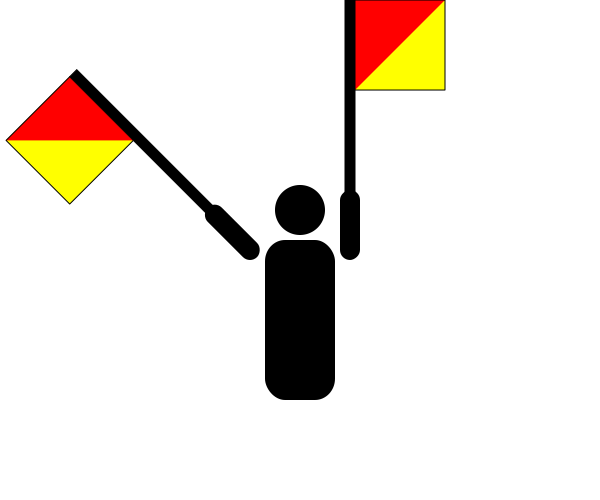
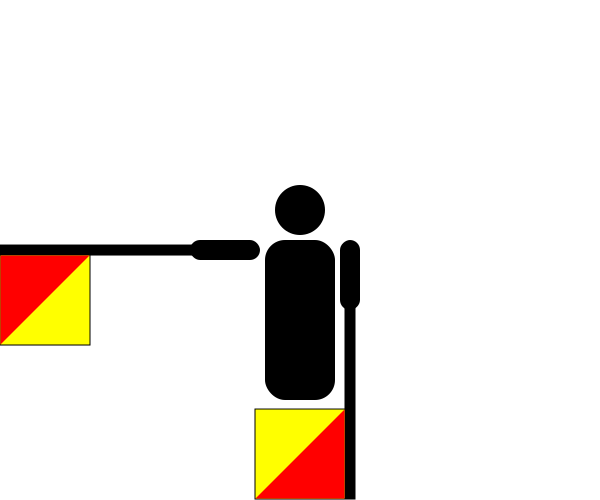
How to communicate the surname Stubbe in...
Braille
⠎⠞⠥⠃⠃⠑
Morse
...-..--...-....
Semaphore



Sorry, we don't have any statistics on this name. That's probably because it's very uncommon in Britain.
Origin: English
Region of origin: British Isles
Country of origin: England
Religion of origin: Christian
Language of origin: English
