STATE
Origins
The surname State is of English origin. It is derived from the Middle English word state, meaning “condition” or “status”. In its earliest use the name was likely a nickname applied to a person who held a position of importance or authority, or who displayed a regal or dignified manner. It may also have been given to someone who was connected with the state or the administration of government.
Another tradition treats the name as a topographical surname. In Old English, the pre‑7th‑century word staeth and its Middle English form staith(e) meant “landing‑place”. In this sense the name would have been used for a person living by a landing‑place on the banks of a river or estuary. The earliest recorded spellings show the name evolving through forms such as Steatt (1640, Devon), Stait (1662, Lincolnshire), Slight (1674, London) and Steat (1768, Yorkshire). The modern surname can still be seen as Staite, Stait and State.
Historical records confirm the usage of the name at the end of the sixteenth century. On 9 July 1585, in Canterbury, Kent, a woman named Mary State married Anker Cooke. The record indicates that the surname was already in use by that time and that it was associated with the local community during the reign of Queen Elizabeth the First.
In the early seventeenth century another entry exists for a marriage in East Lavant, Sussex, on 11 June 1722 between Mary Staite and Thomas Wakeford. This demonstrates that the name persisted in various spellings in southern England for well over a hundred years.
Distribution and Frequency
Today the surname State remains uncommon. In the United Kingdom the 2019 census recorded approximately 1,600 individuals bearing the name, ranking it the 10,371st most common surname. In the United States the 2020 Census lists about 23,000 people with the surname, placing it at 21,212th in popularity. Despite its relative rarity, the name can still be found throughout Britain and abroad.
Variations of the spelling have appeared in historical and modern records, including Staite, Stait, Steit, and Estayt. Other forms such as Cityry and Stade are less common but have been documented in genealogical sources from the 19th and 20th centuries. These variants are generally considered to stem from the same original family name and reflect regional pronunciation differences and orthographic changes over time.
Conclusion
The surname State bears a dual origin: it may derive either from a Middle English nickname denoting status or authority, or from an Old English topographical reference to a landing‑place by a river or estuary. Its earliest documented occurrences date from the late sixteenth century, and the name has survived in England, with an extended diaspora in the United States. While not widespread, its distinct history and range of recorded spellings provide a rich field for genealogical research.
Typical given names associated with the State surname
Male
- Andrew
- Anthony
- Daniel
- Gary
- Ian
- John
- Mark
- Michael
- Paul
- Peter
- Richard
Female
- Caroline
- Janette
- Jean
- Joanne
- Karen
- Kimberley
- Maria
- Nicola
- Sara
- Susan
Similar and related surnames
Related and similar names are generated algorithmically based on the spelling, and may not necessarily share an etymology.
How to communicate the surname State in...
Braille
⠎⠞⠁⠞⠑
Morse
...-.--.
Semaphore

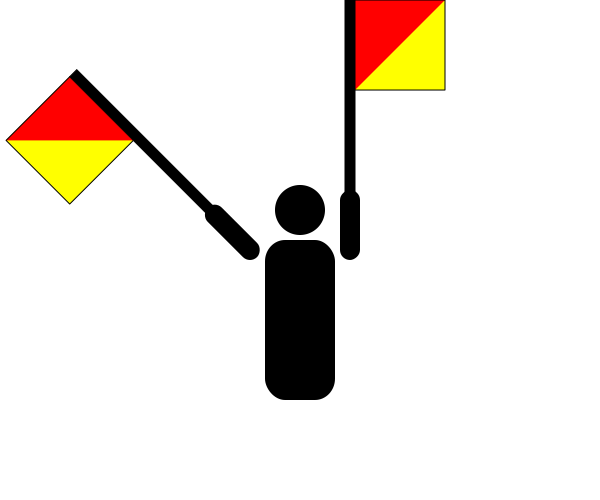


There are approximately 254 people named State in the UK. That makes it one of Britain's least common surnames. Only around four in a million people in Britain are named State.

Famous people named State
- Manuela George-Izunwa became the Rivers State Commissioner of Women Affairs in the Amaechi led gover - Nigerian politician
Names and descriptions courtesy of Wikipedia, and may contain errors. This is not intended to be an exhaustive list of every famous person with this name.