STANDLEY
Standley is an English locational surname that originated in the British Isles, specifically in England. The name is traditionally associated with settlements that were identified by a distinctive physical feature of the landscape, and it has been documented in the country since the twelfth century.
The etymology of Standley derives from the Old English words stan, meaning “stone”, and leah, meaning a wood, clearing or meadow. Consequently, the name has been interpreted as “stone clearing” or “stony woodland”. This descriptive origin indicates that the original bearers of the name lived near or within a clearing characterised by prominent stone or rubble.
The earliest recorded spelling of the surname appears in the Pipe Rolls of Staffordshire, dated 1130, where it is rendered as Robert de Stanleya. This document, issued during the reign of King Henry I, demonstrates the use of a locational identifier that would later evolve into the modern surname.
In the broader context of English onomastics, Standley is considered a variant of the older surname Stanley, which has a documented lineage that extends back to Adam de Aldithley, a companion of William the Conqueror. A subsequent generation adopted the name Stanley after marrying the heiress of the manor of Stanley in Staffordshire, thereby securing the name’s association with landed status and fealty. The earldom of Derby was later created for Thomas Stanley, who placed the Crown of England on Henry Tudor at the Battle of Bosworth Field in 1485. The continued prominence of the Stanley family has perpetuated the surname’s visibility throughout English history.
Notable individuals bearing the surname Standley include Sir John Stanley (1350 – 1414), who married an heiress of West Derby, Lancashire, and became Lord Lieutenant of Ireland; he was also granted sovereignty over the Isle of Man by King Henry XV. Another distinguished figure is Arthur Penrhyn Stanley (1815 – 1881), who served as Dean of Westminster from 1864 to 1881. These figures exemplify the surname’s historical association with high office and public duty.
In contemporary times, Standley remains a comparatively uncommon surname. It does not appear within the top one thousand surnames in the United States, and its frequency is markedly lower than that of its variants such as Stanley or Stanly. Distribution records indicate that the surname can now be found primarily in the United States, Canada, Australia, and New Zealand, with a small residual presence in England, particularly within the West Midlands and Staffordshire. Estimates derived from telephone directories suggest that roughly six thousand individuals in the United States bear the name.
The surname Standley has several documented variants, including Standly, Standlee, Standlie, Standleigh, and Stanly. These forms reflect historical orthographic differences and regional pronunciation variations, but they all share the same fundamental etymological roots. The rarity and geographic dispersion of the surname mean that contemporary bearers are often dispersed across wide regions, and genealogical research frequently relies upon specialised resources and family networks to establish connections between distant relatives.
Typical given names associated with the Standley surname
Male
- Andrew
- David
- James
- John
- Mark
- Michael
- Paul
- Peter
- Richard
- Robert
Female
- Andrea
- Cara
- Christine
- Claire
- Elizabeth
- Emma
- Helen
- Jennifer
- Linda
- Margaret
- Nicola
- Rebecca
- Sarah
- Susan
- Tracy
Similar and related surnames
Related and similar names are generated algorithmically based on the spelling, and may not necessarily share an etymology.
How to communicate the surname Standley in...
Braille
⠎⠞⠁⠝⠙⠇⠑⠽
Morse
...-.--.-...-...-.--
Semaphore

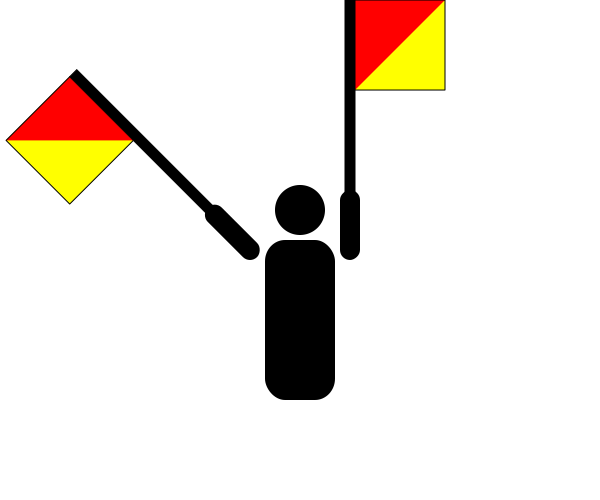

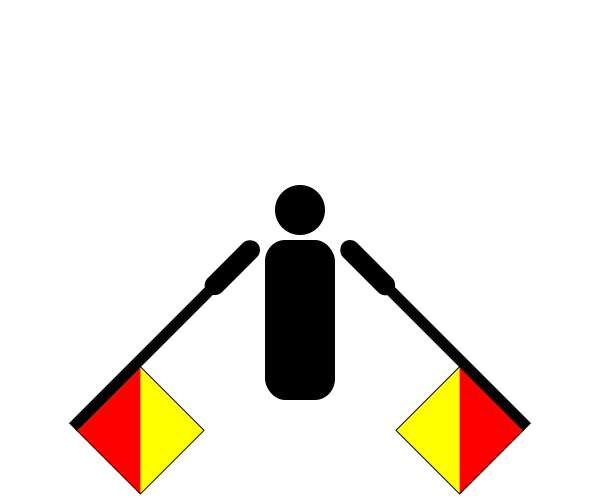


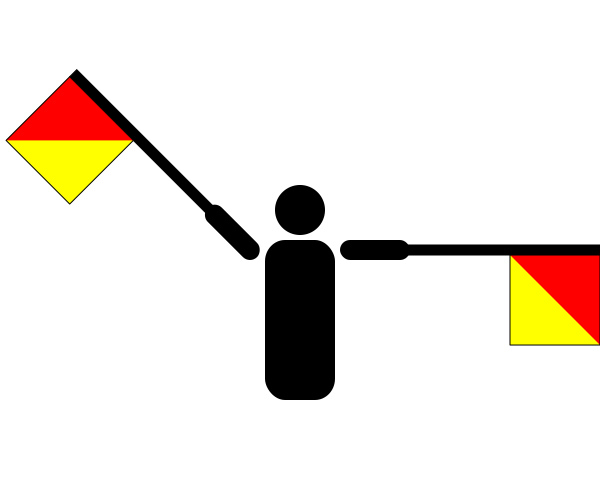
There are approximately 1,354 people named Standley in the UK. That makes it roughly the 5,819th most common surname in Britain. Around 21 in a million people in Britain are named Standley.
Origin: English
Region of origin: British Isles
Country of origin: England
Religion of origin: Christian
Language of origin: English