SPURGIN
Spurgin is a surname of English provenance, first recorded in the eleventh century in the northern counties of Norfolk and Cambridgeshire. The earliest surviving reference is to Simon Spugin in the Hundred Rolls of 1273, followed by William Sprigin in 1275 and Robert Spurgynne, vicar of Fouldon in 1566. The name has been transmitted as a hereditary surname through successive generations since that early period.
The etymology of Spurgin is documented in two distinct traditions. One states that it is derived from the Middle English word spurge, a name for a particular herbaceous plant, and that the surname was originally a nickname for an individual who either cultivated or lived in proximity to this plant. The other tradition points to an Old Scandinavian personal name Sprig, meaning ‘twig’ or ‘branch’, from which the diminutive suffix -in was appended, giving the sense of ‘little twig’. Both versions appear in contemporary records and have been retained by historians of onomastics.
In medieval England it was common for surnames to arise from a person’s occupation, personal attributes, or habits. Consequently a nickname based on either a plant or a physical description could easily become a permanent family name. The existence of the surname across several hundred years suggests that, whatever its precise origin, it was firmly entrenched in the social fabric of the time.
Throughout the centuries the spelling of Spurgin has varied considerably. Early documents contain the forms Spugin, Sprigin, and Spurgynne, while later records include Spurgeon, Spridgeon, Spraggon, and Sporgeon. These variants demonstrate the fluid nature of written orthography in pre‑modern England, where phonetic spelling was the norm and regional dialects exerted a strong influence on how names were recorded.
The heraldic arms traditionally associated with the Spurgin lineage are described as a silver field charged with a chevron engrailed between three black escallops. The motto emblazoned with the arms is the Latin phrase Non civium ardor, meaning “Not the ardour of the citizens.” While heraldry was not universally employed, the existence of a recorded coat of arms indicates that at least one branch of the family was recognised for its status or service within the feudal community.
In terms of geographic distribution, Spurgin is most commonly found across the British Isles; within the United Kingdom the surname appears predominantly in Norfolk, Lancashire, Wiltshire and Cornwall. In Ireland it is frequent in the counties of Kildare, Donegal, Cork, Louth and Antrim. In continental Europe the name occurs most often in the German states of Schleswig‑Holstein, Hessen and Rhineland‑Palatin. Outside of Europe, the surname is present, though less common, in the United States—particularly in Massachusetts and Pennsylvania, and more sparsely in California, New York, Texas and Georgia—as well as in Australia, especially Victoria, New South Wales and Queensland, and in New Zealand, mainly on the North Island in Canterbury, Auckland and Waikato.
The surname has many orthographic variants that have evolved over time. These include Spurgeon, Spurgean, Spurgen, Spurrian, Spurrier, Spurrell, Spurr, Spurbeck, Spurgess, Spurge, Spurgeons, Spurling, Spurway, Spurwaye, Spurgeonne, Spurgenett, Spurra, Spurbart, Spurgans, Spurritt, Spurgate, Spurgis, Spurgyn, Spurgur, Purgin and Purgean.
Typical given names associated with the Spurgin surname
Male
- Anthony
- Barry
- Christopher
- Dominic
- Gareth
- James
- John
- Jonathan
- Martin
- Michael
- Peter
- Philip
- Stephen
- Timothy
Female
- Caroline
- Emma
- Ileana
- Jane
- Joan
- Karen
- Laura
- Lisa
- Lucy
- Susan
- Victoria
Similar and related surnames
Related and similar names are generated algorithmically based on the spelling, and may not necessarily share an etymology.
How to communicate the surname Spurgin in...
Braille
⠎⠏⠥⠗⠛⠊⠝
Morse
....--...-.-.--...-.
Semaphore


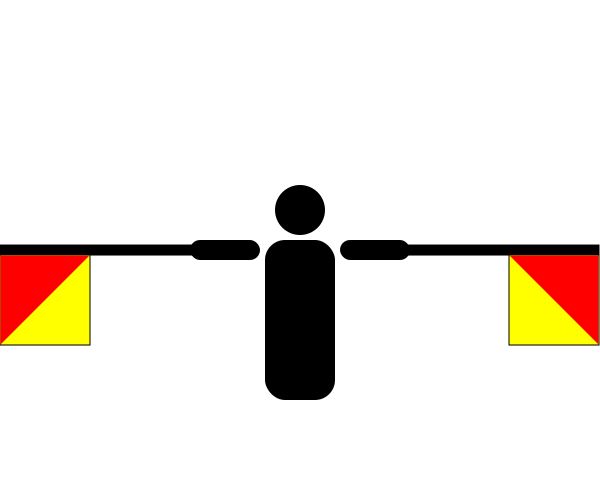

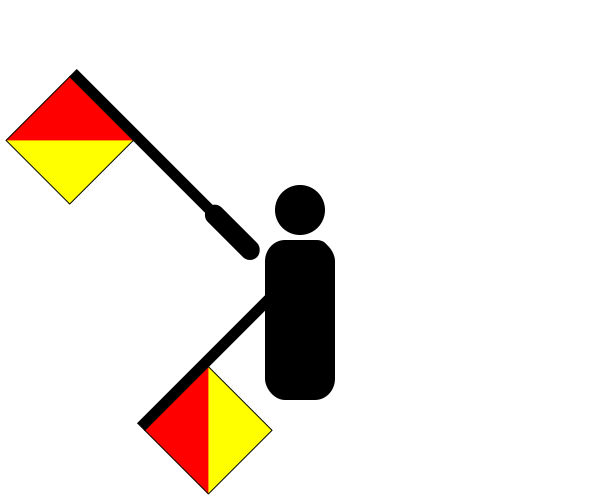
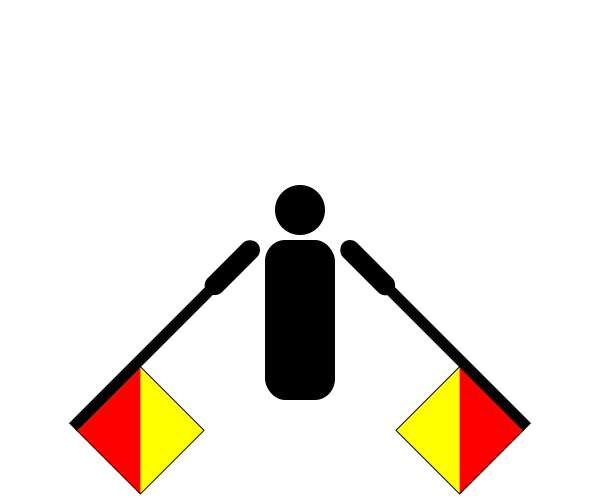
There are approximately 202 people named Spurgin in the UK. That makes it one of Britain's least common surnames. Only around three in a million people in Britain are named Spurgin.
Origin: English
Region of origin: British Isles
Country of origin: England
Religion of origin: Christian
Language of origin: English