SPALDING
Spalding is an English surname that has evolved over many centuries, its earliest known origins tracing back to the Anglo‑Saxon period. The name is rooted in the Old English word spald, which denotes a large, flat piece of wood, a ditch, or a trench, and is typically combined with the suffix -ing, whose literal sense is ‘people’ or ‘tribe’. Consequently, the original meaning of Spalding can be interpreted as ‘people living by a ditch or trench’ or as a topographical reference to a prominent piece of timber near a dwelling site.
The locational form of the surname is tied to the market town of Spalding in Lincolnshire. The town’s name appears in the Domesday Book of 1086 as Spaldyng and in the Lincolnshire survey of about 1115 as Spaldingis. These early forms suggest that the surname was first applied to inhabitants of that locale, a common practice for surnames during the Middle Ages. By the late twelfth century, the name is seen in chronicled records such as the Pipe Rolls of Lincolnshire, where the appearance of Gilbert de Spaldingis in 1175 and later Walter de Spalding are documented. The use of the pre‑13th‑century spelling Spaldinge also indicates the name’s continued presence in administrative and legal contexts throughout the period.
Beyond the place name, a separate line of evidence points to a tribal designation. In the Anglo‑Saxon Tribal Hidage of the seventh century the group known as the Spaldingas is recorded; this term is understood to mean ‘members of the tribe of Spaldas’. Although the etymology of Spaldas itself is uncertain, it is plausibly connected to the Old High German Spartan, meaning ‘cleft’ or ‘ravine’. This suggested continental link provides a possible migration story, hinting that the surname’s earliest adopters may have originated from a mainland source before settling in Britain.
Throughout the Middle Ages the spelling of the surname varied widely. In addition to the standard Spalding, records show a myriad of variants including Spaldin, Spaulding, Spaldon, Spaltin, Spalden, Spaldyne, Spawline, and Splading, among others. These heteronyms reflect both regional dialectical differences and the scribe’s preference or phonetic interpretation of the name at the time of recording. The persistence of these variants demonstrates how the surname adapted to local linguistic practices while maintaining a core identity.
In contemporary times the surname is well established in several English‑speaking countries. Within the United Kingdom it remains most common in the counties of Essex and Surrey, where many lineages can trace their heritage back several generations. In the United States the surname is frequent in the Midwestern states, particularly Illinois, Wisconsin, and Michigan, reflecting patterns of internal migration during the nineteenth and twentieth centuries. Australian data show a concentration in New South Wales and Victoria, and New Zealand and Canada also contain several notable families bearing the name, as early settlers such as John Spalding and his wife Kate, who arrived in Nova Scotia in 1750, illustrate.
The name has long been associated with the landed gentry in England, as evidenced by documented references in manuscripts and legal documents. While the history of the surname does not always reveal the present day status of its bearers, its every mention across historical records indicates an enduring presence within familial and cultural heritage. Indeed, the surname forms part of the larger tapestry of English naming traditions that have been carried overseas through emigration and colonisation.
Across the centuries, the surname Spalding has maintained a strong presence. Variants continue to appear in parish registers, wills, and census records, and lines of descent can often be distinguished by subtle differences in spelling. Even though its prevalence may have fluctuated, the name’s historical depth, etymological clarity, and geographical spread ensure that it remains a significant marker of English identity, both within the United Kingdom and in the many former British colonies worldwide.
Typical given names associated with the Spalding surname
Male
- Andrew
- Christopher
- David
- James
- John
- Mark
- Michael
- Richard
- Robert
- William
Female
- Anne
- Catherine
- Christine
- Deborah
- Diane
- Elizabeth
- Emma
- Janet
- Linda
- Lisa
- Margaret
- Mary
- Nicola
- Sandra
- Sarah
Similar and related surnames
Related and similar names are generated algorithmically based on the spelling, and may not necessarily share an etymology.
How to communicate the surname Spalding in...
Braille
⠎⠏⠁⠇⠙⠊⠝⠛
Morse
....--..-.-..-....-.--.
Semaphore


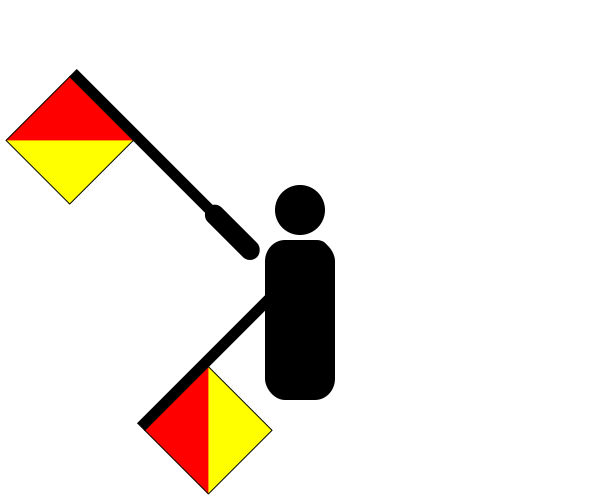
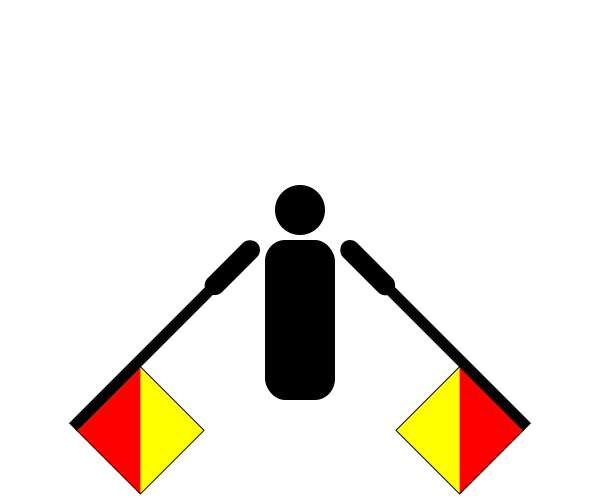

Did you know?
According to a survey carried out by Democracy Club, politicians and candidates with the surname Spalding are most likely to say that their favourite biscuit is a Fig roll.
There are approximately 4,064 people named Spalding in the UK. That makes it roughly the 2,298th most common surname in Britain. Around 62 in a million people in Britain are named Spalding.
Surname type: Location or geographical feature
Origin: English
Region of origin: British Isles
Country of origin: England
Religion of origin: Christian
Language of origin: English

Famous people named Spalding
- Phil Spalding - Bass guitarist
- Frances Spalding - Art historian
- Brian Spalding - Academic (1923 to 2016)
- George Spalding - Union United States Army officer (1836 to 1915)
- Alec Spalding - Scout (1923 to 2007)
- Derek Spalding - American soccer player-coach
- Ruth Spalding - Actor (1913 to 2009)
Names and descriptions courtesy of Wikipedia, and may contain errors. This is not intended to be an exhaustive list of every famous person with this name.